Part 1
Project Proposal
Project 1: First Steps
Exercise 1.1.Exploring Ideas
Listing areas of interest
An individual composer, work, or style of composition that interests you
and influences your own practical work.
- Jazz music arrangements/interpretations in different styles, including blues, soul, jazz-rock fusion and smooth jazz
- Classical music, focus on specifically chosen pieces over several epochs such as baroque, classic, romantic impressionism
A specific compositional technique or device that you have used in your
own work and you wish to learn more about for future use.
- Reviving musical skeletons (Project 2 under: https://dianaslearninglog.wordpress.com/learning-log-16/), which might give good inspiration for the rearrangements.
- Short scoring (Exercise 5 under: https://dianaslearninglog.wordpress.com/learning-log-14/).
- Effective usage of percussion instruments and word settings. I will need to cover those two subject areas more detailed, as they might be important for the practical part of the course, and in comparison to other potential jazz-band instruments, I don’t feel as confident writing voices and drums.
The practical application of a particular technique to a specific instrument
or group of instruments (e.g. the use of extended techniques for viola or
keyboard ornamentation in the Baroque era).
- Knowing a certain amount of playing techniques for the main instruments in a Jazz band arrangement, especially focusing on guitar and e-bass.
- Potential work with different effect pedals for instruments needing an amplifier.
Transcriptions for a particular instrument or by a particular composer (e.g.
Lizst’s piano transcriptions of Beethoven’s symphonies).
- Taking a closer look at Jazz arrangments by Mary Lou Williams, Russel Garcia and similar arrangers.
- Take a focused look on jazz/smooth jazz arrangements for the piano, as I’m also planning on rearrange some pieces just for this instrument.
Exercise 1.2: Choosing a topic
Reflect on your current practice – what are you interested in finding out about? Do any themes emerge in your work?
I generally would like to know more about jazz arrangements and the strategics behind rewriting a piece for a jazz band. Nonetheless my recent works involved music for synthesizers, this gave me the opportunity to work with and explore different kinds of sound colours.
Look at your strongest works from levels 1 and 2 – can you find any common themes?What could you develop further from this work?
I think I felt especially confident about the works including a piano, or small ensembles. Which would suit my aim for a small jazz-band setting for the Major Project. I might find it quite helpful to have another closer look into piano reductions and extended playing techniques for other jazz-band instruments
Consider your personal creative voice. This may already have a clear
identity, or may still be forming. What makes your work different from
other people’s? Do you see any stylistic elements emerging?
As I am currently working on several different projects, I find it rather difficult to distinguish my work from others. Nonetheless, by this point, I would definitely say that I already developed my own type of style for compositions, I just find it difficult to look at it objectively.
If you already have an idea of what the practical side of your project may
entail, consider what additional knowledge you will need in order to
complete it.
Two points that definitely stand out are the efficient use of percussion and singing voices/text placement. I would also like to do some research about other Jazz-arrangers as well as extended playing techniques for the instruments I want to use. Furthermore, as I will be using amplified instruments as well, I also want to know more about the creation of different sound with effect pedals for example.
What areas of music excite you? What challenges you? What are you
passionate about?
I would say, that even though I like composing and arranging, the part I enjoy most about music is performing/playing my instruments. Thus, it is important for me to write music thats not only interesting for listeners, but also encouraging, challenging and entertaining for the performers. Furthermore I am really interested in music theory.
Are there any recent developments in your areas of interest that you’d like
to know more about?
As mentioned above, on one side I would be really interested in learning more about the use of drum sets and singing, but I also want to develop my knowledge of jazz chord structures further in order to use them more efficiently in my compositions.
| Strengths: – I enjoy working on projects – I am well organised | Weaknesses: – I can get distracted easily – I sometimes overlook important details – I tend to do too much at the same time, which delays the completion of projects |
| Opportunities: – I know many musicians who are experts with their instruments that I can ask for help on possible extended techniques – I have a good knowledge and understanding as well as practical experience in Jazz harmonies – I have access to several instruments that I want to use for my compositions | Threads English is not my first language, therefore I am slightly insecure about a possible language barrier. |
Project 2: Your research question
Exercise 1.3. Formulating a research question
Mindmap of my chosen topic:
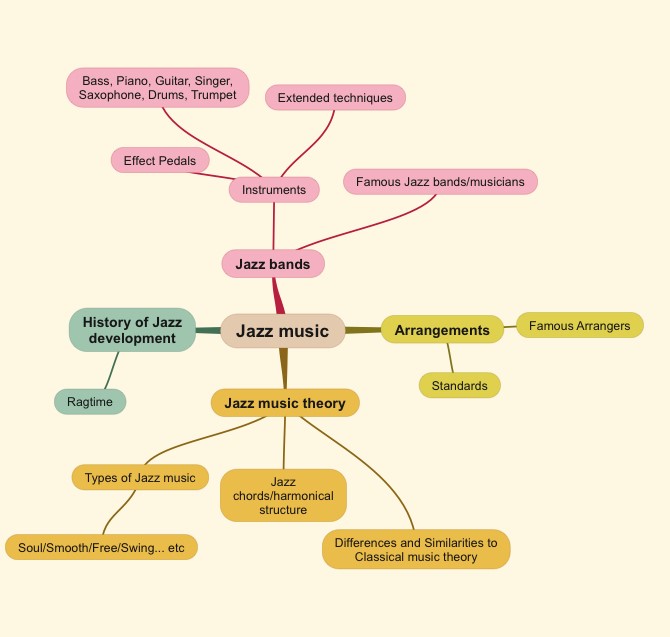
All in all I thought this was incredibly helpful. Even though I ended up with some really interesting ideas, the subject I would be most interested in is the comparison between the music theory of jazz and classical music.
The therefore resulting questions, and similar topics would be:
- What are the differences and similarities between Classical music theory and Jazz music theory?
- How did Classical music influence the music theory of Jazz music?
As “Jazz” and “Classical” music are both really broad subjects, this idea could be developed in more detail, focusing on the Classical era of music history (1750 – 1820) and a certain type of Jazz such as Blues and/or swing. Nonetheless, most harmonies and chord structures seem to appear in most of the under-categories of Jazz music.
- What are the differences and similarities between the music theory of the music from the Classical era and Jazz music ?
Exercise 1.4: Evaluating your research question
Here, I just tried to expand the mindmap further and collect some more ideas.
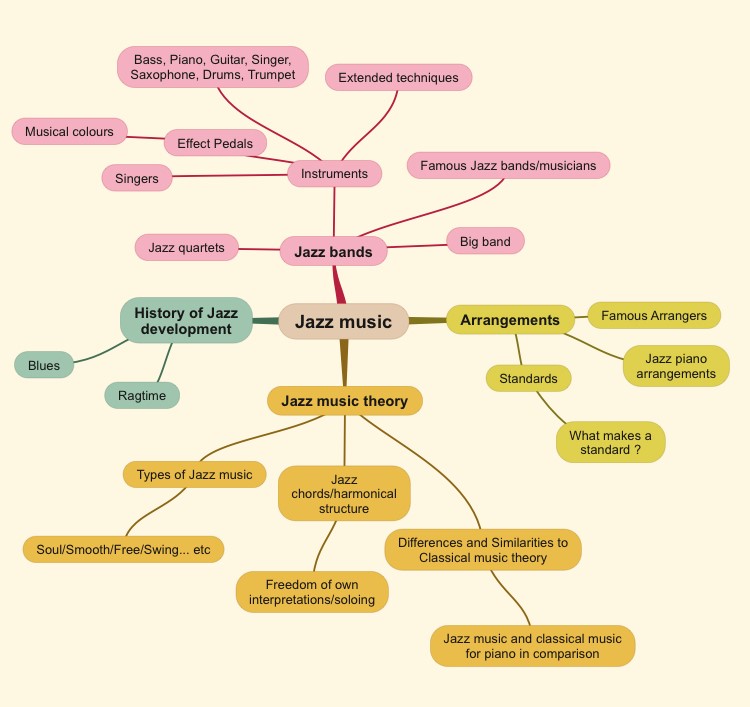
In conclusion, I noticed, that I often come back to the piano as a side subject, thus, I will try to reduce my subject to this instrument, but also want to focus on the music theory in comparison between jazz music and music from the classical era.
Project 3: Investigating resources
Exercise 1.6. Starting to organise
In terms of organisation, I would first of all think of a small notebook to carry around with me during the time of the course, in case something that could contribute to my work comes up unexpectedly. Furthermore, I will keep a folder with sections of notes, separated in recordings I listened to, documents, scores to analyse etc….
Exercise 1.7.The final output
The final output will probably be an essay form of some sorts, either an analysis, or a “traditional”essay. If I happen to come across several smaller subjects, that appeal equally interesting to me, I would also consider writing a portfolio of shorter different topics.
Nonetheless, as the idea was just presented in my study folder, I might also do a comparison between two pieces, with the same origin for piano (one jazz version and one classical music version).
Assignment 1
Project Proposal
As I’m at the very beginning of this project, the idea for my research question might still be able to change slightly. Nonetheless, due to the course guidance, I was able to gather several ideas, most of which lead to the question below.
What are the differences and similarities of music theory regarding piano music of the Classical era and Jazz piano music?
Using this question as a point of orientation, I would like the project to mainly focus on the comparison between music theory of Classical music (1730-1820) and Jazz music. As this can be a broad subject, and it also lies in a personal interest, I would like to narrow this topic further down and focus on piano music. I’m especially interested in researching about the differences in chord structures, chord progressions and which features create a more “Classical” or ”Jazzy” sounding character. It would also be interesting to demonstrate and compare differences in voice leading and the general structure of a piece or song, and demonstrate how Classical music theory may have influenced Jazz music.
A further point of interest would be the differences in notation, especially the range between Classical music and Jazz music that allows personal variations, soloing and interpretations and how they might have an effect on the performance or even the performers.
Overall I’m planning on using a range of different resources, using books on music theory, performances (to compare) as well as several websites. In addition, I will also look out for books with the corresponding topic in the library of my local area. Over the project there will be several more to come, but some of my main ones will be the following:
- Chord-specific scalar material in classical music: An adaption of jazz chord-scale theory by Andrew John Pokorny
- Classical Form: A Theory of Formal Functions for the Instrumental Music of Haydn, Mozart, and Beethoven by William E. Caplin
- Jazz Piano Method: A Player’s Guide to Authentic Styling, by Julie Wright
- “Performance Practices in Classical Piano Music” By Sandra P. Roseblum, by Brown, A. Peter
- The AB Guide to Music Theory, Part I, by Eric Taylor
- The AB Guide to Music Theory, Part II, by Eric Taylor
- The Jazz Harmony Book, by David Berkman
- The Jazz Theory Book, by Mark Levine
I think a good way to start this project is to focus on chord structures and chord progressions. As I move further into the project, I could also demonstrate these differences using examples of a Classical piece and a Jazz piece. This would also give me the option to focus on the differences in range of performance variations.
I think the main challenge for the project will be to stay focussed on the research question, and doing thorough research, without moving too far away from the topic. Furthermore, I am aware that most aspects of music theory can be implemented in a wider sense, and don’t only revolve around the piano. Nonetheless, I will try to refer back to the piano and maybe demonstrate how the differences can be implemented on the instrument.
Over the past few years I developed more on more interest for Jazz music, and even though I always liked listening to it, I barely played anything Jazz related myself. Nonetheless, as a Classical trained pianist I felt like I’ve reached a point about three to four years ago, where I found it difficult to make any further progress with my instrument. Thus, I slowly started to play Jazz music. The most interesting part for me during that process was to be able to move away from the boundaries of musical notation.
On one hand, this caused most things more challenging in the beginning, on the other hand, I had the impression that I was able to communicate better with the instrument and play it in a more intuitive way. Nonetheless, I would still say, that most of the playing techniques and accuracy as well as the foundation of my understanding for music theory originated from the Classical background. Therefore, I would be highly interested in being able to combine those two ideas within the project.
The practical work of the Major Project will consist of several pieces from Classical music which I am planning to rewrite for a Jazz band arrangement involving a Bass, drums, piano, guitar and possibly a singer. In comparison to the research project, I will not only use the music from the Classical era (1730-1820) but also from some pieces from other epochs. Furthermore, as already mentioned, the pieces will not only be written for the piano. This decision was also made, as I started playing some of the instruments mentioned above and would therefore also be interested in writing for them. Nonetheless, the broad idea of the practical project correlates well with my research work for Contextual Studies, as the same subjects (Classical music and Jazz music) are combined within the same project.
I’ve been studying with the OCA for a while now and got used to working productively and independently. Although, I know that I’ve got days where I’m able to work more efficiently than others, which also correlates a lot with my personal life and job. Therefore, the suggested dates below may still have to be altered, but overall I’m planning on taking between 1 to 2 months for one course part. Taking some more time for Assignments 3 and 4 it would come to the following schedule:
- 1st Assignment: 30th August 2023
- 2nd Assignment: 30th September 2023
- 3rd Assignment: 30th November 2023
- 4th Assignment: 30th January 2024
- 5th Assignment: 30th February 2024
The format of the project will probably be a blog, as I would be able to include musical examples within this format, which I think is essential for the chosen topic. Similarly, to an essay, it would also be able to include some pictures of notation for demonstrating the differences between chord structures.
Part 2
General thoughts on the paper
The following paragraphs will reflect my thoughts on the research topic. As suggested in my last feedback, I will try to narrow the topic down further, and will come back to this page when some ideas emerge or something changes.
Before starting this project, it has to be mentioned, that I want to narrow my chosen topic down further to comparing the music theory and chord structures of sonata forms used by Mozart or Beethoven within the first movement of their piano sonatas with the music theory provided in Jazz music, during a specific time period. I am planning on comparing two pieces of music, one from each epoch to have a practical example of my research. (02.11.2023).
A wider question that came up with the statement above is, what defines a “jazzy” sound in music theory and practice (specifically on the piano). Ideally, I want to demonstrate the differences between Jazz piano music and Classical music, using two different pieces, one by Beethoven and another one by a Jazz pianist and composer. It would be great to look out for similarities within those two pieces, so it can be clearer to define the differences. For the Jazz part, I will probably focus on a Swing or Bebop style. (16.11.2023)
The pieces I will be focussing on are Beethovens 5th Sonata (1st movement) and the Jazz standard “Misty”by Erroll Garner. (06.02.2024)
Putting together all of the above, I could base the end result on a paper with a title (or something similar) as follows: The Harmonic Progressions and melodic lines in Classical music and Jazz: A piano perspective.
Project 1: Research Methods
Exercise 2.1. Understanding methodologies (1)
I think the research methods from the list that are most relevant form my project are the following:
- Analytical research
- Description
Analytical research mainly focusses on the question “why” something came to be. Critical thinking as well as an objective and organised overview over important facts seem to be of importance as well. It is often used to affirm or deny assumptions. Furthermore, it is important to look at and analyse different views of the same topic and use those to come to an objectively logical conclusion.
Another term I came across quite often researching this topic is “definition research”, which seems to be confused often with analytical research. In comparison to analytical research, definition papers don’t present a deep analysis, but are mainly used to show sorted and categorised data.
Furthermore, it is possible to use several recommendations for a conclusion.
- Usage
For my project, I could use this form of research to gather some objectively written information about the music theory used and taught for the piano sonatas written between around 1750 and 1830. I could compare these with the music theory involved in Jazz music written between 1920 and 1970. (Payforwriting, no date)
- Case-study research
- Description
Case study research is mainly used for describing, comparing, evaluating an understanding (McCombes) different aspects of a topic. They seem to be an effective way of gaining more knowledge of a specific topic. Most case study researches use qualitative research methods, which involves analysing texts, videos or audios.
- Usage
I think this form of research could be quite useful for the comparison of the two pieces as mentioned within General thoughts on the Projects. Nonetheless, I think it also slightly overlaps with the point mentioned above, where I’m planning to inform myself more about the music theory of two different epochs.
- Historical research
- Description
This form of research builds on a wider range of sources including primary and secondary ones. An example for a primary source would be some eyewitnesses, or public records, whilst secondary sources refer to encyclopaedias, newspapers and other media. As with the topics above, it will be necessary to check on the accuracy of the chosen source materials.
- Usage
Even though I might not have access to eyewitnesses from the 18th century, I might be able to talk to some people who are actively performing classical music, as well as some people performing Jazz music (both on the piano). Furthermore, focussing more on secondary sources, I could make a deeper research about the music theory within those two epochs and compare them.
- Practical based research
- Description
The main aim for this research method, is to gain new knowledge or prove assumptions by participating in practical examples. As provided within the title, this form of research involves the person researching (me, in this case) to actively explore and do things and comment on them in order to create and build the research project. (Candy, 2006)
- Usage
As I’m a pianist myself, I think in terms of the music theory as well as the comparison between the two pieces (which have yet to be chosen) it seems quite suitable to be able to play those pieces myself and reflect on the structural and harmonic differences.
Exercise 2.1. Understandingmethodologies (2)
The second part of this exercise, was to find a few examples of the research methods mentioned above.
- Analytical research
For the analytical research, I found a study by Patrice Madura Ward-Steinman, (2008) Vocal Improvisation and Creative Thinking by Australian and American University Jazz Singers: A Factor Analytic Study. This research is clearly structured, involving headings for each new aspect of the study as well as different approaches evolving around the same subject. The study starts with a research and even used some participants to help underline the statement from the beginning. At the end of the study, the outcomes of the results of the test is being discussed.
For the other research methods, it was a bit more difficult to find anything in particular, where it was easy to determine, that the research used this specific method. Nonetheless, having read through several different papers I can say, that I definitely found some small parts where different research methods were used and with the first part of this project I was able to roughly categorize them.
Project 2: Theoretical Frameworks
Exercise 2.2. Theoretical Frameworks
The first study I looked into was A Comprehensive Analysis of Jazz Elements in Nikolai Kapustin’s Violin Sonata Opus 70 and String Quartet Number 1, Opus 88, written by Ching-Hsuan Wang in 2019. Here several theories lead to a conclusion at the end, one of them being that the composer created a unique sound by combining jazz harmonies with classical forms.
This theory is based on several different statements from other sources. It nonetheless also leaves the question open what defined “Jazz harmonies” are and how they differ from Classical harmonies.
In a research about a specific classical frame (Preludes and fugues) interpreted by Kapustin it is stated, that, from a historical aspect, George Gershwin was probably one of the first composers to add Jazz elements to classical compositions. Nonetheless, the terms are kept apart with the justification, that Jazz music should involve some form of improvisation, which is not the case in Kapustin’s music. (Daugulis, 2019)
This underlines the theory, that Kapustin seemingly created a middle path by “writing out” the improvisations directly.
Another analytical research study written in 1997 by Monika Herzig, Elements of Jazz Piano Pedagogy, suggests, that Jazz, in contrast to classical piano music, should be taught more in a form of a “human expression” instead of scales and patterns, as Jazz music is played more intuitively.
As I did some further research about the teaching methods of Jazz music I came across the thesis Teaching and learning jazz music improvisation: an investigation of approaches using Q methodology, by Sherrill Elaine Rutherford, written in 2014. Using several Jazz musicians as participants, she evaluated the most common techniques to teach Jazz music, specifically focussing on improvisation.
Overall, the study revealed, that it comes down to knowing the technical abilities of the instrument but also being able to play by ear, a skill that can be trained at any age but works more efficiently on musicians who are just starting to play. The focus and reliability on scores seems to develop and leave less room for improvisation. There also has to be a certain amount of taking a “risk” and understanding the underlying harmonies and rhythmical features of the corresponding jazz style. (Rutherford, 2014)
Exercise 2.3. Identifying Keywords
Prior to this exercise, I moved back to the beginning of this course part to General thoughts on the paper to narrow down my topic.
After creating a mindmap I came up with the following terms/topics.
- Performance settings:
- Concert Settings, focus on interpreting the composer’s intentions with presicion
- Jazz piano settings more often in clubs, festivals or on Jam Sessions, more emphasis on spontaneous interactions
- Playing techniques:
- Classical: Precise finger placement/posture/Discipline
- Jazz: also Technical proficiency, but more freedom for interpretation
- Jazz: Experimenting with chords and voicings
- Rhythm/Phrasing: mostly straight vs. swinging feel/ syncopation
- Harmony and Music Theory:
- Differences in Harmonic Progressions/Melodic lines
- Classical: often bound to traditional tonal systems
- Jazz: extended chords/alternated harmonies/more room for harmonic exploration and improvisation
- Notation vs Leadsheet
- Classical: Specific instructions for dynamics and articulation
- Jazz: Basic framework of melody and chords on leadsheet
Potential keywords would be the following (in order of importance)
- Harmonic progressions
- Chord voicings
- Extended chords
- Rhythmical phrasing
- Playing techniques
- Harmonic exploration
- Improvisation
- Alternated harmonies
- Interpretation
- Articulation
- Candy, L. (2006). Practce Based Research: A guide. University of Technology, Sydney. .Available at: https://www.creativityandcognition.com/resources/PBR%20Guide-1.1-2006.pdf. (Accessed: 02.11.2013)
- Ching-Hsuan Wang. (2019). A Comprehensive Analysis of Jazz Elements in Nikolai Kapustin’s Violin Sonata Opus 70 and String Quartet Number 1, Opus 88. University of Northern Colorado. Available at: https://digscholarship.unco.edu/cgi/viewcontent.cgi?article=1611&context=dissertations (Accessed: 15.11.2023)
- Daugulis, E. (2019). Preludes and Fugues op. 82 by Nikolai Kapustin: Classical or Jazz?. Daugavpils University, Latvia. Available at: https://www.proquest.com/docview/2469839432?accountid=14178&parentSessionId=OrS63GgCwbMRoMjv4PHDbF41jhZ6sADhzvl%2Fz7YtXdc%3D&pq-origsite=summon&forcedol=true (Accessed: 15.11.2023)
- Herzig, M. (1997). Elements of jazz piano pedagogy: A content analysis. Indiana University ProQuest Dissertations Publishing. Available at: https://www.proquest.com/openview/6c48da9f87a509896d02a1e5c3743425/1?pq-origsite=gscholar&cbl=18750&diss=y (Accessed: 15.11.2023)
- Payforwriting (no date). How to write an analytical research paper. Available at: https://payforwriting.com/writing/research-papers/how-to-write-analytical-research-paper.html. (Accessed: 03.11.2023)
- Rutherford,S. (2014). Teaching and learning jazz music improvisation: an investigation of approaches using Q methodology. Summit Research Repository. Available at: https://summit.sfu.ca/item/14752 (Accessed: 15.11.2023)
- Ward-Steinman, P. (2008). Vocal Improvisation and Creative Thinking by Australian and American University Jazz Singers: A Factor Analytic Study. Journal of Research in Music Education, vOl. 56, Iss. 1. Available at: https://www.proquest.com/docview/214480375?parentSessionId=v8wBb22%2FCkbJ45QGVMKtguJFvLWBiIsEB24m%2B2Y8QFM%3D&pq-origsite=summon&accountid=14178 (Accessed: 15.11.2023)
Using the Keywords:
Going through my keywords, I tried to find a few papers, which fit to my main subject, I wasn’t able to find works for every keyword, but by reading through some of them, I was able to narrow down my chosen subject further.
- Harmonic Progressions
Broze, Y. and Shanahan, D. (2012) A diachronic Analysis of Harmonic Schemata in Jazz. School of Music. Ohio State University. Available at: https://www.researchgate.net/profile/Daniel-Shanahan-3/publication/307981744_A_Diachronic_Analysis_of_Harmonic_Schemata_in_Jazz/links/57d75f4a08ae5f03b494e575/A-Diachronic-Analysis-of-Harmonic-Schemata-in-Jazz.pdf
Caplin, W. (2013). Analysing Classical Form – An approach for the Classroom. Oxford University Press. Available at: https://books.google.at/books?hl=de&lr=&id=ech8AQAAQBAJ&oi=fnd&pg=PP1&dq=harmonic+progressions+classical+music&ots=PHlycXt_vQ&sig=_uW1QR4gpJ9jvudSnAm9EzybFBQ&redir_esc=y#v=onepage&q=harmonic%20progressions%20classical%20music&f=false
- Chord voicings
McGowan, J. (2011).Psychoacoustic Foundations Of Contextual Harmonic Stability In Jazz Piano Voicings. Journal of Jazz Stdies, vol. 7, no 2, pp. 156 – 191. Available at: file:///C:/Users/Diana/Downloads/pkpadmin,+McGowanFinal.pdf
Richards, M. (2011). Analysing Tension and Drama in Beethoven’s First –Movement Sonata Forms. Graduate Department of Music. University of Toronto. Available at: file:///C:/Users/Diana/Downloads/Richards_Mark_C_201106_PhD_thesis.pdf
- Extended Chords
Latarski, D. (1990). An introduction to Chord Theory. Alfred Publishng Co., Inc. Available at: https://books.google.at/books?id=TS3du-jpFXEC&printsec=frontcover&hl=de&source=gbs_ge_summary_r&cad=0#v=onepage&q&f=false
- Rhythmical Phrasing
Ng,S.(2012).Phrase Rhythm as Form in Classical Instrumental Music. Music Theory Spectrum, Volume 34, Issue 1, pp. 51 – 77. Available at: https://academic.oup.com/mts/article-abstract/34/1/51/1053703
Belfiglio, A. (2008). Fundamental rhythmic characteristics of improvised straight -ahead jazz. The University of Texas at Austin. Available at: https://www.proquest.com/openview/1aadfbfa664cf54b2638931415fd6e3f/1?pq-origsite=gscholar&cbl=18750
- Playing Techniques
Zhu, Y. (2017). Study on the Evolution of Piano Playing Techniques. University of Sanya, Hainan. Atlantis Press. Available at: https://www.atlantis-press.com/proceedings/ssehr-17/25891606
Marx, A. (1895). Introduction to the Interpretation of Beethoven Piano Works. Clayton F. Summy Co. Available at: https://books.google.at/books?hl=de&lr=&id=H0Y95vFyLUIC&oi=fnd&pg=PA11&dq=piano+playing+techniques+beethoven&ots=pGKKcjJ3xU&sig=bzomZMZkhQZKENi2en9eAxfMrEg&redir_esc=y#v=onepage&q=piano%20playing%20techniques%20beethoven&f=false
Vial, A. (2023). Strategies and Techniques for multiple-voice Jazz piano improvisation. McGill University, Montréal. Available at: https://escholarship.mcgill.ca/concern/papers/fx719s56b
- Harmonic Exploration
/
- Improvisation
Shane, N. (2013). Speaking Classical Music: An Argument for Improvisation in Classical Music Education. Weseyan University. Available at: https://citeseerx.ist.psu.edu/document?repid=rep1&type=pdf&doi=f6c964586cc592b11fa6f33d9f1797fc85b6dee3
Müller, A. (2023). Creative Interactions – Creative Learning, Creative Teaching and Teaching for Group Creativity in Music Education. Is there any Freedom in Performance? On the decline of improvisation in Classical instrumental performance and teaching. University of Music and Theatre Munich, pp. 69 – 78. Available at: https://www.researchgate.net/profile/Andrea-Sangiorgio/publication/370584223_Creative_interactions_Creative_learning_creative_teaching_and_teaching_for_group_creativity_in_music_education/links/645764a297449a0e1a8107a7/Creative-interactions-Creative-learning-creative-teaching-and-teaching-for-group-creativity-in-music-education.pdf#page=82
Mermikides, M. and Feygelson, E. (2017) Music and Shape – The shape of music improvisation. Oxford University Press, pp. 170 – 179. Available at: https://books.google.at/books?hl=de&lr=&id=ecQ9DwAAQBAJ&oi=fnd&pg=PP1&dq=music+and+shape&ots=zYJGBFSHdS&sig=Iwh_gCFpOnrz12Nl0WFnAAIZ3ow&redir_esc=y#v=onepage&q=music%20and%20shape&f=false
- Alternated Harmonies
Rohrmeier, M. (2020). The Syntax of Jazz Harmony: Diatonic Tonality, Phrase Structure, and Form. Leuven Unversity Press. Available at: https://www.ingentaconnect.com/content/leuven/mta/2020/00000007/00000001/art00001
Rohm, J. (1974) Jazz Harmony: Structure, Voicing, and Progression. The Florida State University. Available at: https://www.proquest.com/openview/9645d8baecb8223100f608b0950a5784/1.pdf?pq-origsite=gscholar&cbl=18750&diss=y
Corral. À; Serrá. J and Serra-Peralta, M. (2021). Heaps’ law and vocabulary richness in the history of classical music. EPJ data science, 2021, Vol.10 (1), pp.1-17, Article 40. Available at: https://library-search.open.ac.uk/discovery/fulldisplay?docid=cdi_doaj_primary_oai_doaj_org_article_58297e8c4a254ba2b663361106ab7a40&context=PC&vid=44OPN_INST:VU1&lang=en&search_scope=MyInst_and_CI&adaptor=Primo%20Central&tab=Everything&query=any,contains,classical%20music%20harmonies&offset=0
- Interpretation
/
- Articulation
Palmer,C.(1986). Methods of articulation in piano performance. The Journal of the Acoustical Society of America. Availble at: https://pubs.aip.org/asa/jasa/article/79/S1/S75/735260
Assignment 2
Prior to this Assignment, it has to be mentioned, that I might stumble upon some further papers and articles that might contribute towards my research, and even though I won’t be able to upload them for the Assignment, I will update my blog (https://dianaslearninglog.wordpress.com/major-project-and-contextual-studies/ ) regularly, in case I find any other research sources that I want to use.. For this Assignment, I took a further look at the list from the last exercise, and added the sources that seemed relevant for my research.
- Belfiglio, A. (2008). Fundamental rhythmic characteristics of improvised straight -ahead jazz. The University of Texas at Austin.
In this paper, the author investigates the rhythmical jazz phrasing “swing”. Transcriptions of improvised passages from jazz recordings provide examples for the study. Within several different studies the meaning of the term “swing”, it’s characteristics, rhythmic techniques and the relation between them are examined. Before the analysis of the transcriptions, the foundation and perception of “swing” music is determined, starting with African rhythm culture and taking a closer look at the rhythmical subdivision and beat placement of swing later on.
- Broze, Y. and Shanahan, D. (2012) A diachronic Analysis of Harmonic Schemata in Jazz. School of Music. Ohio State University.
In this Study, the authors examine common chord progressions used in Jazz music and investigate, how they evolved over time. An electronic database was created to analyse the evolution of harmonic progressions appearing in jazz standards between 1925 and 1970. Commonly used chord progressions, such as “ii – V – I” and their popularity as well as the involvement of modal jazz are included. In addition, the authors also look into the evolution of rhythm changes and their role in jazz music. They conclude, that the usage tonal harmonic syntax decreased over the given period of time.
- Caplin, W. (2013). Analysing Classical Form – An approach for the Classroom. Oxford University Press, pp. 1 – 27
The authors use and analyse the harmonic progressions and their functions using the foundations of Western Classical Music, focussing on the “Classical” time period of Haydn, Mozart and Beethoven. The chapter covers the foundations of harmonic rules, such as the use of tonic, dominant and pre – dominant chords, and in which order they serve a certain function. Nonetheless, they also take a closer look at other chord progressions used repetitively within the “Classica” period.
- Latarski, D. (1990). An introduction to Chord Theory. Alfred Publishng Co., Inc.
The author’s intent is to show how chords are structured built and used, within the context of western Pop/Rock and Blues music. He starts by describing intervals and their use for building chords consisting of 3 or more notes. Moving on to triads and larger chord structures are described and examined in more detail. Lastly, he also looks at the usage of chord functions, possible alterations and chord substitution.
- Marx, A. (1895). Introduction to the Interpretation of Beethoven Piano Works. Clayton F. Summy Co.
Within this book, the author tries to analyse and describe the underlying musical features of Beethoven’s piano works, especially focussing on the expression of his music, by comparing them to others created during the same era. The book’s intention, is to create a good sense of Beethoven’s works for better performances on the piano, it doesn’t only focus on the music, but also the art of interpretation and also directly addresses the musicians interpreting the music. It is stated, that Beethoven’s unique expressionistic way of writing, is in the need of a very specific interpretation guide, which the book is trying to achieve, by taking a close look at Beethoven’s piano sonatas.
- McGowan, J. (2011). Psychoacoustic Foundations Of Contextual Harmonic Stability In Jazz Piano Voicings. Journal of Jazz Studies, vol. 7, no 2, pp. 156 – 191
In this study, the researcher analysed the use of harmonic functions and options of improvising “tonal” jazz pianists in terms of structural stability of the chords. A “harmonic dialects” model is presented, accounting for alternatives of the functions of different chords and chord progressions. Further, he takes the theory of he examines the interpretation and conception of “stable” and “unstable” sounding chords taking jazz theory and the history of Western musical theory in consideration.
- Müller, A. (2023). Creative Interactions – Creative Learning, Creative Teaching and Teaching for Group Creativity in Music Education. Is there any Freedom in Performance? On the decline of improvisation in Classical instrumental performance and teaching. University of Music and Theatre Munich, pp. 69 – 78
In this work, the author tries to find the grade of individuality performers can express with composed music. It is explained, that performers were mainly known to be playing their own music, and only a few works of other composers, therefore, the line between improvisation and composition was historically not as clearly defined as it is today. As piano works got progressively more difficult to play, performers had to start focussing on the technical challenges of the piece, instead of improvising. The article also makes a comparison about the audience from different time eras, and how the demand towards technical detail instead of improvised musical parts increased.
- Ng,S.(2012).Phrase Rhythm as Form in Classical Instrumental Music. Music Theory Spectrum, Volume 34, Issue 1, pp. 51 – 77.
Within this essay the author discusses that the essence of tonal form is not mainly based on harmony, but rhythm. Using different analytical methods, it is demonstrated, how phrase rhythm can also create standardised musical phrases and that the rhythm and meter of a piece have a vast impact on how listeners understand the tonal form. With a few practical music examples, mostly of western classical music, it is demonstrated on which occasions down beats and upbeats are used, and how a certain “rhythmical structure” can be found within different pieces.
- Richards, M. (2011). Analysing Tension and Drama in Beethoven’s First –Movement Sonata Forms. Graduate Department of Music. University of Toronto. pp.
This study explores dramatic and non-dramatic parts in Beethoven’s First Movement Sonata Forms. “Drama” in this case is referred to a way of harmonic progression and interaction that results in high levels of musical tension. The author divides the term into “rhetorical” and “syntactical” tension and gives examples for several combinations to create harmonic tension. In the second part of the study, Richards, applies the demonstrated analytical methods of creating tension in music and applies them to some of Beethoven’s work.
- Rohm, J. (1974) Jazz Harmony: Structure, Voicing, and Progression. The Florida State University.
In this article, the author looks at the harmonic basis for improvisation and the general harmonic features underlying Jazz music. These elements are structured into chord structure, chord voicing and chord progression. In the first part, the author examines six harmonic structures often used in Jazz music, and look at chord extensions, polychord combinations. The second part evolves around different ways of voicing the harmonies, accompaniment and solo parts, discussed in the first part. Within the last part, the author demonstrates the in Jazz most commonly used chord progressions. For demonstration, selected piano literature is presented to underline the given arguments from the study.
- Rohrmeier, M. (2020). The Syntax of Jazz Harmony: Diatonic Tonality, Phrase Structure, and Form. Leuven Unversity Press.
This article examines the structure of Jazz chord sequences, underlying harmonies, and also looks at the psychological side of Jazz linking the maths of music theory with the perception of music. It demonstrates a few syntactic based analyses examining harmonic phenomena. Within the second part it examines how Musical Form and phrase structures in Jazz are created. Furthermore, the author tries to explain terms used in Jazz music, such as the different chord symbols, commonly used chord sequences and the different possibilities of creating and realize a chord on different instruments.
- Shane, N. (2013). Speaking Classical Music: An Argument for Improvisation in Classical Music Education. Weseyan University
The author of this thesis starts with a more historical view towards improvisation, starting with teaching methods in the Baroque era. A comparison between the teaching methods of different time periods is made, also examining in which period improvisation was used more frequently. Moving on towards a more modern approach to improvisation, teaching methods which are supposed to help students with their musical self – expression are presented and how the musician “connects” to the instrument while playing. The thesis concludes, that the instrumentalists learning improvisation generally have a more open approach towards their instrument, and the understanding of musical performance in general.
- Vial, A. (2023). Strategies and Techniques for multiple-voice Jazz piano improvisation. McGill University, Montréal.
This thesis/method book demonstrates several piano playing techniques for Jazz pianists to explore the art of improvisation with several voices at the same time. It analyses and explains playing techniques from several different cultures and their historical background. For practical examples, transcriptions, practice exercises and harmonisation concepts are being analysed. The author starts by having a closer look at the “right” mind-set and approach towards practicing itself, moving on towards specific methods of learning improvisation. He comes to the conclusion, that the art of improvisation, consists of a combination of small musical blocks, which can be increased and refined over time through regular practice on the piano.
- Zhu, Y. (2017). Study on the Evolution of Piano Playing Techniques. University of Sanya, Hainan. Atlantis Press
The author analyses the development of piano playing techniques as well as the history of teaching them, focussing mostly on “Western Classical Music”. Explaining, that viewed historically, the piano was one of the most often used instruments to express music and therefore had a rapid development in terms of playing techniques, especially in the Classical and Romantic era, when people started playing in their own houses. Furthermore, the study looks at distinguishing piano playing techniques for each epoch since the Romantic era, and how those different techniques influenced one another.
Part 3
Reflective Commentary
Whilst working through this part of the course, I will continue to come back to this part, and add some personal reflective thoughts about the project. The following paragraphs also project the work for most of the exercises and projects.
20.06.2024
On my journey to finding new research material about my subject, I came across a book called “The Lydian Chromatic Concept of Tonal Organization”, which brought my to the idea, of how I could narrow down my subject even further. Originally, I was planning on comparing a piece from the Classical era and a Jazz standard. It was pointed out by my tutor, that those pieces don’t necessarily represent the “mainstream” of their era, and that I’d have to focus on the definitions of these time periods in particular, which would have left less room to compare the two pieces.
Instead I chose to focus on two pieces written in Lydian mode, also one from the Classical era, and one of a more recent era. I will try to focus on the Lydian Scale, and compare its use within this two pieces.
23.06.2024
Surprisingly, Finding a Lydian piece within the Classical era, was evenly difficult as finding one from the last century. Thus, I expanded my search over other eras as well. I was able to find and listen to several (which can be found in my Listening Log below. Some of the pieces referred to more often where the following:
- Etudes dans les tons majeurs, OP. 35, No. 5 – Allegro barbaro by Charles Valentin Alkan
As mentioned in my listening log, I found this piece a bit monotonous, and would find it rather challenging to write a good reflection on it, let alone compare it to another piece.
- The B section of Mazurka Op. 24, No. 2 by Frédérik Chopin
Reflectively, this would also have been a good choice for the comparison, especially because this piece was also written for the piano. As it is mentioned below, I wanted to focus more on why the Lydian mode was used, and come back a bit further to the Classical era. When I don’t stick to the piano as I originally planned, I have more room for the interpretation of the Lydian mode instead of focussing on the technical sides of piano playing.
- String Quartet op. 132, 3rd movement by L.v.Beethoven
Seeing, that this piece is more out of context with its time, it would be rather interesting to find out why Beethoven chose to use the Lydian mode on this, and if any parallels can be drawn between this and the later use of the Lydian mode.
In addition to the pieces mentioned above, I also listened to a few more, all of which can be found in my Listening Log.
03.07.2024
The choice for the piece of the Classical era was difficult. Firstly, I wanted to stick as close as possible to my original choice of pieces and use one of Beethoven’s pieces again. Nonetheless, after analysing it more thoroughly, I noticed that it is only partially written in Lydian mode, and is actually in a Major Key, where occasionally the fourth augmented.
Secondly, I was thinking about using a piano piece for both eras, but for this research, I really want to focus more on the compositional techniques used and not different playing techniques on the piano. This is also more in connection with the Major project, as both pieces are written for a small set of different instruments or singers.
05.07.2024
Eventually, also to narrow down my topic further, I chose to not specifically compare pieces written in Lydian mode, but more why the modes where used in different contexts. To stick mainly to my original idea with the Classical era with the first piece, I decided to stick to Beethoven’s piece. It may not be a “perfect”representative of the Classical era, more of the Romantic era, but it certainly is for the use of a Lydian key. Especially because during this time, most composers of the Western musical culture where writing in either Major and Minor keys. This is also the case with this piece, nonetheless, the Fourth note of the Major key is lifted up a half step during the whole section, making it Lydian.
09.07.2024
I also have to mention here, that the term I used earlier, a piece being in a “Lydian Key” is not exactly correct for the Jazz piece. All pieces I chose from were either written in a major or a minor key, nonetheless, due to a frequent use of #11 chords, and their involvement around them, my goal is to find out, why those chords/the key were used in both eras, and whether there are any connections to be found. So the questions, I’m eventually trying to answer is:
- Why was the Lydian mode used in those two different centuries ?
- what impact did they have/what mood do they present ?
- Why were they used by these composers?
- Are there any connections between them?
16.07.2024
After I attended a level 3 meeting, I realised, that during my research, my project gradually moved further away from my original idea, and therefore also further away from my Major Project. So moving back to the connection between Jazz and Classical music, and still sticking to the Lydian key, I decided to include one of the pieces I’m about to analyse in my Major Project as well, in form of a larger composition for a Bigband.
18.07.2024
To organise my thoughts about this topic a bit further, I started creating a mind map alongside my comments here, which I will add at the end.
Over this mind map, I came to the following conclusions:
- I tried to adapt the Complete use of the Lydian mode onto both pieces, instead of focussing on the use of the Augmented 4th, which is easier to find in both contexts
- Most Jazz pieces are presented in a Leadsheet and therefore performed in a different way, I may be able to find two pieces which are both played solely on the piano, in order to make a better comparison of harmonic use and playing techniques.
- The only “solo piano” piece from the Classic/Romantic era, I was able to find was Chopin’s Mazurka, which is not completely written in a Lydian key, but similar to Jazz standards, uses the augmented fourth often.
- Trying to chose a “pop” music piece, I moved even further away from my major project, which was meant to combine Classical Music with Jazz music
- The pieces I wrote for the Major Project so far, are not only from the Classical era, therefore, I can also use a piece from another era as comparison to a Jazz piece, and maybe even rewrite it for the Major project
- After submitting my last Assignment to my tutor for my Major Project, we discussed, that I should do one larger piece, for a wider ensemble, and several small ones, instead of having many small pieces.
- I also found out, that not all the pieces I write have to be made public.
- This leads to the thought, that as a larger piece, I could take a longer piece and rewrite it for a Bigband ensemble.
Coming to the choice for the Jazz piece, I narrowed the pieces down to the following options:
- Inner Urge by Joe Henderson
- Beatrice by Sam Rivers
- Siabhorn by Pat Metheny
- Un Poco Loco by Bud Powell
- Tell me a Bedtime Story by Herbie Hancock
25.07.2024
Having listened to the Jazz pieces mentioned above, I also have to add, that Jazz recordings are different each time, manly due to the solo sections, but also because instrumentation as well as chord voicings are played differently each time. Therefore, the Listening Log entries are all just impressions of this particular setting/version of the piece.
16.08.2024
Reflection on Reading through George Russel’s The Lydian Chromatic Concept of Tonal Organisation.
At the beginning of the book, Russel wants to demonstrate the “stability” of two chords, both starting from C, stacked up in thirds, the second one uses the Lydian scale.
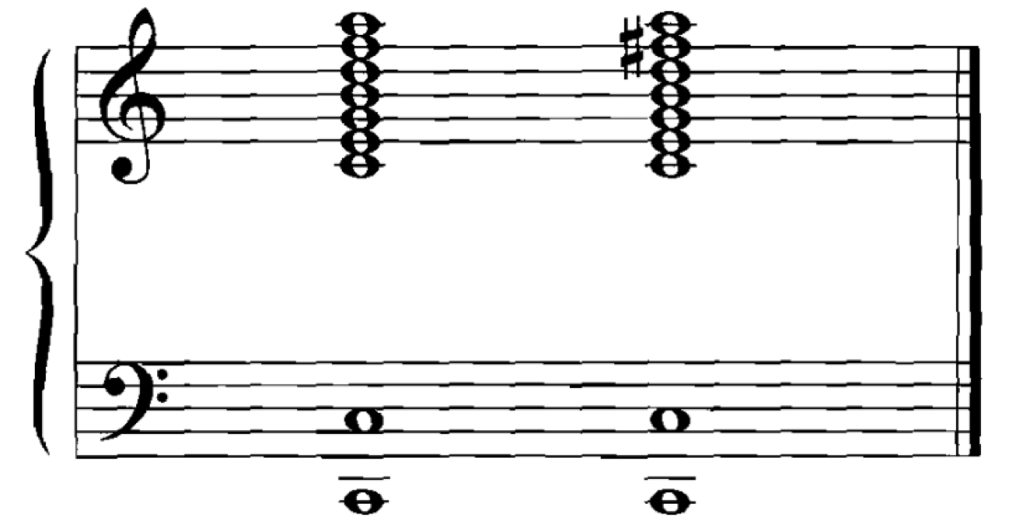
I played these chords on the piano separately from one another by firstly playing the chord in the tremble clef staff with both hands, using the pedal of the piano to hold the chord, and added the two bass notes (C) afterwards. For Reference, I also want to include a short audio file below:
My personal opinion: Playing these two chords separately from one another, I really had the impression, that the second chord sounded more conclusive than the first. I suppose, this is also stated in the book later on, but I think the main unresolved tension in the first chord comes from the Tritonus Interval at the two top notes of the chord between B and F. In the second chord, this issue is resolved, as the F is simply put up by a half note, creating a perfect 5th interval, and therefore a more “whole” sounding interval.
29.09.2024
After reflecting on the topic a few more times, I noticed, that, so far, I wasn’t really able to find a suitable jazz piece to compare. This ultimately lead me to the conclusion – Is a comparison necessary to answer the question to my chosen topic, or can I just see how Beethoven’s piece is situated in its historical context? This, for one, would make my research topic much easier and would also help me to make a better connection with my Major Project. Nonetheless, at this point, I also put a lot of effort into researching a few Jazz pieces, especially Hancock’s Tell me a Bedtime Story, which I will add below, even though they won’t be present in my final thesis.
Project 1: Keeping on Track
Due to some personal circumstances, I haven’t been able to do much for this course for the last few months. Nonetheless, I know that I will have some more time at hand within the coming weeks. The course has to be finished at the 27th of July 2025, which still gives me enough time for a detailed research.
The rough outline of my essay will probably involve introducing Beethoven’s String Quartet at the beginning, creating an analysis of the piece, analysing it in an harmonic context and seeing how it is situated in it’s historical context.
Project 2: Writing as thinking
As suggested, and written above, I will include any thoughts occurring during my research within the first part of this part of the course (Heading “Reflective Commentary).
Project 3: Primary and Secondary Sources
This chapter not only motivated me to go to more local libraries, but also to go deeper in the depths of the internet, I was able to find a few more sources on my topic both ways and added a small summary underneath. I realise, that not all of these works will end up in my study, and in future there will be more added, but they certainly helped me to understand the broader topic.
- Barbera, A. (1984). Octave Species. [online]. The Journal of Musicology, Vol.3, no. 3; 229-41. https://www.jstor.org/stable/763813.
Babera presents an analysis on the concept of “species”. The aim is to examine musical fragments of different harmonies, mainly focussing on the octave species. The word “species” is described as the different ways a set of notes can exist within a specific musical context or scale. The author first focusses on the first tetrachord of an octave, and demonstrates different possibilities to arrange intervals in order to create specific characteristics. Furthermore, other species, not involving a perfect fifth are examined, comparing the use of a fifth at the centre of an octave, dividing it into two, to the use of 7 notes, arranged freely in second – intervals to create different modes.
- Brett,C. (2014). A New Lydian Theory for Frank Zappa’s Modal Music. Music Theory Spectrum. Vol. 36 (1), pp. 146 – 166. Available at: https://library-search.open.ac.uk/discovery/fulldisplay?docid=cdi_proquest_miscellaneous_1888644863&context=PC&vid=44OPN_INST:VU1&lang=en&search_scope=MyInst_and_CI&adaptor=Primo Central&tab=Everything&query=any,contains,lydian mode&offset=10
This article demonstrates the how Frank Zappa made a significant use of the Lydian scale, taking George Russel’s “The Lydian Chromatic Concept of Tonal Organization”, the book, which originally brought me to this topic. The author analyses Russel’s theory, and creates his own work, combining it with the usage of the Lydian scale by Frank Zappa. Further on within the article, Brett demonstrates contrasts between the Lydian mode and other modes and discusses, from what point, the Lydian key can be perceived as the tonic of a piece.
- Demotta, D. (2015). The contribution of Earl “Bud” Powell to the modern jazz style. [online]. The City University of New York. Available at: https://www.proquest.com/openview/5834ee4f2b2ba91fcd1542050f369762/1?pq-origsite=gscholar&cbl=18750 https://www.proquest.com/openview/5834ee4f2b2ba91fcd1542050f369762/1?pq-origsite=gscholar&cbl=18750
This study of the pianist Bud Powell looks at his contributions to the modern Jazz style “Bebop” and looks at his harmonica and rhythmical approaches in his compositions. Through various interviews, professional jazz pianists state, that they highly contribute of Powell’s style. Within the second chapter Powell’s improvisational style is analysed.
- Haunschild, F. (1988). Die neue Harmonielehre. Ein musikalisches Arbeitsbuch für Klassik, Rock, Pop und Jazz. Brühl: AMA Verlag
- Haunschild,F. (1992). Die neue Harmonielehre Band II. Ein musikalisches Arbeitsbuch für Klassik, Rock, Pop und Jazz. Brühl: AMA Verlag
- Levidou, K., Romanou, K., and Vlastos, G. (2016). Musical Receptions of Greek Antiquity: From the Romantic Era to Modernism. [online]. Cambridge: Cambridge Scholars Publishing. Available at: https://books.google.at/books?hl=en&lr=&id=Fdn6DAAAQBAJ&oi=fnd&pg=PR5&dq=the+lydian+mode+in+the+romantic+era&ots=emg40r5snM&sig=d4U6At1ZAGoTYh–hz01J8LES-M&redir_esc=y#v=onepage&q=the lydian mode in the romantic era&f=false
- Pelczynski,B.(2019). The Not-Lydian Modes: Loss of Meaning in Subjective Notational Systems. Humanities 104. Available at: https://humes.benpelczynski.com/wp-content/uploads/2019/05/PelczynskiBentonResearchPaperFinal.pdf
- Ramsey, G.P. (2013). The Amazing Bud Powell – Black Genius, Jazz History and the Challenge of Bebop. [online]. University of California Press. Available at: https://ebookcentral.proquest.com/lib/open/reader.action?docID=1163755
- Rosen, C.(1971). The Classical Style. Great Britain: Farber Paper covered editions.
- Taylor, E. (1991). The AB Guide to Music Theory. Part II. England: ABRSM (Publishing)
- Viljoen, N. (2000). The raised fourth degree of the scale in Chopin’s mazurkas. [online]. Art Academia, Vol, 32 (2), pp. 67 – 85. Available at: https://scholar.ufs.ac.za/server/api/core/bitstreams/02af74a2-89f1-4ae9-86cc-567fecfc3fc8/content
- Sheung Yung, J. (2010) TONAL AND FORMAL ASPECTS OF SELECTED MAZURKAS OF CHOPIN: A SCHENKERIAN VIEW. https://deepblue.lib.umich.edu/bitstream/handle/2027.42/77777/yips_1.pdf?sequence=3
Project 4: Primary Data Collection Methods
In preparation for this interview, I first made a mind map of the questions I wanted to have answered. A short information about the interviewed person:
I’ve known the person who was interviewed for a few years on professional terms, they had Classical piano training starting from the age of 8, have a huge repertoire, played on several Classical music competitions and worked as a concert pianist for several years before moving more and more towards the genre of Jazz. They are now a well established Jazz musician, playing in several bands, and even write their own songs.
When I asked about a potential interview, they agreed, but brought up the wish to stay anonymous. We agreed to meet up and do the interview verbally, I recorded it and will display the translated transcription below. It has to be mentioned, that the interviewed person and I are both native German speakers, thus the interview was not held in English.
Interviewer: Hi, thanks for taking the time today.
Pianist: I’m glad if I can help!
Interviewer: I’ve prepared a few questions to start with that I’d like to go through with you, but if we stay on one topic for longer that’s fine too.
Pianist: That sounds good, I’m looking forward to seeing what you have prepared.
Interviewer: As I understand it, you are one of the jazz pianists who originally come from a classical background. Could you tell me a bit about your journey from classical music to the jazz world?
Pianist: Sure, of course. Like many others, I was put into a music school by my parents at a young age, where I had my first encounters with classical piano music. After a few initial difficulties, I managed to build a pretty good career from playing the piano. What I liked about classical music was that you can go into great detail in terms of touch, precision and dynamics, and even if you still have a certain amount of room for your own interpretation, I always had the feeling that the sheet music was restricting me to a certain extent. Since I was only involved in the classical music scene to a certain extent, I had little association with jazz music at first. I still think it’s kind of funny that in some circles there’s almost a “war” between classical musicians and jazz musicians, because both groups think they’re making music “right”.
Interviewer: What’s your opinion on that?
Pianist: Now, uh, having an insight from both worlds, I don’t think there’s a “right or wrong” in music, it’s ultimately about being comfortable with what you’re doing. On a more analytical side, you could say both sides have their pros and cons. As a classical pianist, for example, you certainly have a certain accuracy, and better practicing techniques, perhaps also in terms of speed and precision, because you strive for a certain perfection, to hit every note exactly right. On the other hand, as already mentioned, you are more bound to the score and have less opportunity to incorporate yourself creatively. A jazz player, on the other hand, will tell you that he can “speak” his instrument better and tell his own story, but that means he has less precision in what he says.
Interviewer: And yourself? Why did you change?
Pianist: That’s actually a funny story; as I mentioned, I felt very brainwashed by the classical scene and didn’t think jazz musicians were real musicians. I also, until my late teens, only had the association of jazz with random “doodle music” that seemed to have absolutely no context or structure. A good friend is actually to blame for me ending up where I am now. We were out and about in Vienna quite late at the time and he had the spontaneous idea of going to a jazz club because a former classmate of his was performing there as a singer. He was very interested in her at the time and wanted to see her on stage, but thought it would be too “conspicuous” if he went there alone. I was a bit hesitant at first, but then I was persuaded to go along. In hindsight, that night changed my whole career later on. Admittedly, I wasn’t particularly enthusiastic about the vocals, but the rest of the instruments – bass, piano and drums – almost blew me away. Logically, I was particularly captivated by the young pianist who, despite my prejudices, played precisely and created beautiful timbres and rhythmic phrasing that was new to me at the time but very interesting. In the end, I stayed there longer than my friend and listened to the pianist, he was ultimately the decisive inspirational point as to why I am interested in jazz music.
Interviewer: Hey, it’s a really exciting and funny story, especially because you would probably never have ended up there without this friend. What are the main differences for you between playing classical piano and jazz piano?
Pianist: The differences are greater than you might think, I really struggled at the beginning. After I found a suitable teacher who followed a similar path to the one I wanted to take, the first thing he said was that I should pay attention to my phrasing. Unlike in classical music, in jazz music the emphasis is usually on 2 and 4 instead of 1 and 3. That was very unusual for me, especially when it came to getting the feel of it. I remember being given the task back then of playing a piece from my repertoire, Trolltog, by Edvard Grieg with a new phrasing on 2 and 4. It was quite a fun challenge. But to come back to your question: Other differences between the two are really, as mentioned, the emphasis on perfection and execution of a score, which generally also contains more precise instructions as far as dynamics and playing technique are concerned. In jazz, on the other hand, you usually have a rough model and of course a lot of room for interpretation and improvisation, so there is also more opportunity to express yourself with your instrument.
Interviewer: How do you feel about this change from structure to freedom?
Pianist: I was a bit anxious at first and had to push myself a lot to get out of my comfort zone, it was almost as if I had to get to know the instrument all over again. What was very helpful in my case was that I was able to adopt many playing techniques from classical music. But admittedly, at first I felt like I had to jump down a cold waterfall. But what I always liked about it was that every single interpretation of a piece was always something new. Especially passages that didn’t just give chords, but also explicitly said “Hey…now” improvise on these and these chords” I found difficult at first, but they got better every time and are now one of the best parts of jazz for me.
Interviewer: Speaking of improvisation: I briefly mentioned before the interview that my work is also about the Lydian key. Is there any method in which you specifically incorporate this, but perhaps also other modal keys into your improvisations?
Pianist: Oh, Lydian is actually one of my favorite keys! I like the dreamy quality that comes with the raised fourth degree.
Interviewer: Yes, I totally understand!
Pianist: I also really like the tensions and suspensions you can create with it, something that is very rare in classical music. I usually use them over major 7 chords when I feel the piece needs a little more color.
Interviewer: Do you think that Lydian, even if it is used more, plays a more important role in jazz than in classical music?
Pianist: Definitely. I’ve often observed jazz musicians freely exploring modal scales, but still consciously using certain scales to create certain timbres, as I do. Although, some composers of temporal classical music, but also a few exceptions of the first Viennese school and Romanticism resort to this scale, which are otherwise only in the diatonic range. For me, the lyric scale gives a certain timbre and expressivity that is particularly well suited to jazz.
Interviewer: How would you describe this timbre?
Piansist: Hm, that’s a difficult question. I’m generally more of a friend of minor scales because they usually all have something mysterious about them. Although the Lydian scale is a major scale, it is still something special for me. Although it only differs by one note from the Ionian, i.e. the major scale, it sounds more exploratory, bright and upbeat. It could also be that I like it so much because the Ionian scale is used so often that it’s nice to have a change. I’m not sure myself why, but that little step of the raised four makes the key instantly more open and free. If I had to assign a color to the scale, it would be yellow and warm golden tones, for the bright warmth, maybe mixed with a bright sky blue, for the shallowness.
Interviewer: Do you think there are different reasons why the Lydian scale was used in classical and jazz music?
Pianist: Well, if you interpret classical music in a broader sense, I would say that the scale is used more to convey a certain brightness or a sense of something otherworldly. Composers have often used it to create a dreamy atmosphere. I think Debussy goes in that direction quite often, but I’m not quite sure if he consciously used this scale. In my classical period, I only had a few pieces by Debussy in my repertoire. In terms of jazz music, I would say that the Lydian scale brings a relatively fresh and sometimes even unusual palette of colors for jazz, and for me personally it has often helped with improvising and how to approach melodic structures.
Interviewer: One last question: would you have any tips for me as a pianist and composer on how to best incorporate the Lydian scale into your pieces?
Pianist: Well, I don’t know what your other approach to composing is, and I’m “only” a pianist myself, so I’m going to have a hard time giving you advice on that, but as far as playing goes, I can only advise you to just do it until it feels right. It’s best to take a simple repeating chord progression, since you’re also playing jazz, maybe a 2 – 5 – 1 progression, and play in the lyrical scale of 1 above it, or maybe only on the route chord at first.
German Original:
- Interviewer: Hi, Danke für’s Zeit nehmen heute.
- Pianist: Freut mich wenn ich helfen kann!
- Interviewer: Ich hab mir hier für den Anfang ein paar Fragen vorbereitet, die ich mit dir gerne durchgehen würde, falls wir länger auf einem Thema verharren wäre das aber auch in Ordnung.
- Pianist: Das klingt gut, bin schon gespannt was du vorbereitet hast.
- Interviewer: So wie ich das verstanden habe, bist du einer der Jazz Pianisten, die ursprünglich aus der Klassik kommen. Könntest du mir ein bisschen über deine Reise von der Klassik in die Jazz Welt schildern ?
- Pianist: Klar gerne. Ich wurde, wie viele andere auch, in jungen Jahren von meinen Eltern in eine Musikschule gesteckt, wo ich meine ersten Begegnungen mit klassischer Klaviermusik hatte. Nach ein paar Startschwierigkeiten, hab ich’s geschafft mir eine recht gute Karriere vom Klavierspielen aufzubauen. Ich mochte an der Klassik, ähm dass man sehr ins Detail gehen kann was Anschlagstechnik, Präzision, und Dynamik angeht, und auch wenn man noch gewissen Raum für Eigeninterpretation hat, habe ich doch immer mehr das Gefühl gehabt, dass mich das Notenbild gewissermaßen einschränkt. Da ich gewissermaßen nur in der Klassikszene unterwegs war, äh, hatte ich erstmal nur wenig Assoziation mit Jazz Musik. Ich find’s immer noch irgendwie lustig, dass in manchen Kreisen fast schon einen “Krieg” zwischen Klassischen Musikern und Jazz Musikern gibt, da beide Gruppen der Meinung sind, sie würden Musik “richtig” machen.
- Interviewer: Was ist deine Meinung dazu?
- Pianist: Jetzt, äh, da ich von beiden Welten einen Einblick habe, bin ich der Meinung es gibt kein “richtig oder falsch” in der Musik, es geht im Endeffekt darum, dass man sich dabei wohlfühlen kann was man macht. Auf einer analytischeren Seite könnte man sagen beide Seiten haben ihre Vor – und Nachteile. Als Klassischer Pianist, zum Beispiel, beherrscht man sicher eine gewisse Genauigkeit, und bessere Übungstechniken, vielleicht auch was Schnelligkeit und Präzision angeht, weil man eine gewisse Perfektion anstrebt, jede Note exakt richtig zu treffen. Dafür ist man, wie schon mal erwähnt, mehr an das Notenbild gebunden und hat weniger die Möglichkeit sich selber kreativ einzubauen. Ein Jazzer wiederum, wird dir sagen, dass er sein Instrument besser “sprechen” kann und seine eigene Geschichte erzählen, damit hat er allerdings wiederum weniger Genauigkeit in seinen Aussagen.
- Interviewer: Und bei dir selber? Warum bist du gewechselt?
- Pianist: Das ist eigentlich eine lustige Geschichte; Wie erwähnt, war ich von der Klassik Szene sehr Gehirngewaschen und der Meinung Jazzmusiker sind keine richtigen Musiker. Ich hatte außerdem, bis zu meinen späten Teenager Jahren nur die Assoziation von Jazz mit willkürlicher “Dudelmusik”, die absolut keinen Zusammenhang oder Struktur zu haben schien. Ein guter Freund ist eigentlich Schuld dass ich im Endeffekt da gelandet bin wo ich jetzt bin. Wir waren damals recht spät in Wien unterwegs, und er hatte die spontane Idee in einen Jazz Club zu gehen, weil dort damals eine ehemalige Klassenkameradin von ihm als Sängerin einen Auftritt hatte. Er hatte sich damals sehr für Sie interessiert und wollte Sie demnach auch gerne auf der Bühne sehen, aber meinte es wäre zu “auffällig” wenn er nur alleine hinginge. Ich war erst etwas zögerlich, lies mich dann aber dazu überreden mitzugehen. Im Nachhinein hat diese Nacht meine ganze spätere Laufbahn verändert. Ich selber war von dem Gesang zugegeben nicht sonderlich begeistert, aber die restlichen Instrumente, also Bass, Klavier und Schlagzeug waren das, haben mich fast vom Hocker gehauen. Logischerweise, war ich besonders gebannt an den jungen Pianisten, der trotz meiner Vorurteile präzise gespielt hat und gezielt wunderschöne Klangfarben sowie für mich damals neue aber sehr interessante rhythmische Phrasierungen geschaffen hat. Ich blieb dort im Endeffekt länger als mein Freund und hörte dem Pianisten zu, er war im Endeffekt der ausschlaggebende inspirierende Punkt warum ich mich für Jazzmusik interessiere.
- Interviewer: He, voll spannende und lustige Geschichte, vor allem weil du wohl ohne diesen Freund wohl nie dort gelandet wärst. Was sind für dich jetzt die Hauptunterschiede was das Spielen angeht zwischen Klassischem Klavierspiel und Jazz Klavierspiel?
- Pianist: Die Unterschiede sind stärker als man Vermuten lässt, ich hab mir am Anfang echt schwer getan. Nachdem ich mir einen geeigneten Lehrer gefunden hatte, der einen ähnlichen Weg gegangen ist wie ich ihn gehen wollte, war dass erste das er gesagt hat, dass ich auf meine Phrasierung achten solle. Anders als in der Klassik, ist es in der Jazzmusik meistens so, dass man die Betonung auf 2 und 4 anstatt auf 1 und 3 hat. Das war für mich sehr ungewohnt, vor allem wenn es darum ging es ins Gefühl zu bekommen. Ich kann mich erinnern, damals die Aufgabe bekommen zu haben, ein Stück meines Repertoires, der Trolltog, von Edvard Grieg mit einer neuen Phrasierung auf 2 und 4 zu spielen. War eine recht lustige Challenge. Aber um auf deine Frage zurück zu kommen: Sonstige Unterschiede zwischen den Zweien sind wirklich wie erwähnt der Schwerpunkt auf Perfektion und Ausführung eines Notenbilds, das generell auch genauere Anweisungen enthält was Dynamik und Spieltechnik angeht. Im Jazz wiederum, hat man meistens ein grobes Leitbild und natürlich viel Raum für Interpretation sowie Improvisation, somit gibt es aber auch mehr Möglichkeit sich selber mit seinem Instrument auszudrücken.
- Interviewer: Wie fühlst du dich über diesen Wechsel von Struktur zur Freiheit?
- Pianist: Ich war anfänglich etwas ängstlich und musste mich sehr viel dazu bewegen aus meiner Komfortzone herauszugehen, es war fast als müsste ich das Instrument neu kennenlernen. Was in meinem Fall sehr hilfreich war, ist dass ich viele Spieltechniken von der Klassik übernehmen konnte. Aber zugegebenermaßen, habe ich mich anfangs gefühlt als müsste ich einen kalten Wasserfall hinunterspringen. Was ich jedoch immer daran mochte, ist dass jede einzelne Interpretation eines Stückes immer etwas neues war. Besonders Passagen die nicht nur Akkorde vorgegeben haben, sondern auch explizit gesagt haben “He…jetzt” improvisier’ mal über diese und diese Akkorde” fand ich anfänglich schwierig, die wurden jedoch von mal zu mal besser und sind inzwischen für mich einer der besten Bestandteile des Jazz.
- Interviewer: Wenn wir gerade bei Improvisation sind: Ich habe vor dem Interview kurz erwähnt, dass es in meiner Arbeit auch um die Lydische Tonart geht. Gibt es irgendeine Methode in der du spezifisch diese, aber vielleicht auch andere modale Tonarten in deine Improvisationen einbaust?
- Pianist: Oh, Lydisch ist sogar eine meiner Lieblingstonarten! Ich mag die verträumte Art die die gehobene vierte Stufe mit sich bringt.
- Interviewer: Ja versteh ich total!
- Pianist: Ich find auch die Tensions und Aufhebungen die man damit kreieren kann echt schön, sowas kommt in der Klassischen Musik nur sehr selten vor. Ich benutz sie meistens über Major 7 Akkorde, wenn ich das Gefühl hab, das Stück braucht etwas mehr Farbe.
- Interviewer: Denkst du, dass Lydisch, auch wenn’s mehr verwendet wird, eine wichtigere Rolle im Jazz spielt als in der Klassik?
- Pianist: Definitv. Ich hab oft beobachtet, wie Jazzmusiker Modalskalen frei erkunden, aber dennoch bewusst gewisse Skalen nutzen um, wie ich auch, gewisse Klangfarben zu erzeugen. Obwohl, einige Komponisten von temporärer klassischer Musik, aber auch einige wenige Ausnahmen der ersten Wiener Schule und Romantik greifen auf diese Skala zurück, die sich sonst nur im diatonischen Bereich aufhalten. Für mich gibt die Lyrische Skala eine gewisse Klangfarbe und Expressivität, die sich besonders gut für Jazz eignet.
- Interviewer: Wie würdest du diese Klangfarbe beschreiben?
- Piansist: Hm, eine schwierige Frage. Ich bin ja grundsätzlich mehr ein Freund von Mollskalen, weil sie meistens alle etwas mysteriöses haben. Die Lydische Skala zählt zwar zu den Durskalen, aber ist für mich dennoch etwas besonderes. Obwohl sie sich nur um eine Note von der Ionischen, also der Dur-Skala unterscheidet klingt sie erkundungsfreudiger, hell und aufmunternd. Es kann auch sein dass ich sie so mag, weil die Inoische Skala so oft genutzt ist, dass es nett ist mal etwas Abwechslung zu haben. Ich bin mir selbst nicht sicher woran das liegt, aber dieser kleine Schritt der erhöhten Vier macht die Tonart augenblicklich offener und freier. Wenn ich der Skala eine Farbe zuteilen müsste wären es gelbe und warme goldene Töne, für die helle Wärme, vielleicht gemixt mit einem hellen Himmelblau, für die Seichtheit.
- Interviewer: Denkst du es gibt unterschiedliche Gründe warum man die Lydische Skala in der Klassischen bzw in der Jazz Musik verwendet hat?
- Pianist: Also, wenn man klassische Musik in weiterem Sinne auslegt, würde ich sagen, dass die Skala eher verwendet wird um eine gewisse Helligkeit oder ein Gefühl von etwas Außerweltlichem verbreiten möchte. Komponisten haben sie oft verwendet um eine träumerische Atmosphäre zu kreieren. Ich denke, Debussy geht ziemlich oft in so eine Richtung, weiß aber nicht ganz sicher, ob er bewusst diese Skala verwendet hat. In meiner Zeit der Klassik, hatte ich nur wenige Stücke von Debussy in meinem Repertoire. Bezogen auf die Jazzmusik würde ich sagen, dass die Lydsiche Skala eine relativ frische und manchmal sogar für den Jazz ungewohnte Palette an Farben mit sich bringt, und mir persönlich hat sie auch oft beim Improvisieren geholfen, und wie man an Melodiestrukturen herangeht.
- Interviewer: Eine letzte Frage hätte ich noch: hättest du für mich als Pianistin und Komponistin vielleicht Tipps wie man die Lydische Skala am besten in seine Stücke einbauen kann?
- Pianist: Also, ich weiß nicht wie deine sonstige Herangehensweise ans Komponieren ist, und ich bin selbst “nur” Pianist, deswegen werde ich mir etwas schwer tun dir dahingehend einen Rat zu geben, aber was das Spielen angeht, kann ich nur raten einfach machen, bis es sich richtig anfühlt. Nimm dir am besten eine einfache sich wiederholende Akkordverbindung, da du auch im Jazz unterwegs bist, vielleicht gleich eine 2 – 5 – 1 Verbindung, und spiel in der Lyrischen Skala der 1 darüber, beziehungsweise, vielleicht anfänglich nur auf der 1.
Reflection:
Even though I was a bit nervous at first, I really enjoyed doing the interview, especially as I’ve never done anything similar before. I got on well with the interviewed person and as a pianist myself, we also had some small talk about piano playing in general, which I excluded as it didn’t seem relevant for my research. I also should mention here, that I had the pianist proofread the interview, after writing it down. This seemed important to me, firstly, to give them the required level of anonymity, and secondly, to see if they were comfortable with the level of professionalism. To create a further association with my Major project, I decided to dedicate one of my pieces to the interview, and rewrote Edvard Grieg’s Trolltog for my Jazz Ensemble.
Field Work
The Concert
In addition to the interview, I did some “field work”, if I’m able to refer to these events like this, regarding my topic. A short while ago, I was able to see a concert arranged by a small group from the Wiener Symohoniker. The percussionist and arranger of the pieces Friedrich Philipp Presendorfer made a short introduction about the project. Works such as Johann Strauss’ Radetzky March and Maurice Ravel’s Bolero were presented. With 11 musicians, the arrangement seemed to be arranged quite strictly, assuringly to contain a certain “order”, but some musicians were given some space to perform solos on their instruments. Even though it didn’t directly relate to the topic of the Lydian key, I was often able to make out a raised fourth within these improvised passages, as well as the B section of the Jazz adaption of Ride of the Valkyries, where the mode was intentionally implemented for a whole section.
On another, maybe more personal note, it was very interesting to observe the other members of the audience. Most of them seemed to not be used to the more (for the “Classical Western Ear”) dissonant sounding chords, but as the concert progressed, all of them started moving slightly to the rhythm of the music. I asked some of the audience members after the concerts how they felt about the experience, and the answers I mainly got were, that they simply weren’t used to “that kind of music”, but ended up enjoying it towards the end.
Overall, I really enjoyed the concert, and was even able to get some inspiration for my Major Project, Presendorfer often made melodies “wander” through his instruments, so that each of them had the opportunity to present themselves. Even though my ensemble is only half the size and includes two singers, I would still like to take inspiration from this idea of handling a melody over several instruments/ voices.
Unfortunately, I wasn’t able to consult one of the soloists after the concerts to ask them to their approach of their passages or how they felt about it.
Playing Piano
For analysing the Jazz piece “Tell me a bedtime Story”, I played it myself several times in order to analyse the chord structure an melodic movement, this gave me a better understanding of the piece, as well as the mood and feeling it generates.
Project 5: Research Ethics
For all the information provided above in project 4, especially considering the interview and my field work studies after the concert, I informed all people I asked questions about my intention and motivation, and also enquired, if they were comfortable answering.
As stated above, the person I interviewed wished to stay anonymous, which I highly respected and also wished to read through the script and my reflection on it before they gave me consent to publish it on this website.
For the field work involving the Jazz – Concert, I didn’t take any photographs, videos nor recordings of it, as this was stated as strictly prohibited at the location of the concert. The notes I took on the music where mainly reflecting my own observations and feelings about the music as well as the audience.
I also pre informed the members of the audience that I asked about the concert about my intentions with my questions, and respectfully accepted as two of them denied to share their experience.
Project 6: Cycles of Research
For this project, I was asked to arrange my research into several stages of The Research Cycle, involving Planning, Acting, Evaluating, reflecting and presenting. In the list below I included all the topics I already covered and put them unter the part of the cycle that seemed most suitable, as I progress through this part of the course, I will add some further notes, especially under “Reflect” and “Present”
- Plan
- Creating a mind map
- Finding out which sources/books/articles I’m going to use
- Planning ahead for my own research, especially when it involves other people
Firstly, I felt a bit unsure about how to get started with this part of the course, these things helped me to get a good overview of the research methods I wanted to use, and also helped me to get to the topic of the Lydian scale. Making some notes/questions prior to the interview as well as the concert helped me to create clear intentions to what I want to achieve from the research process
2. Act
- Listening to and evaluating Music related to my topic (Listening Log)
- Reading through articles and papers related to my topic
- Doing my own research
Once I knew I wanted to focus on the Lydian key, compared within different genres, listening to music that relates to the topic was the first thing I did, this helped me to get a “settled” feeling for the Lydian key and in which contexts it can be used. Secondly, I found out a lot by reading through papers online as well as in my local library, and sometimes even found new topics, that would have been very interesting to research. It was sometimes slightly difficult, to get myself to stay on the same topic. Nonetheless, I made notes on all the other subjects that were of interest for me and may come back to them at some point in the future. This was the first time, were I had the opportunity, to do my own research, which was an interesting experience. I was really nervous at first (especially about the interview), and it took a lot of self – convincing work to find out which methods would be most useful, but eventually, I was really pleased with the results I gathered.
3. Evaluate
- Reflecting and commenting on the pieces I’ve listened to
- Making short summaries of the books/articles and papers I came across during my research
- Evaluate if my findings are related to or relavant for my chosen topic.
4. Reflect
- As a reflection, I would count in all of my “writing as thinking” notes, starting at the top of this page.
- My Listening Log entries
- My thoughts on the interview, the concert and my own piano research (Project 4)
Reflecting on nearly all the points I’ve made above was very useful, as it gave me the opportunity to look at my research in a more objective way, and exclude data that seemed not relevant for my topic. On the other hand, it also gave me new ideas on which steps I should take next.
5. Present
- This Page
- The Presentation I’ll be holding for the Assignment
A “presentation” in form of a written down format, was also very useful during my research, as I was able to move back and fourth between different cycles and movements of my thinking process.
Project 7: Project 7: Analysing and Interpreting your Data
For the last project of this course, I was asked to reflect on my collected data again, and interpret my findings, I had the following questions as a guide to use, some which I will try to answer directly:
For the last project of this course, I was asked to reflect on my collected data again, and interpret my findings, I had the following questions as a guide to use, some of which I will try to answer directly:
- What does the data mean?
I think I can separate my research in 3 categories here:
- The Backgrounds of Beethoven’s String Quartet
Beethoven’s impulse for writing this piece in this specific key, was that he had recently recovered from a serious illness, furthermore in historical context, only a few other musicians used this scale as explicitly.
- The Analysis of Beethoven’s String Quartet
Demonstration of the mood the piece creates, and how it is harmonically structures.
- The Primary Research
The reflections on the interview, as well as the concert I attended can be read above.
- What context is it situated in?
The piece can be reflected upon in its historical context, and why it was rather unusual to use this scale explicitly during the Romantic era.
- Are there any anomalies that need to be explained or investigated further?
There might be several other topics coming up as soon as I start the writing process, especially considering the comparison of the two pieces
- Are you aware of your own biases? How might they have impacted on the data collection and/or your interpretation? How can you address or acknowledge this in your findings?
I think in this particular case, I would find it difficult to find anything that might be prejudged. I’m trying to be open to all possible outcomes and topics surrounding my subject equally. The only thing that might happen, is that I partially drift away into a more detailed topic that’s not really relevant for the subject I want to write about, but I think that this can be avoided by frequent reflections during my writing process.
Assignment 3
For this Assignment I was asked to make a short presentation about my research so far as well as a reflective commentary which I will add here: (The Presentation will only be uploaded on the Learning Platform of my university)
Reflectively, this was one of the most difficult units I had to do for the OCA so far. As this is not the first thesis I’m writing, I thought I would find it a bit easier, but the research approach I was confronted with took a lot more time and energy than I thought.
I’m aware, that thorough research about a topic before starting to write is mandatory in order to have a better workflow during the writing process itself, nonetheless, in my opinion, this course put a bit too much emphasis on reflection and evaluation. As I will mention below, the reflective commentary was certainly useful, I felt that some parts were stopping my working flow during the researching process. For Example Project 6, which was, for me, just a retelling of the research I’ve already gathered, and instead of moving forward I felt like I was moving in circles. Nonetheless, I can understand, that everyone works differently, and this process might have been just right for another person.
The reflective commentary, as well as the mindmap helped me to narrow down my topic to something that was manageable and interesting to me. Furthermore, I was able to create a good connection with my Major Project, as I’ll be rewriting one of the pieces I’m analysing for Contextual Studies for a Bigband. Without the detailed documentation of my thinking process, I certainly wouldn’t have ended up with this conclusion. Even though I already invested a lot of work in it, I also only came to the conclusion, to NOT compare two pieces at the very end of my researching process.
Looking at the Lydian scale from a broader view allowed me to see, that there might be some few similarities to find if looked for them in different historical contexts, but it was mainly differences in almost all musical and historical aspects.
The primary research I did was highly interesting as well, I never had the chance to conduct an interview before, and learned a lot from the experience, especially the preparation. Furthermore, I already went to several concerts for other projects for the OCA over the past few years, and always enjoyed the experience, this one was even more special, as it directly lined up with my Major Project and gave me some inspiration for writing a larger piece.
Conclusively, as mentioned above, I found it very difficult to get through this part of the course, which is also why it took me over three months to finish it. On the other hand, I’m grateful for the learning process I had during this time. I learned several new researching methods and made some, for me, very valuable experiences, which will certainly have an impact on the rest of the researching process.
 Bluefoxxmusic