- Assignment 1: A Composition for a group of untuned percussion
- Assignment 2: Composition for a solo Woodwind instrument
- Assignment 3: A Little Polyphony
- Assignment 4: Fugue for three
- Assignment 5: Classical Jazz
Assignment 1
A Composition for a group of untuned Percussion
For the assignent I was asked to finish a somposition for a short dance scene for untuned percussion. The piece should last for about 2 or 3 minutes
Wild Dance
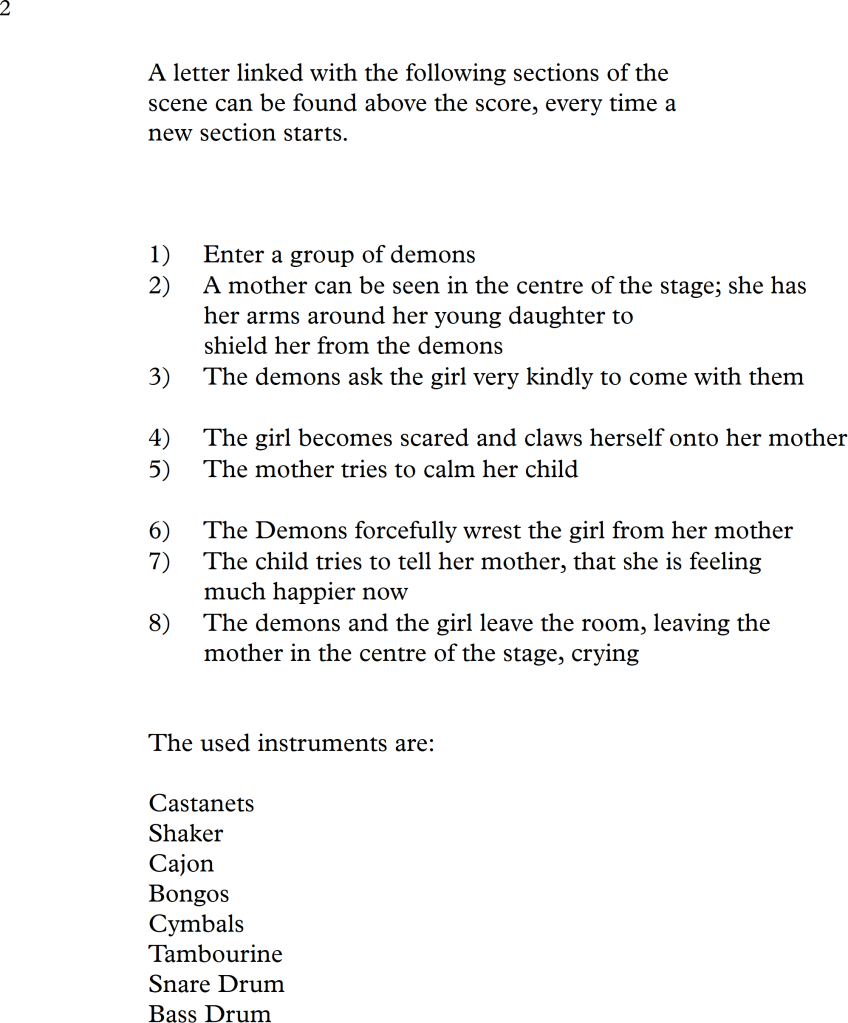
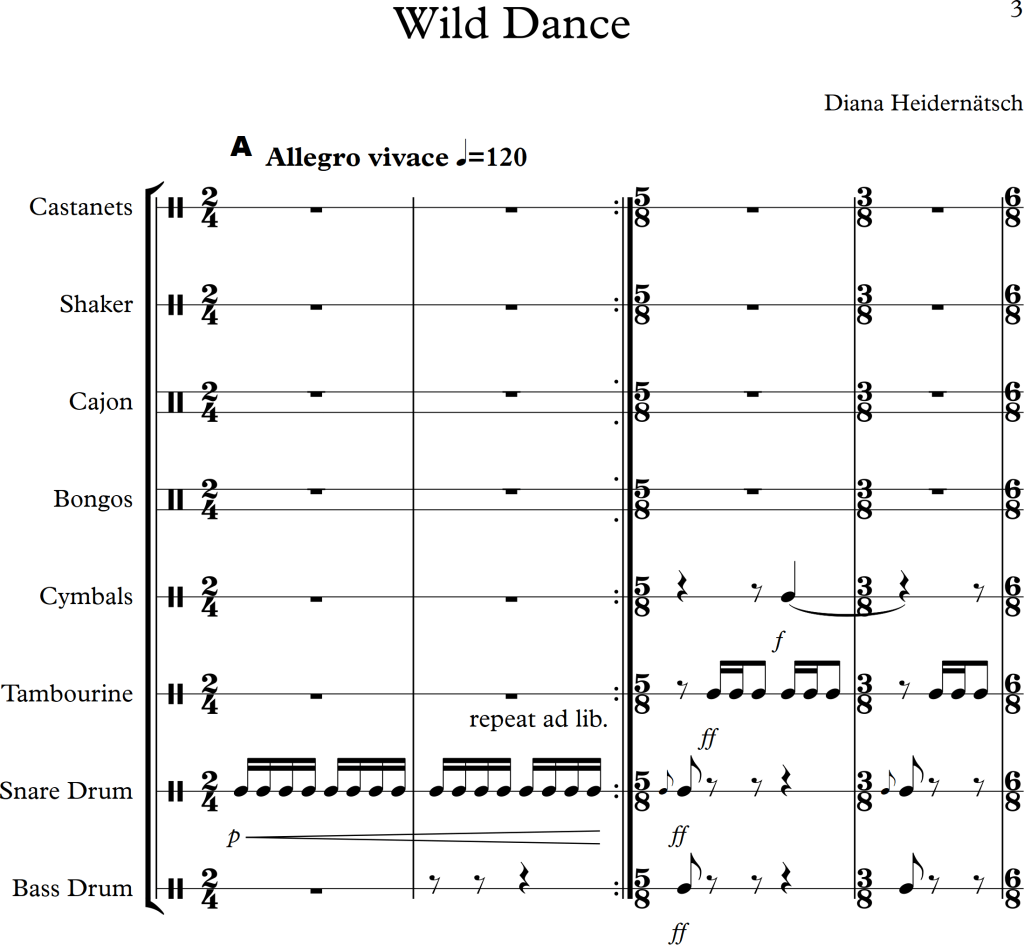
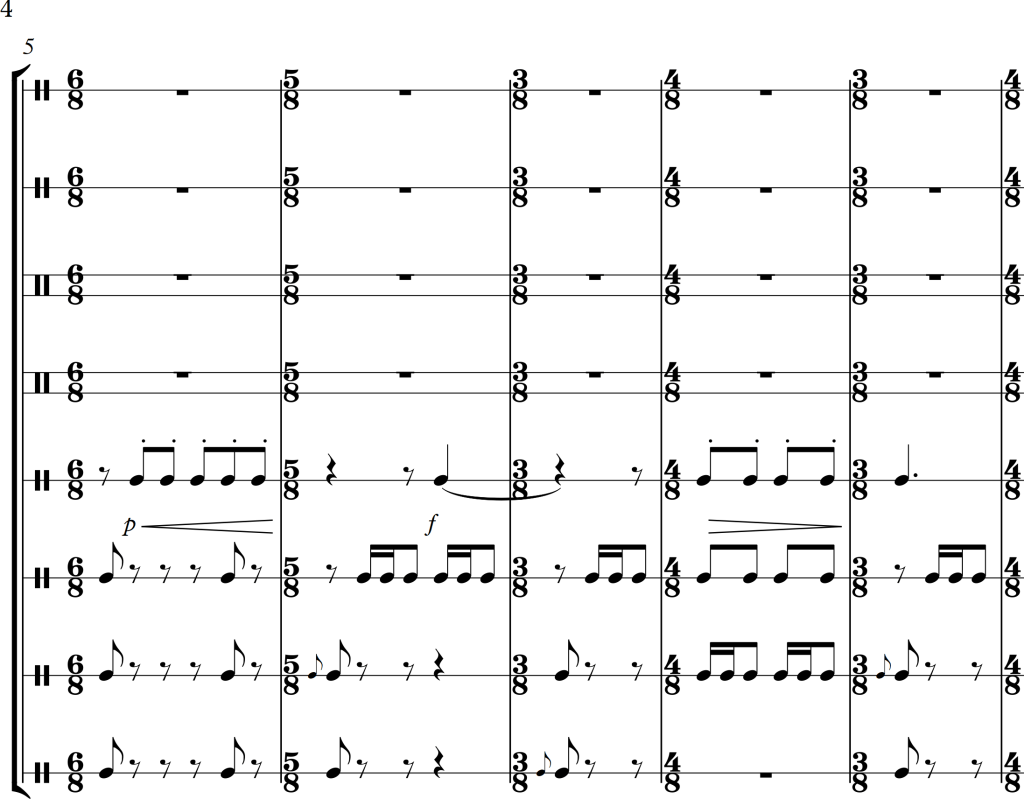
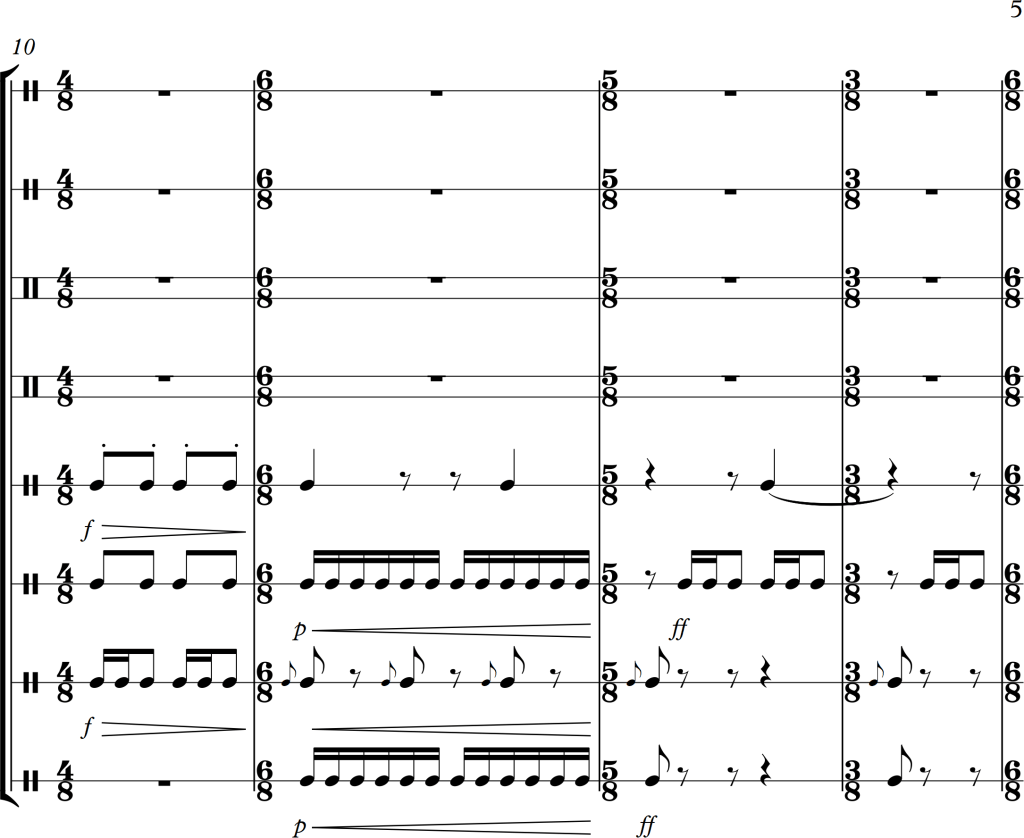
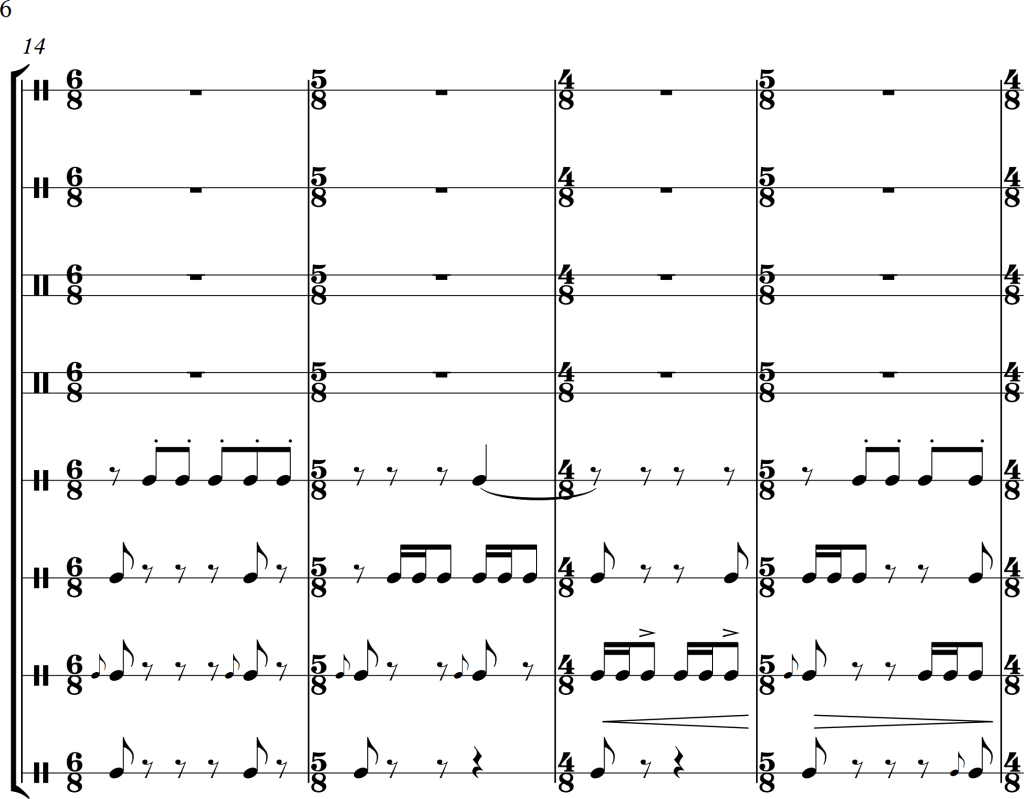
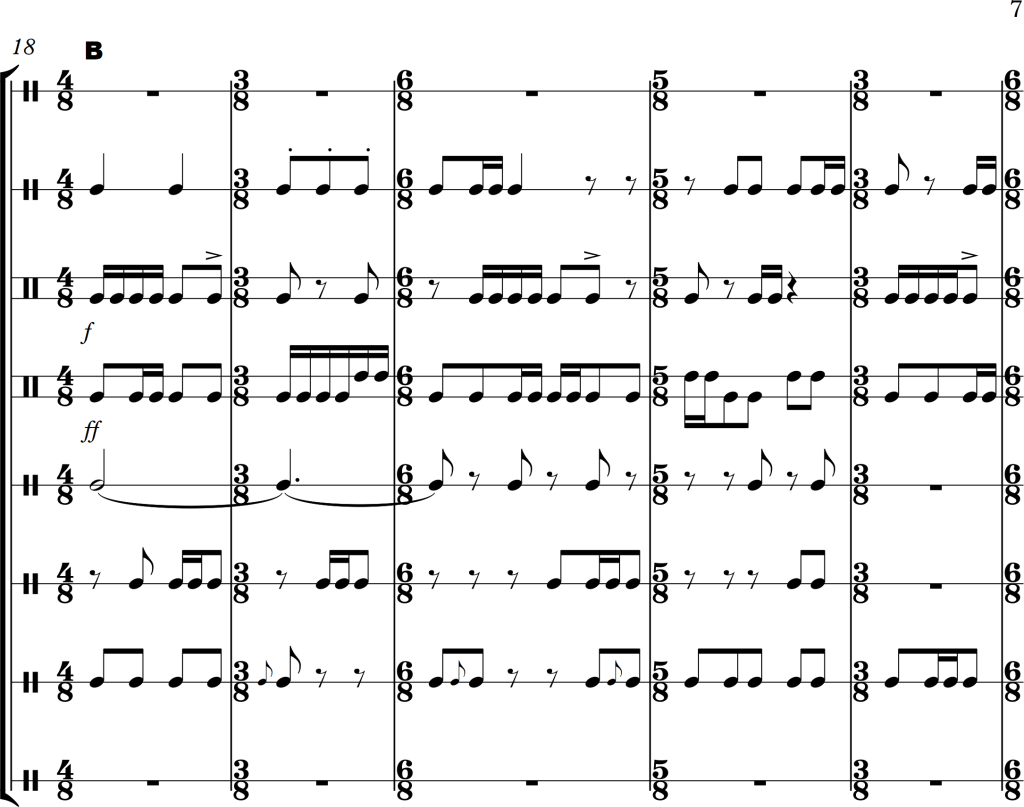
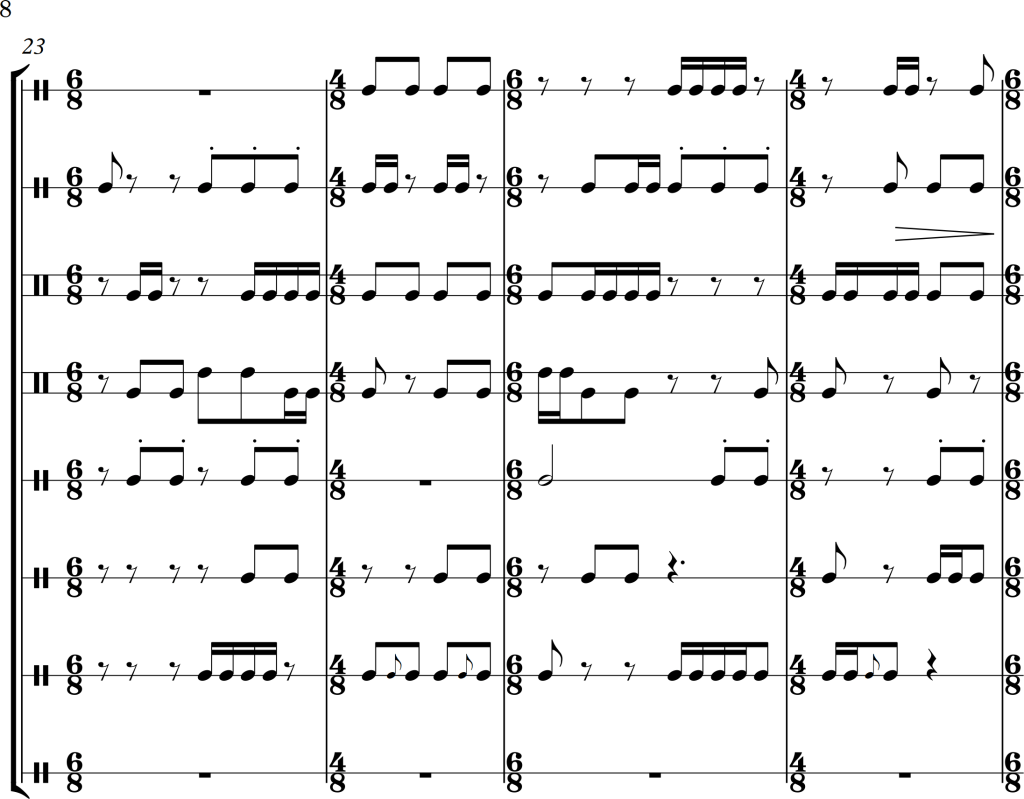
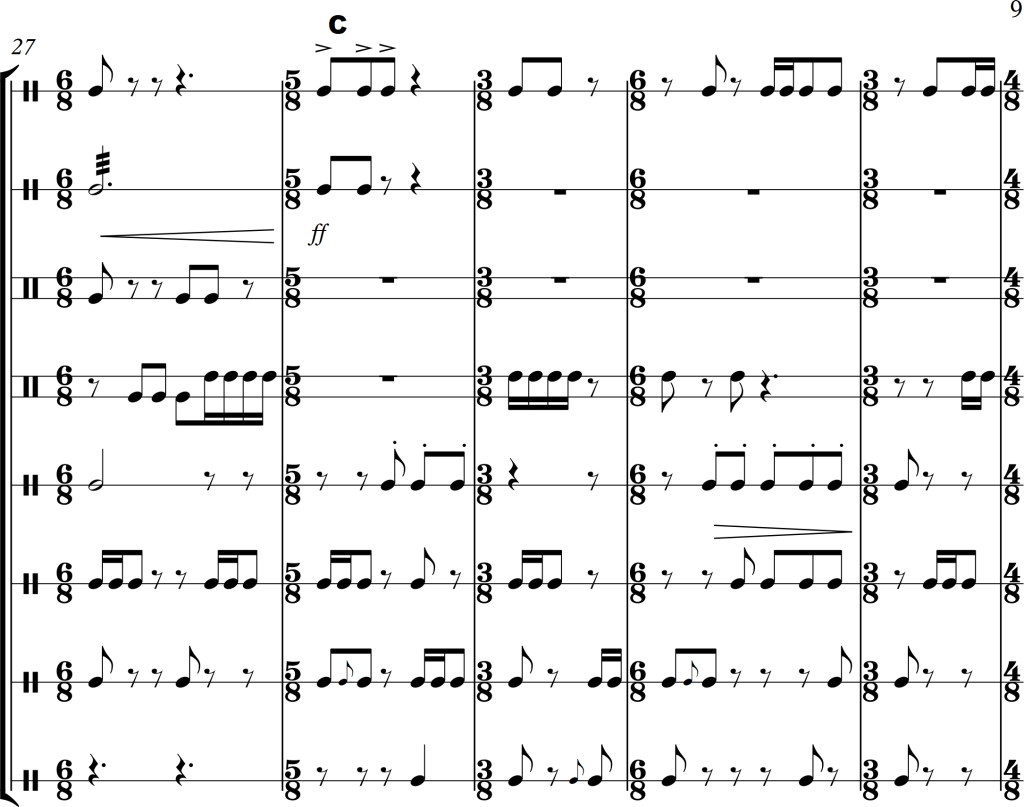
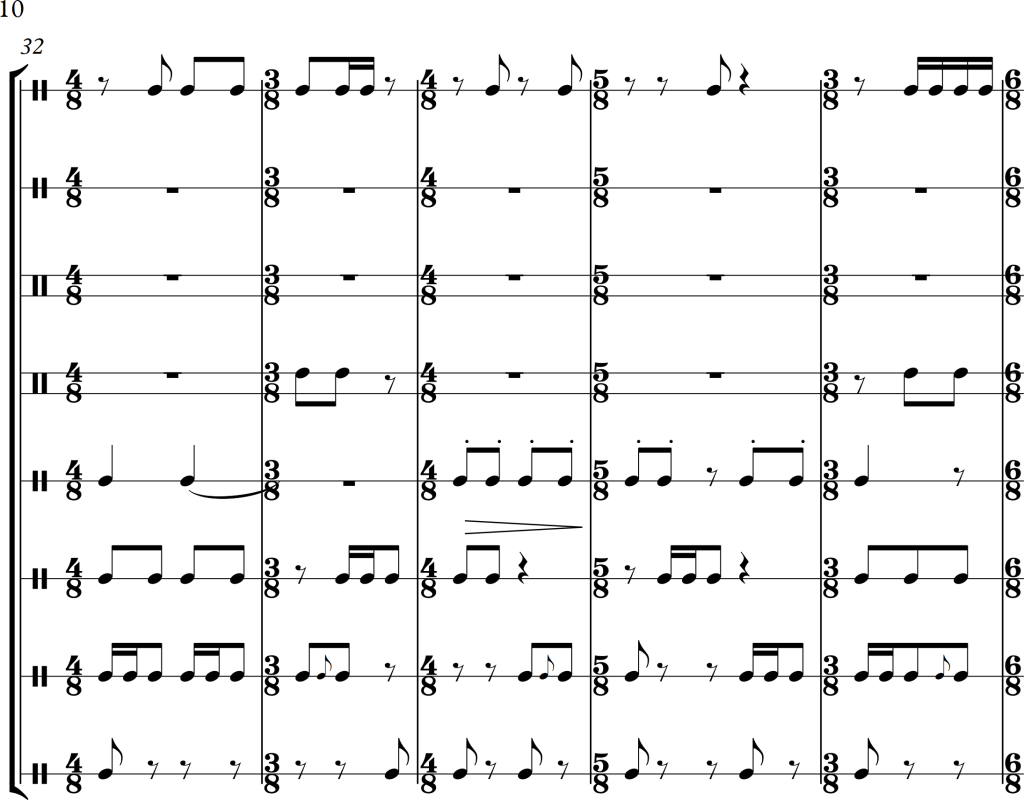
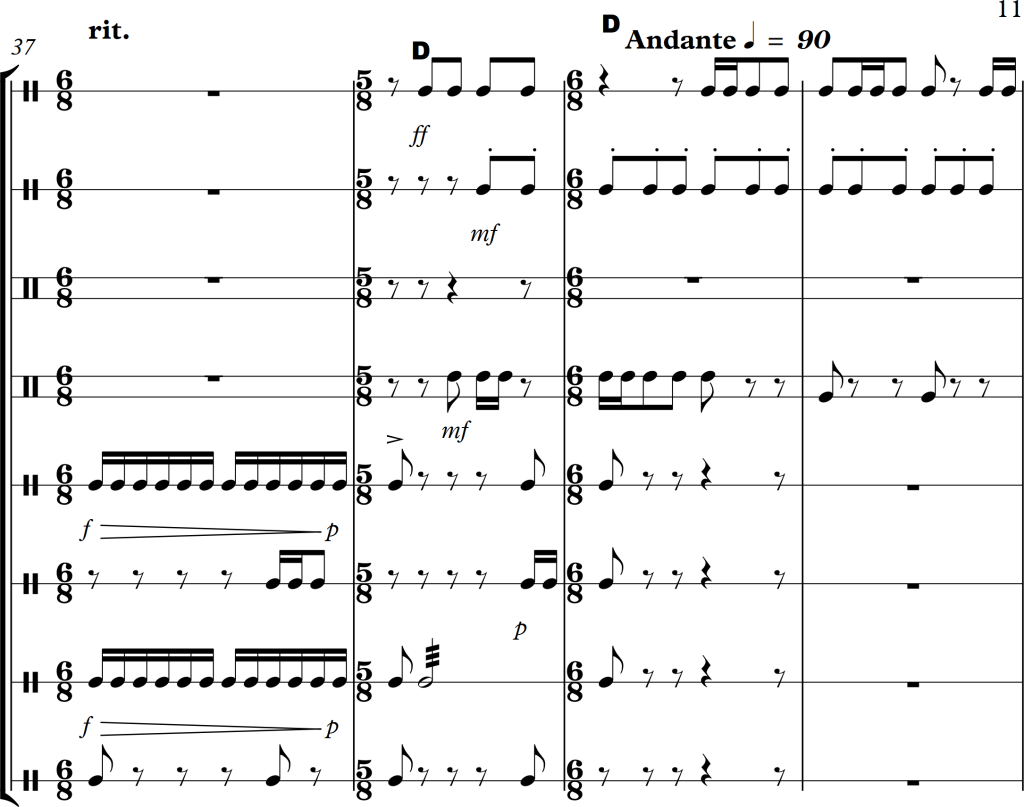
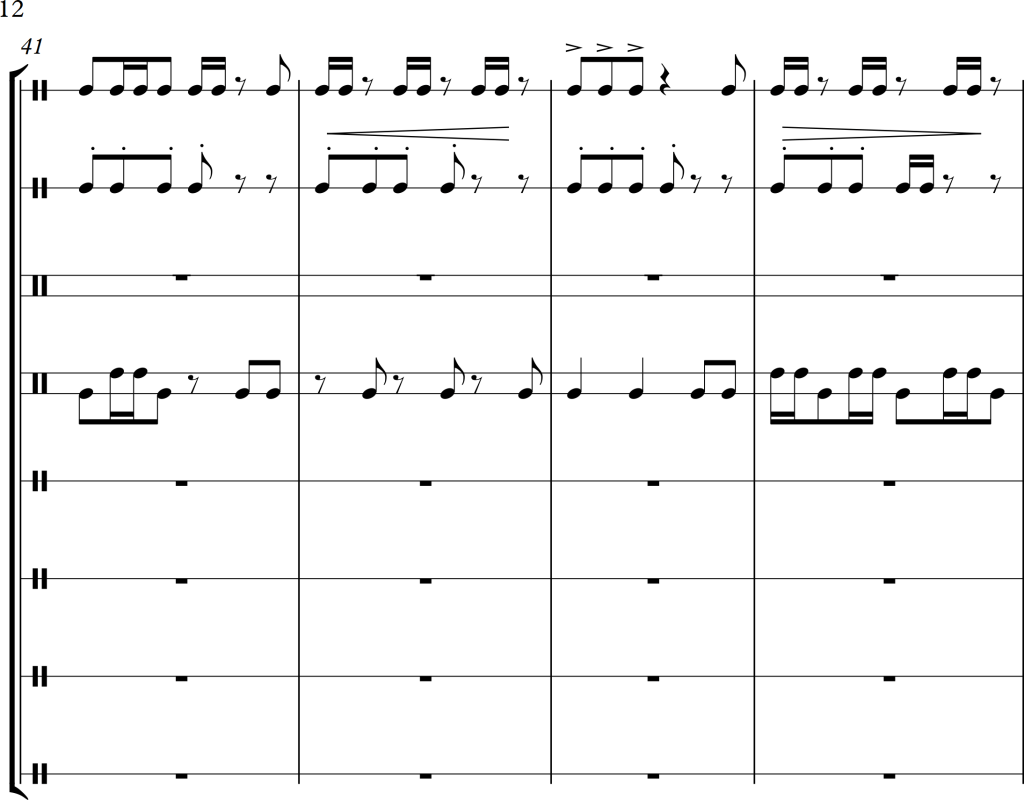
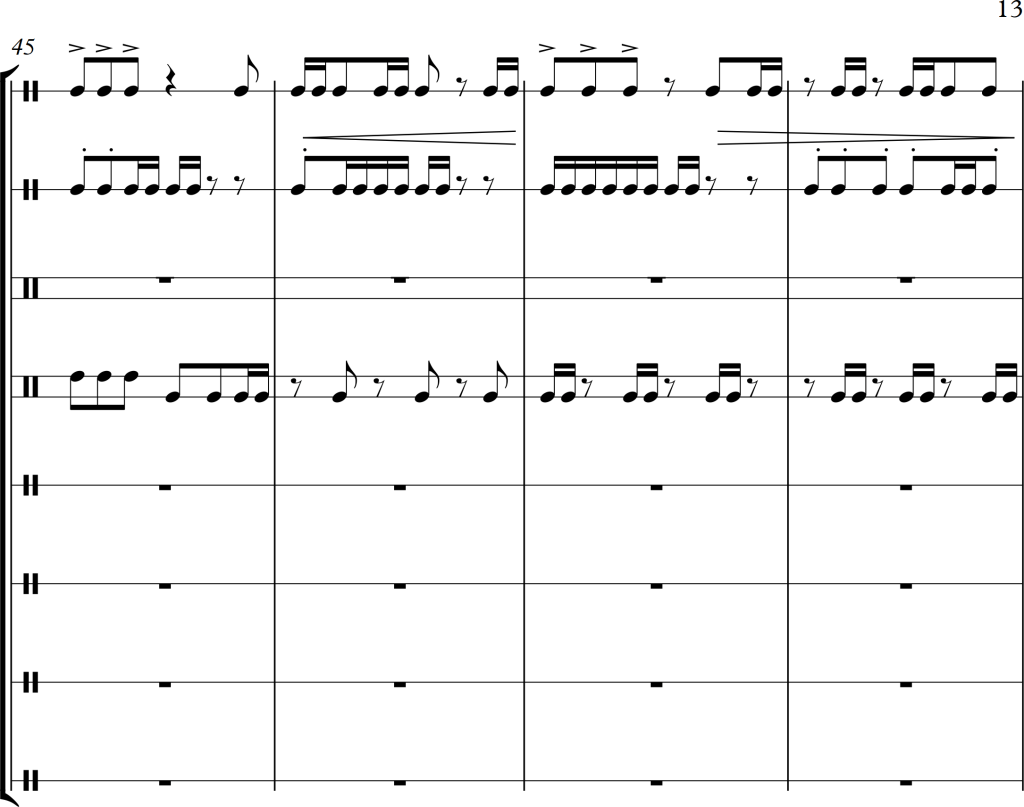
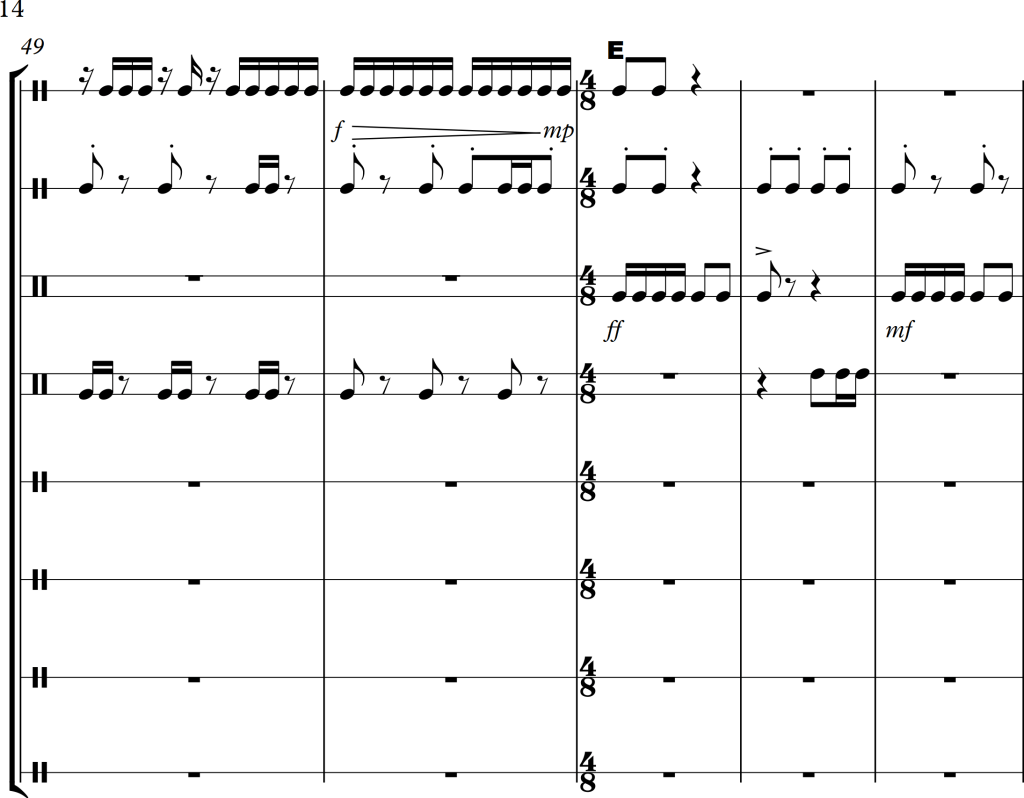
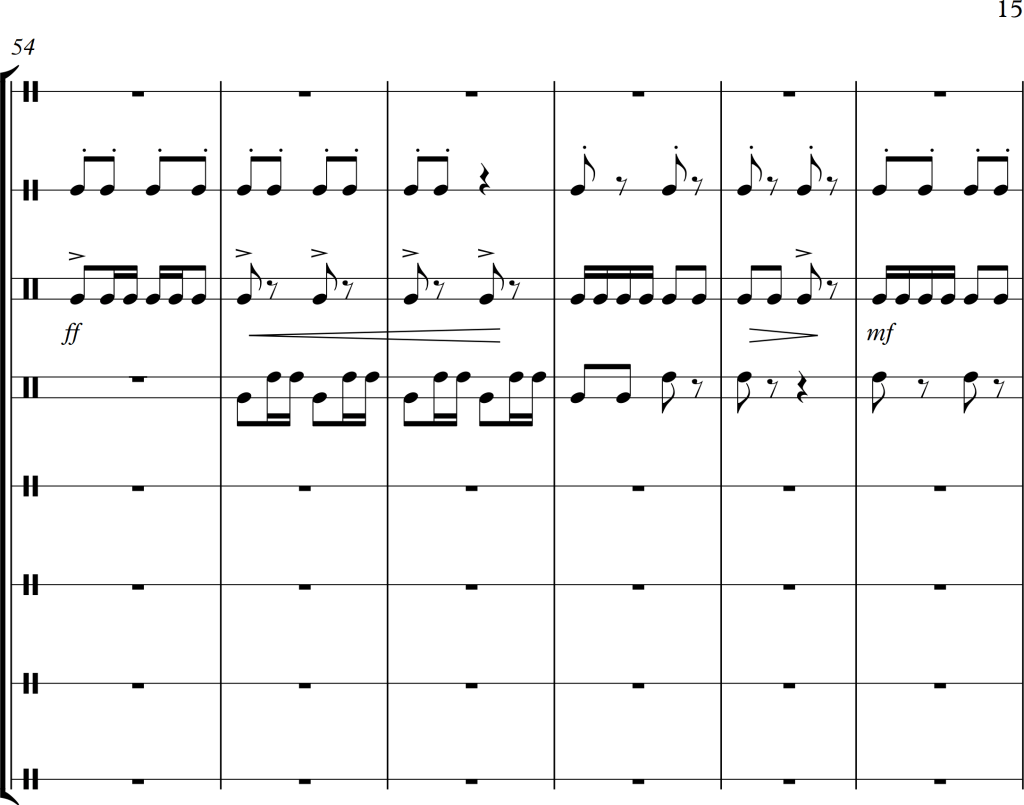
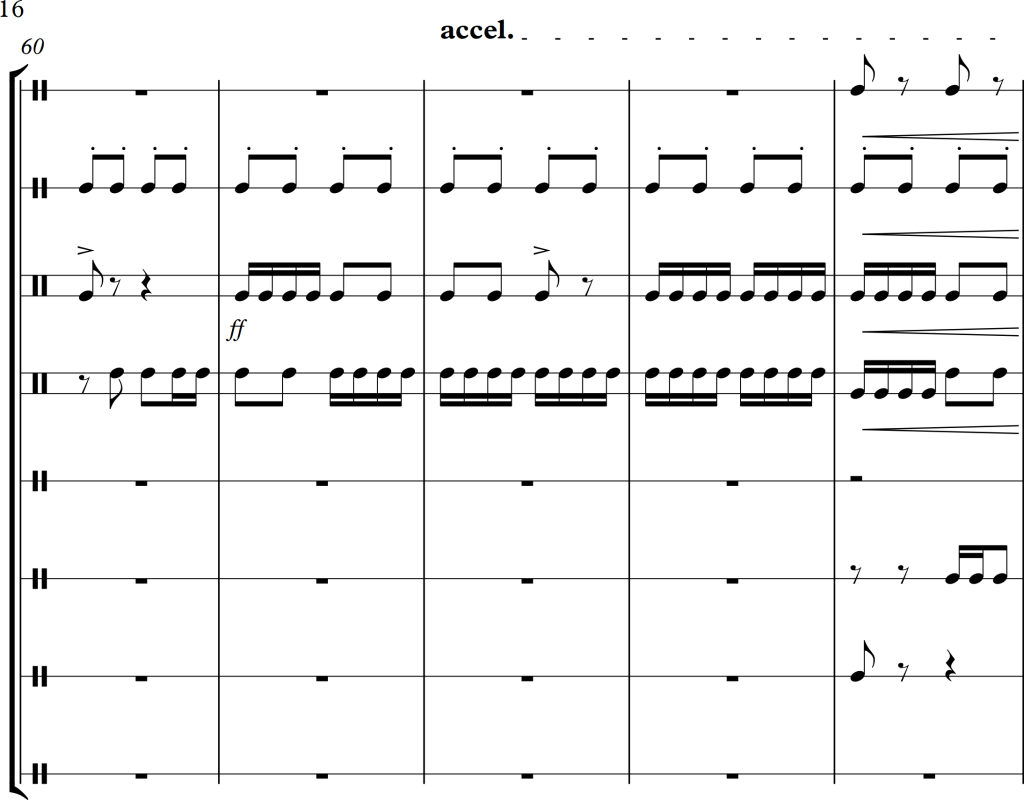
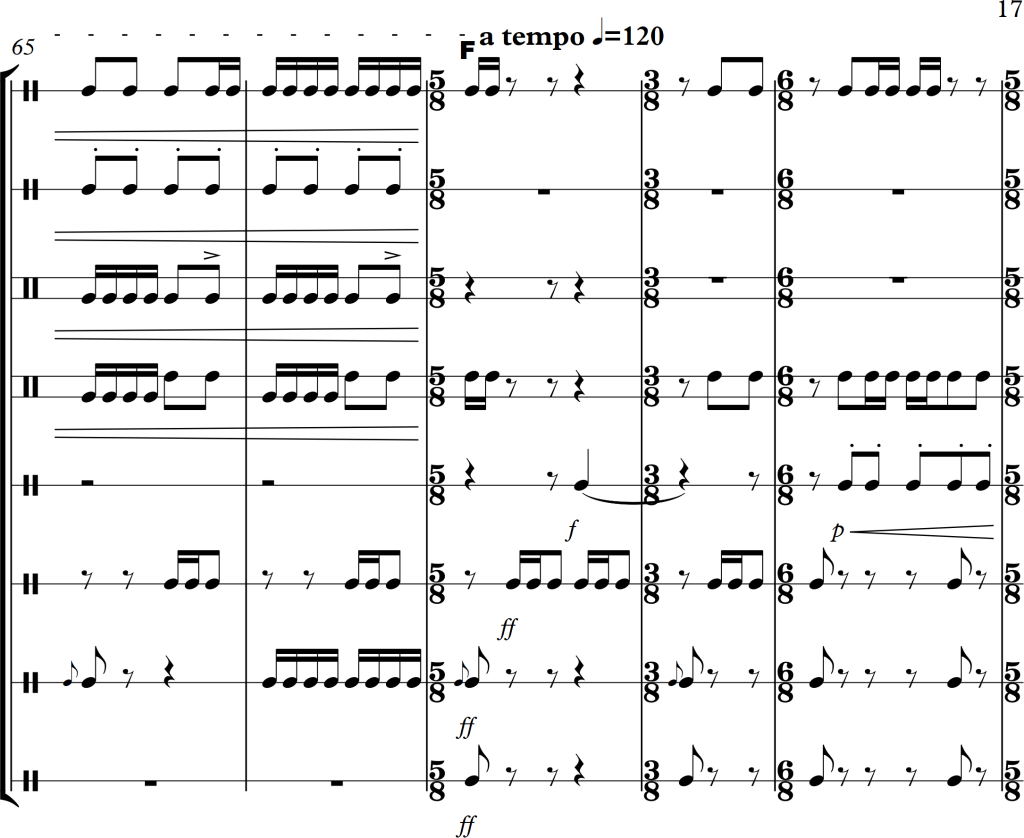
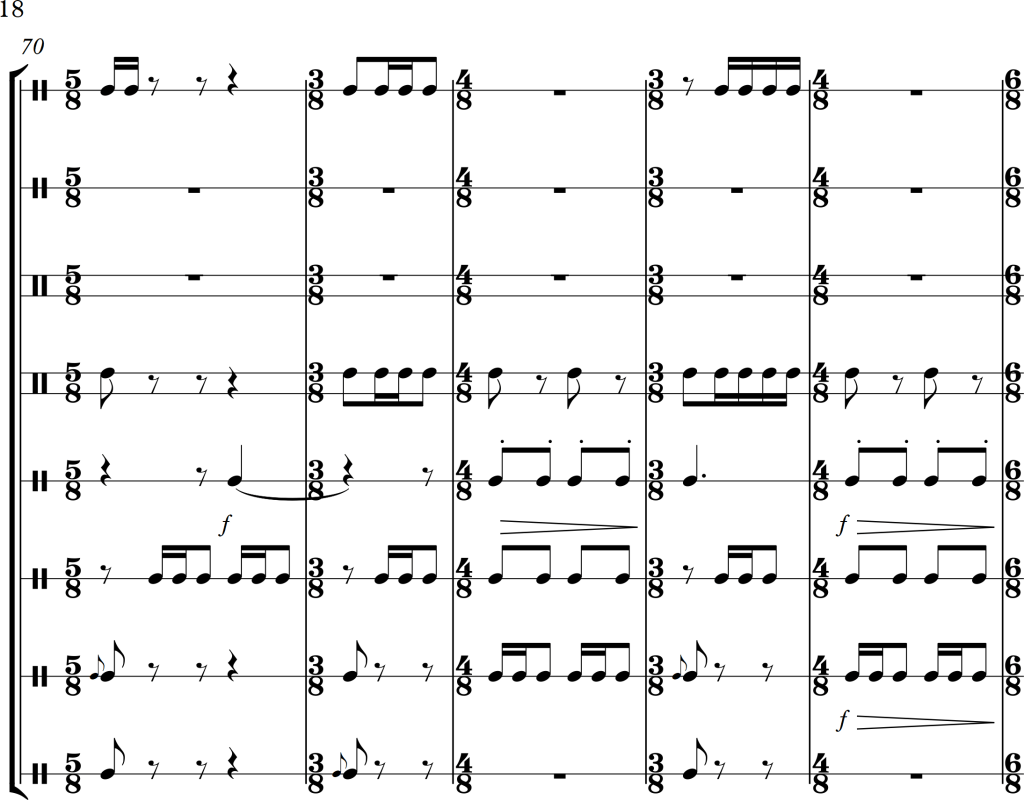
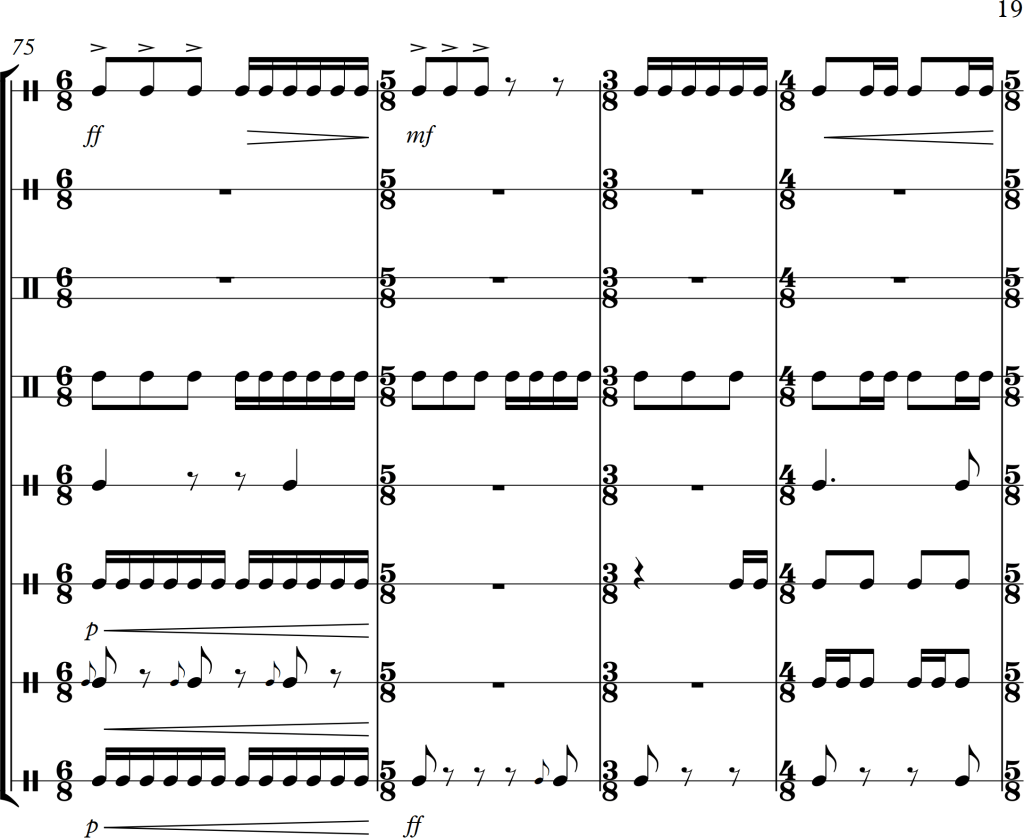
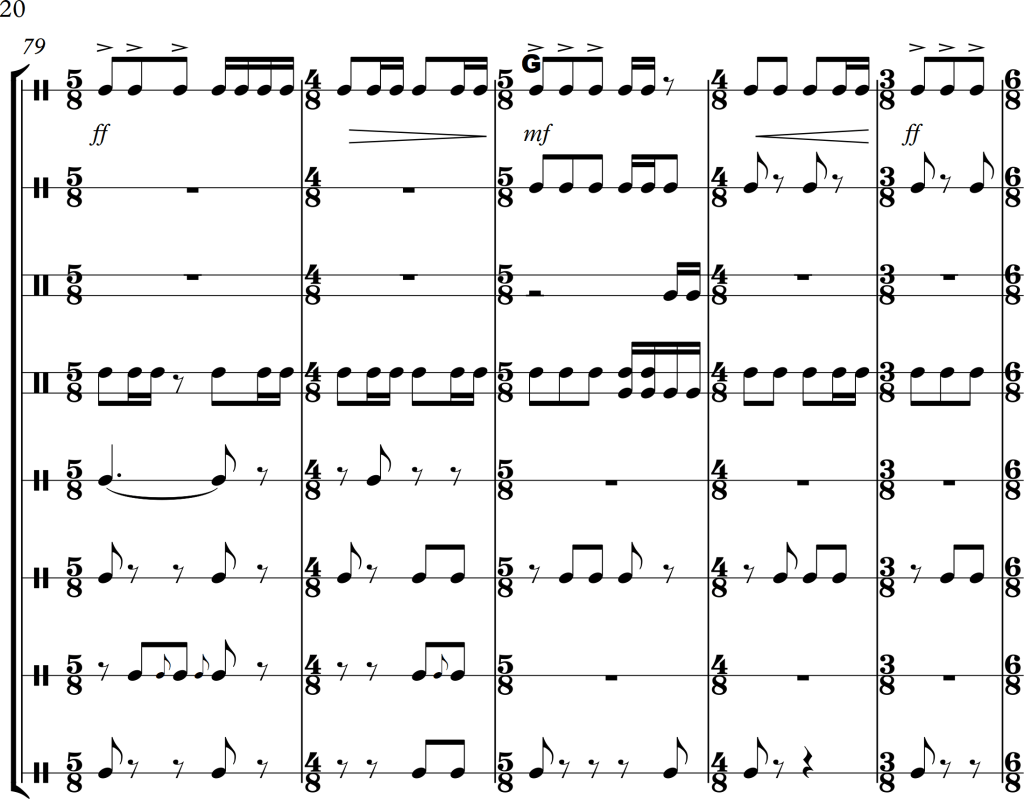
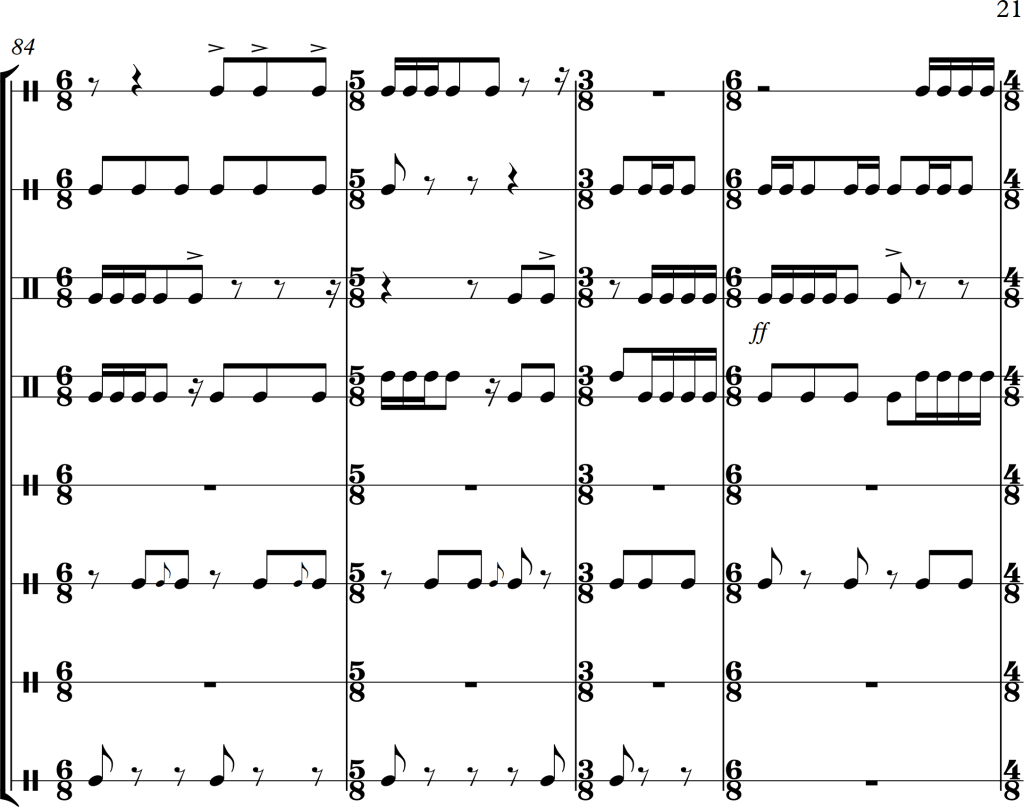
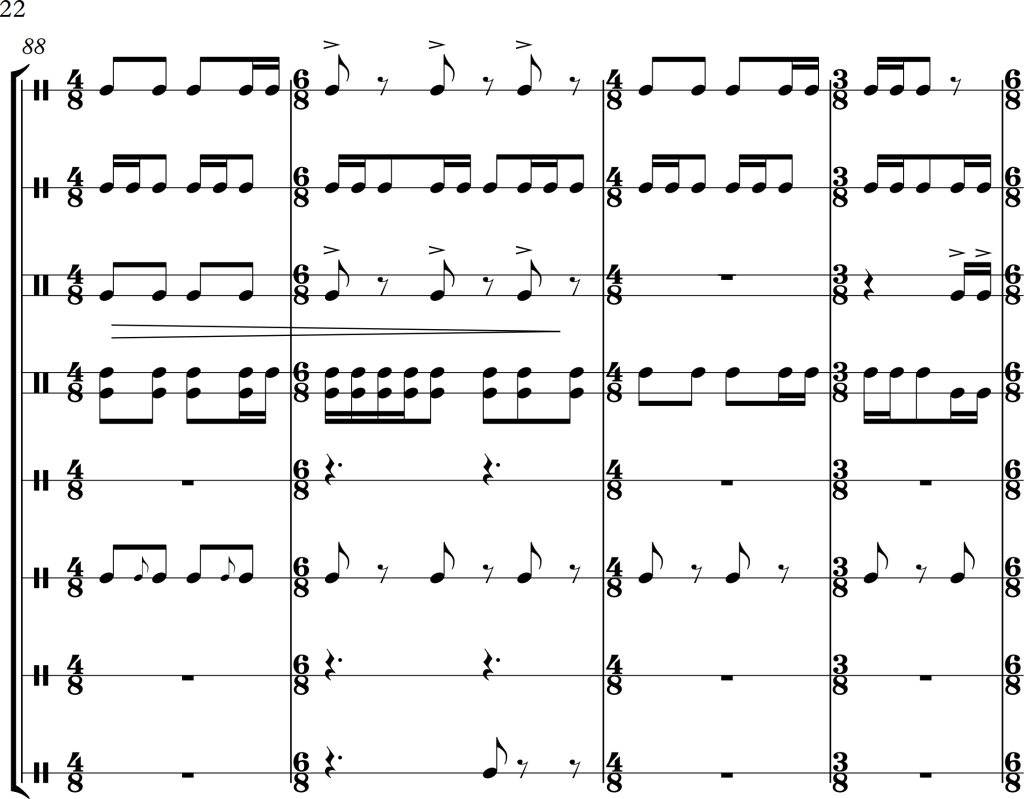
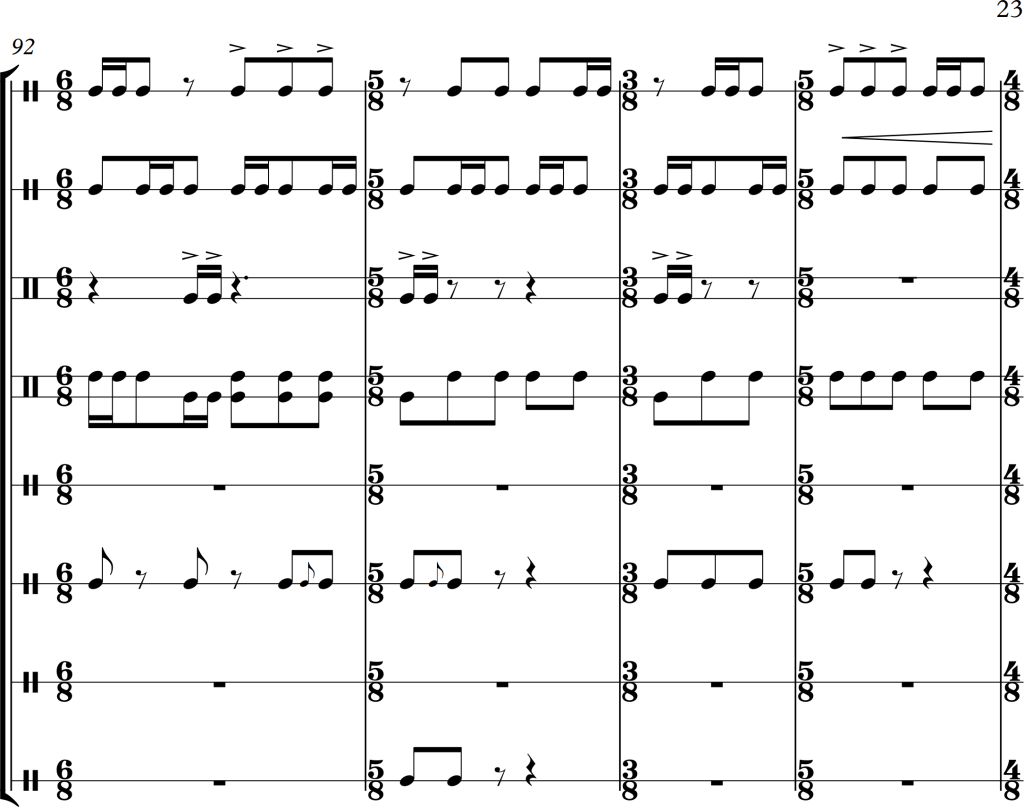
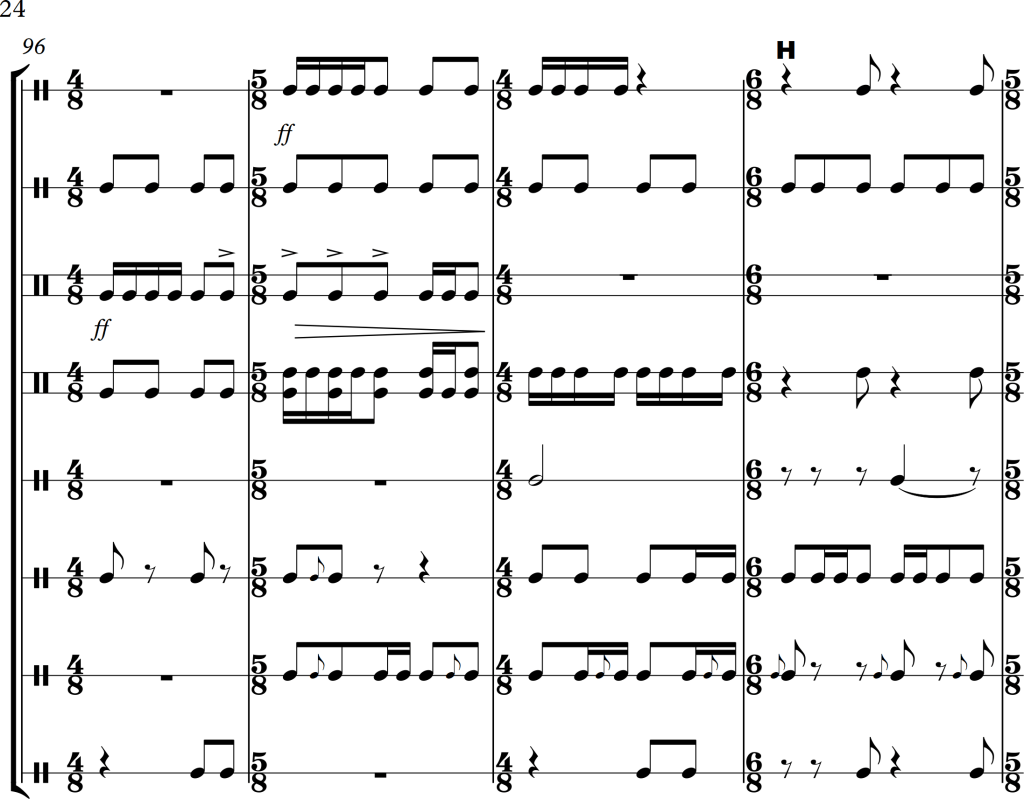
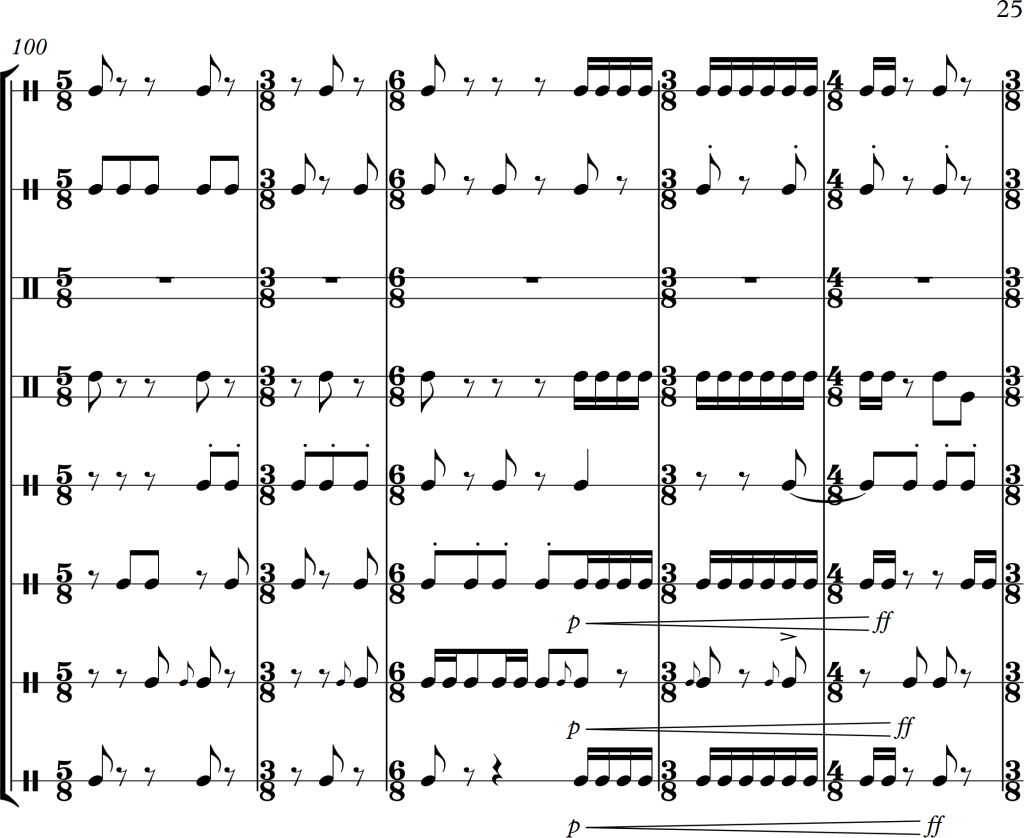
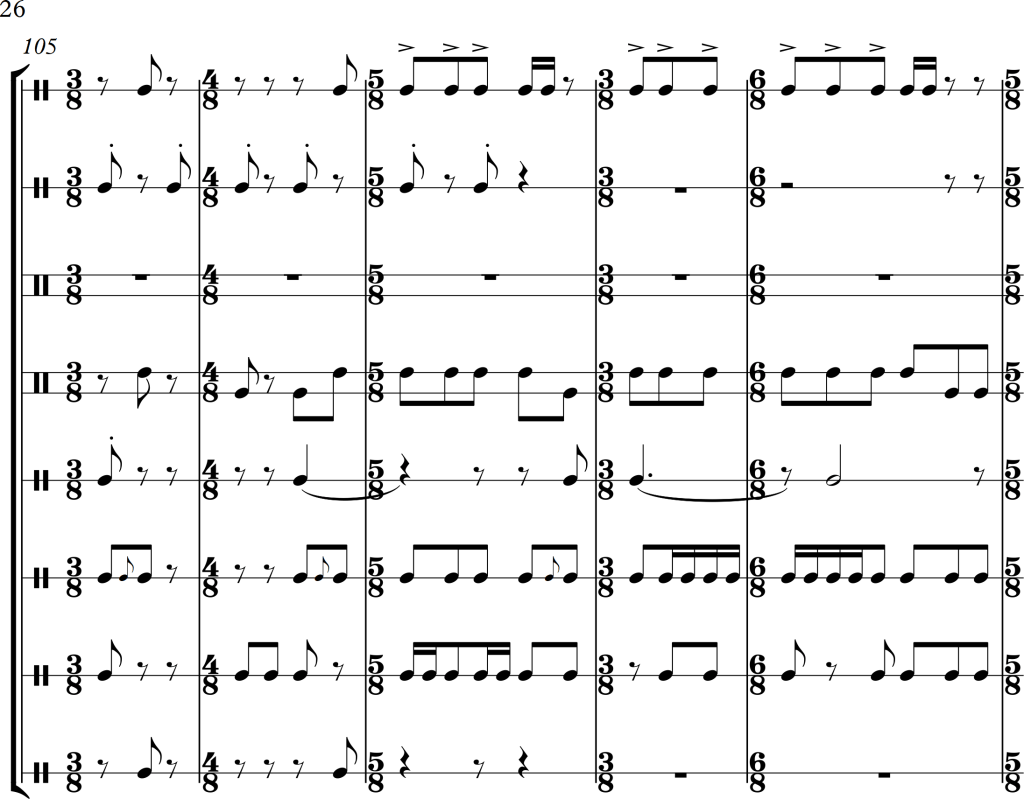
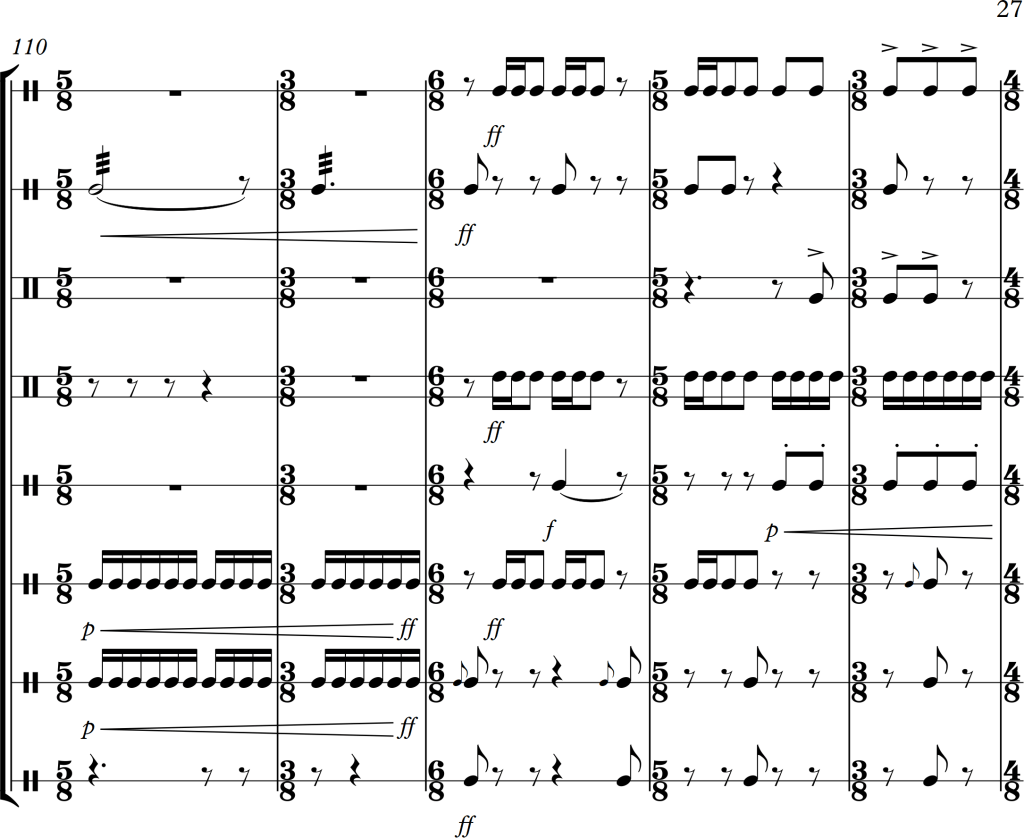
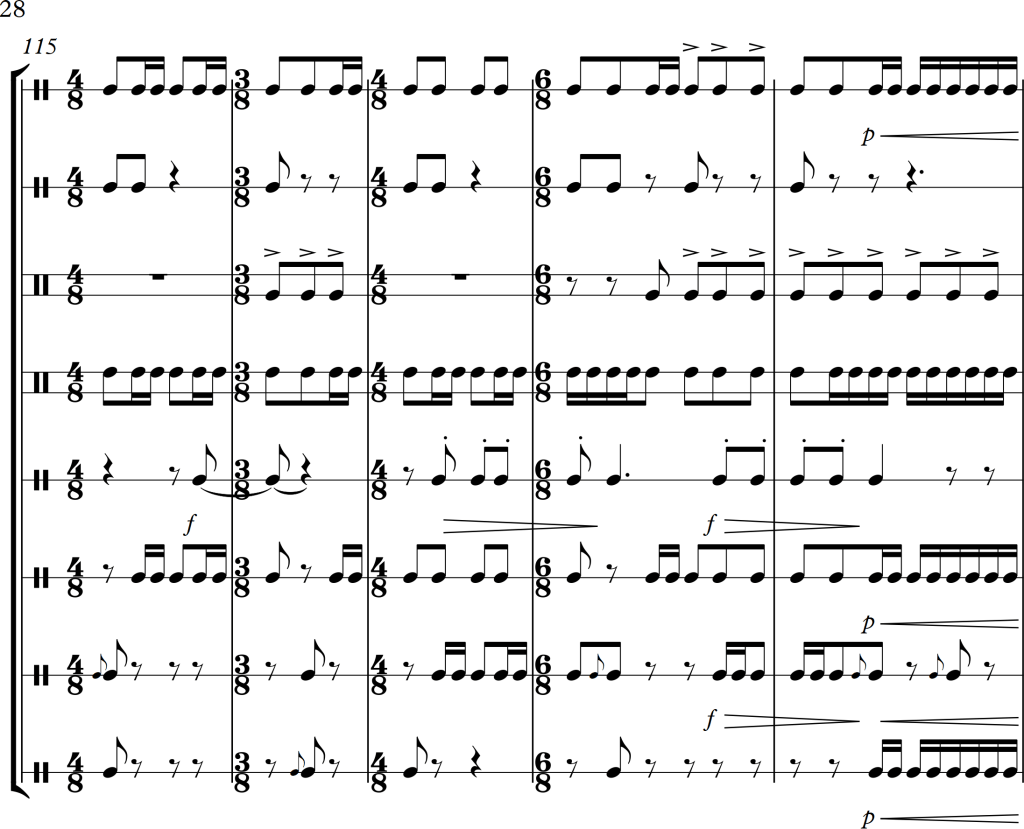
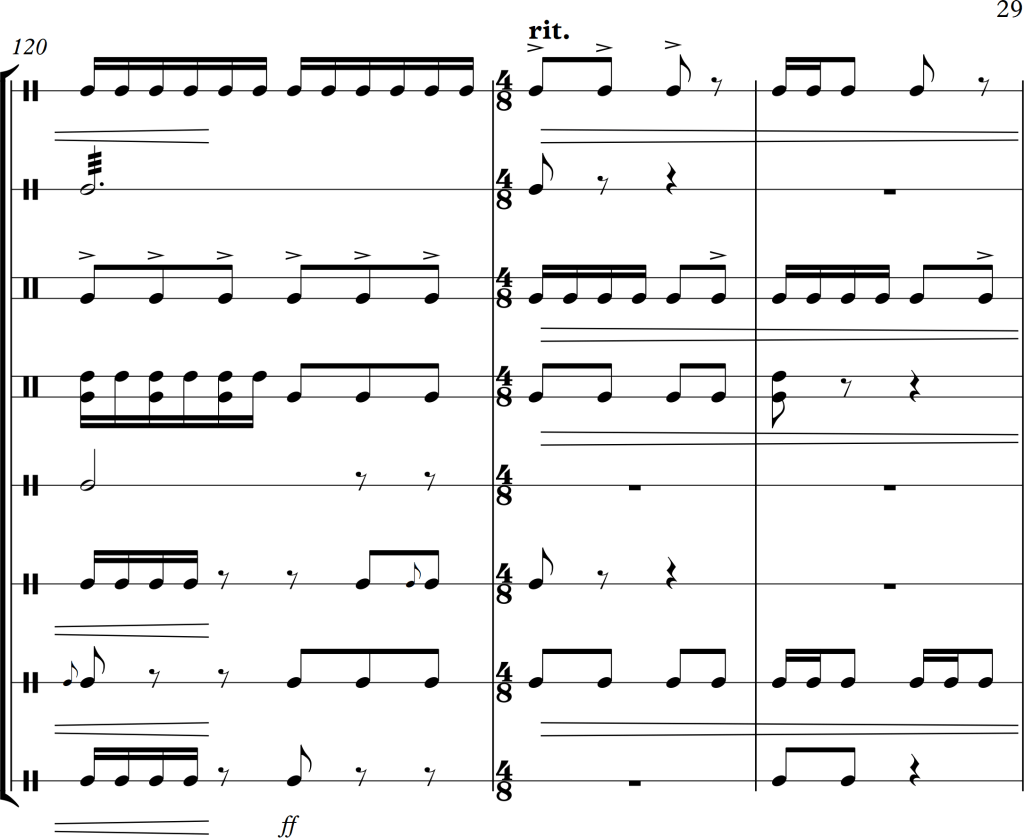
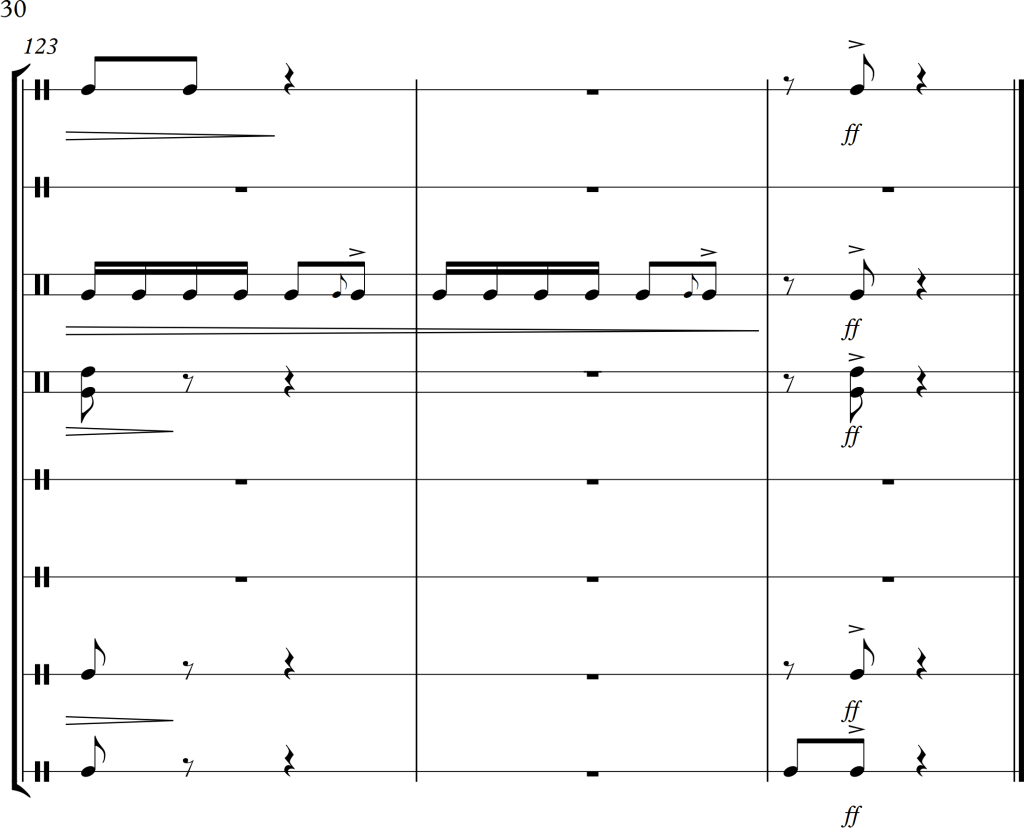
Reflection & structural development
I really enjoyed finishing this piece. It was longer then any of my previous pieces, which I had to write for projects, but due to the use of more instruments, I was able to develop the given musical ideas much more easy than I assumed. It took me a little bit longer than expected in the beginning to start working on it, especially because I tried to work out a mathematical pattern of the variable metre from the beginning of the piece.
Due to the fact that I only have worked instinctively on my compositions so far, not only on the ones for the course projects, but also for several other short pieces I wrote before I started this course, I really struggled with creating a structural design (which is part of project 4). When I eventually started writing the piece, I surprisingly found it incredibly helpful to have a rough plan of where to start and finish.
I initially wanted to write this piece in the suggested order, with which I would have started with the principal section (A+B), then continued with the principal reprise (B+A) being followed by writing the Subsidairy-part (C), which is placed in the middle of the two previous sections. Nevertheless, I ended up writing the piece from the beginning to the end.
Structural design
I started with developing the idea of the first part (A) until I moved onto a little side section (B), introducing several new instruments (which reflect two characters), (to find the plot attached to this piece please follow this link: Exercise: Compositional Plan ). The principal section, including motives A+B lasts until bar 37, where the subsidairy section (C) starts in a much slower pace. Except for the Cajon, I only used several chosen instruments for this part, which have a lighter sound than the instruments that were used for the introduction-theme. In bar 64, when the tempo starts to become faster again, some of the motives from the first part (A) can be heard, resulting on a come back of the first part. Played by the Castanets, some ideas from section C are repeated and combined with some motives from section A. Bars 80 – 98 reflect the child and the mother talking, whilst the child is transformed into a demon. The last part of the piece involves several motives repeating themselves . Near the end, one instrument at a time stops playing, leaving the Cajon only, resulting in one final tone played by all the instruments, except for the Shaker, Cymbals and Tambourine.
The piece includes 125 bars and takes about 2 minutes and 30 seconds.
Assignment 2
Composition for a solo woodwind instrument
The task for this assignment, is to compose a piece for a solo woodwind instrument of my choice, which should last for about 1,5 to two minutes.
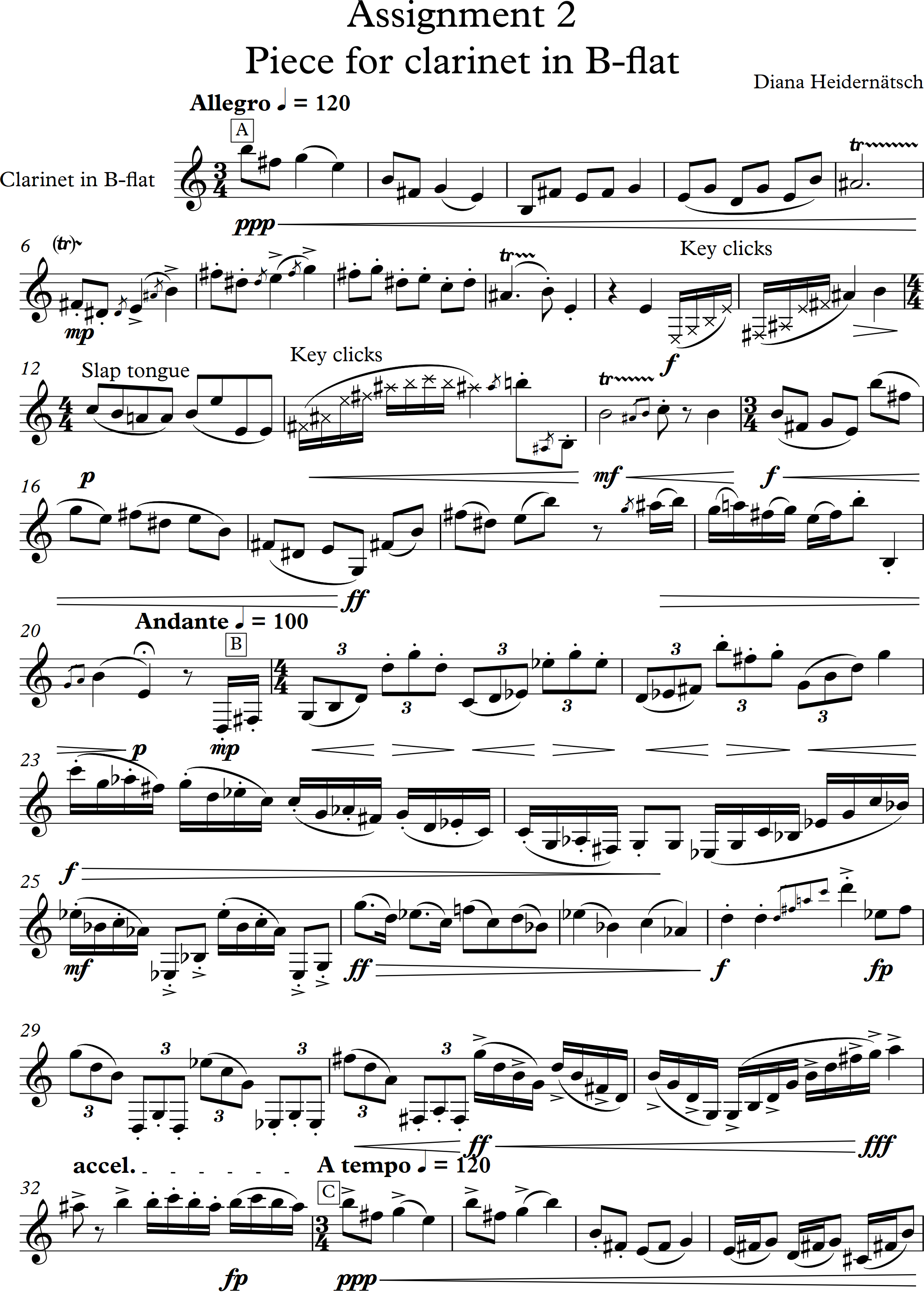
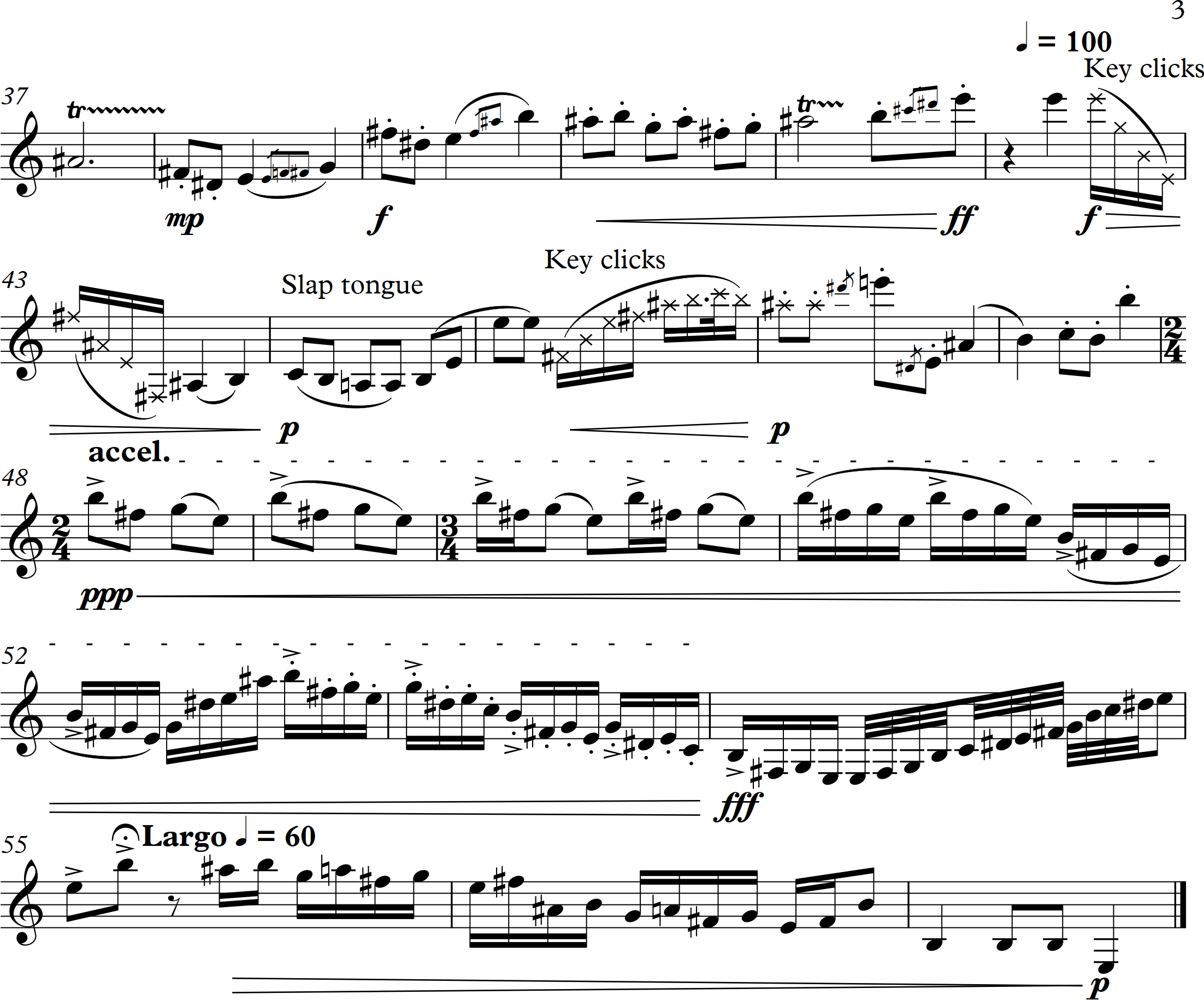
Compositional Plan
Seeing, that it really helped me with my first assignment, I was very happy to create a structural plan for this one as well.
First of all I started to look for an appropriate wood-wind instrument, and ended up using the clarinet for several reasons. I’ve worked with this instrument for former projects in this part of the course. Even though I had many more instruments to choose from, I stayed with the clarinet, simply because I personally like its interestingly warm colour of sound as well as the fact that it can change in dynamics very rapidly. I made a list of things which where possible to perform with the clarinet to be able to use its specific strengths in the composition :

I ended up not using all of those effects, but tried to include some of them to make the piece more interesting.
After that, I started with making a rough plan for the composition, by dividing it in three parts, giving each of them a time-signature, and idea of a tempo as well as a key signature, whereas part 1 and 3 are quite similar to one another. Trying to keep in mind, that the whole piece should only take up 1,5 to 2 minutes, I tried to give every section around 30 seconds. From the scales I had to work with in project 7, the east-European-minor scale was my personal favourite. I therefore used it as my main scale.
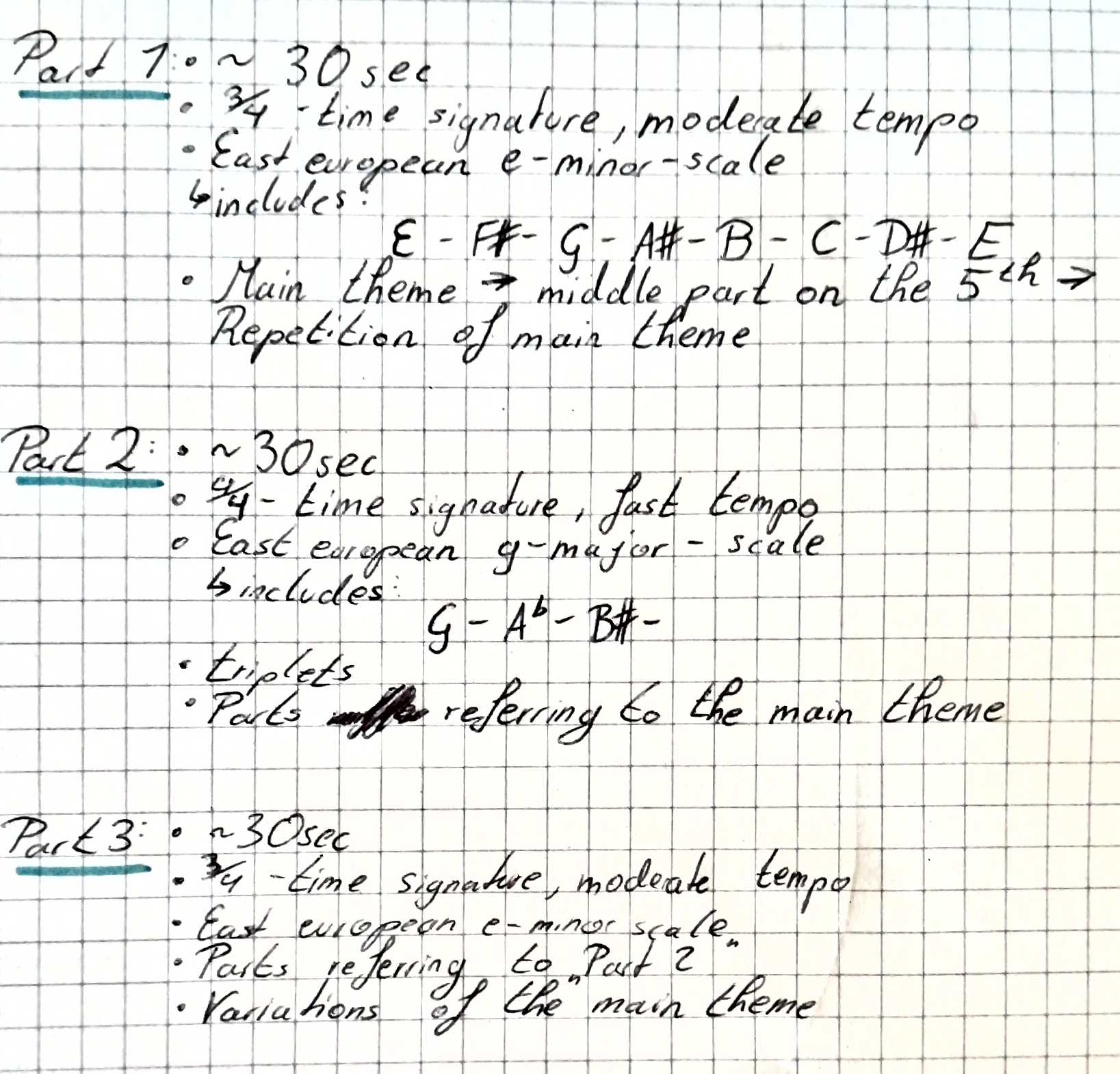
When I came to the end of the composition, several things where different than originally planned, nevertheless, I found it very useful to have a rough sketch to stick to, from where I could develop my ideas.
Reflection on composing Piece for Clarinet in B-flat
By looking at the task for this assignment, before starting the second part of this course, I would have not thought, that it was possible to create an interesting piece with a memorial theme for just one single instrument. One thing that really proofed me wrong , and therefore also the thing I found most useful in this part of the course, was Project 6, the analysis of solo woodwind-instrument pieces. To practice writing some short pieces myself for project 7, whereas some of them actually ended up being quite long was a great help as well. I found it furthermore quite interesting to make listening log entries on pieces, which only have one instrument playing. Another thing I have to mention at this point is that, even though I had the opportunity to explore other techniques on how to use a woodwind instrument, I wanted to keep the piece simple, due to personal preferences.
By writing the structural plan for the assignment, I tried to use an idea from Malcolm Arnolds “Fantasy for clarinet op.87”, which I wrote about in project 6. This “idea” mainly involves the use of a strong main theme, which is being repeated in varied ways, and accompanied by a contrasting motive.
The piece itself can be divided in 3 main parts, labeled from A to C, which can be separated in even smaller parts :
Part A
Part A starts with presenting the main theme in a 3/4 – time signature , followed by a short side-part in a different time signature (4/4) until a variation of the main theme is being played again. I used the east-european minor scale, as it was my personal favourite when I had to work with it for project 7.
Part B
In this part I tried to make a contrast, by using a different scale (east-european-major), time signature (4/4) and tempo. Nevertheless, I tried to stick to the main theme by setting “reminders” in the middle and the end of the section.
Part C
Having come back to a 3/4- time signature, I started with a variation of the main theme, again with the side part from Part A, maintaining the same time signature (3/4) this time. I still changed it once to 2/4, to help increasing the speed to come to a climax, which is fast played with an increased volume. The composition ends, as it started, really quietly.
The composition itself takes around 1 minute and 50 seconds.
As already mentioned, I found it quite helpful to have a structural plan. What I didn’t have from the very beginning though was a good motive. I tried two other ideas before I came to the end result, which I found, after having listened to them several times, rather boring. One thing that really helped me being objective with those themes, was taking a short break to let my mind wander off a bit and then listening to it with a clear head again. This doesn’t only apply to the main theme of the piece, but also helped me throughout the whole composition. Especially at the end when I had listened to it several times, I still made some big changes and adjustments, to keep the piece interesting. I will try to use that “mind-break” to listen to it for future compositions as well.
All in all, I really enjoyed working on this part of the course, especially because I already knew from my former musical-education some things that where included and found it therefore easier to understand, follow and work on different tasks (The analysis for Project 6, for example). But I also learned and practiced some new things, from which I wouldn’t have thought I would be able to do them. An example for that would be the task for project 7; to write 9 different pieces, all of them differently for nine different scales. When I started this project I had a fear of running out of ideas, but finished the task much quicker than I would have thought, with having written some of the pieces quite long, a thing I was amazed about.
Assignment 3
A little polyphony
Reflection on”A little polyphony”
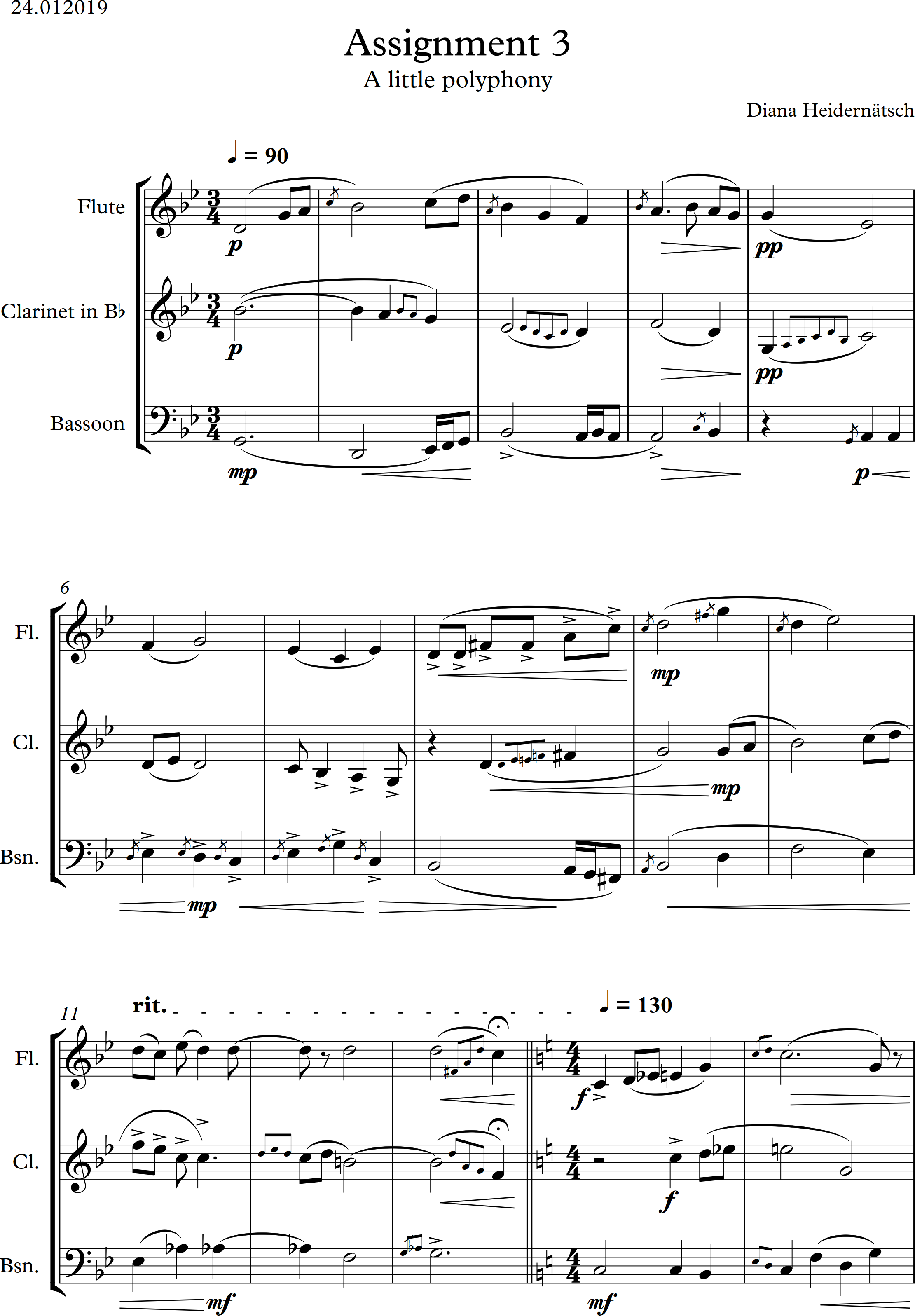
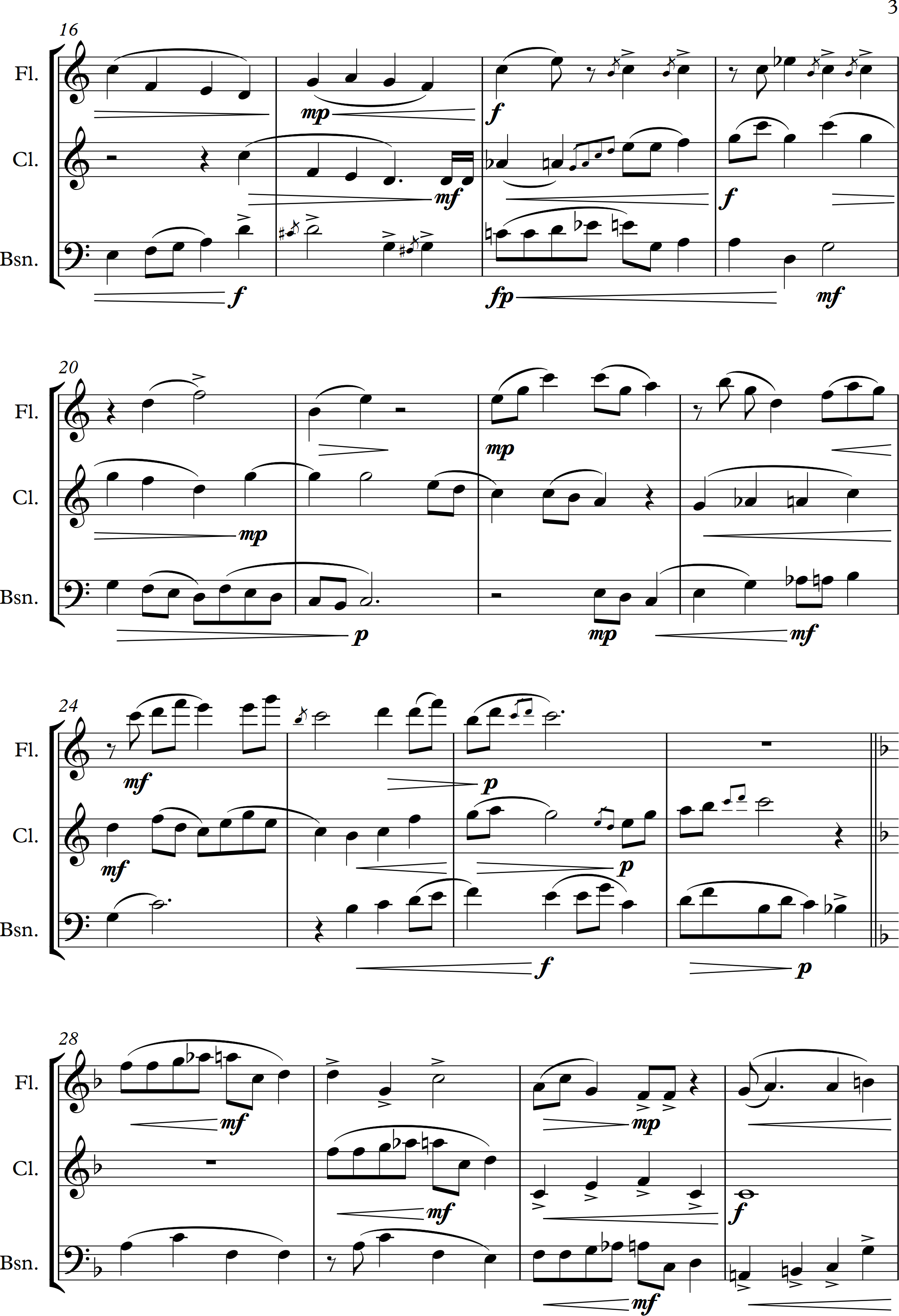
For this assignment I was asked to write a polyphonic piece for three woodwind instruments with a duration of around 2 minutes. Even though I was provided with a plan of how to create a rough surrounding texture for the piece ( by placing several triads in advance) , I really struggled to find a good start.
Quite interestingly I didn’t have a problem with finding a beginning for project 10, even though the tasks where similar. I ended up having to restart around 3 times, before I was feeling confident with the first few lines I wrote.
The triads I had in mind for “A little polyphony”, which surprisingly stayed the same until I finished writing, were the following :

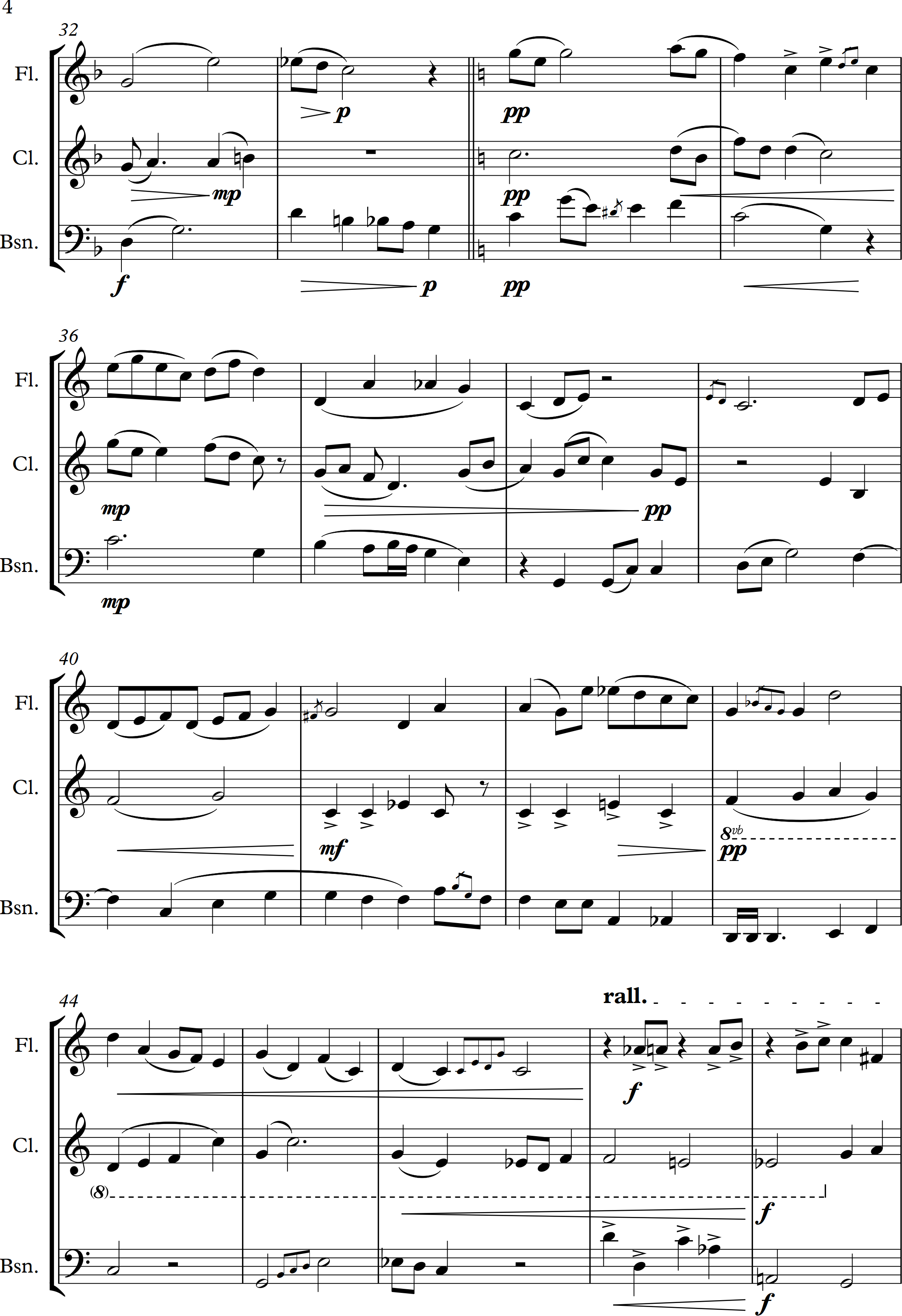
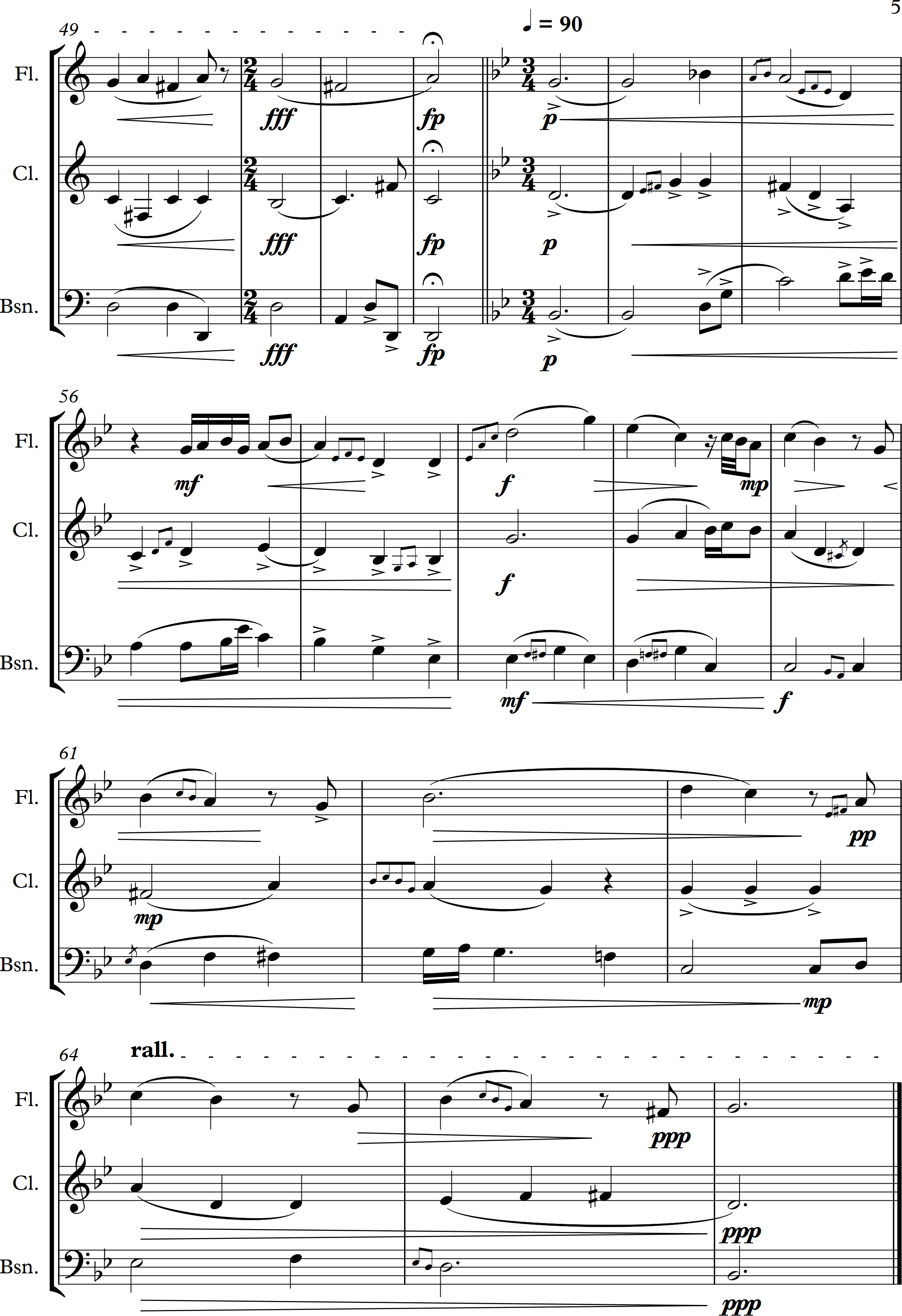
Even though nothing is repeated in the exact same way, one can still find a A-B-C-B’-A’ -form, which is quite similar to a rondo form. One can distinguish between these parts by looking at the key signature, whereas A= G-minor, B= C-major and C= F-major.
I initially only had the first three parts A, B and C, and still about 30 seconds out of the two minutes left to fill. Seeing that the first three parts where quite a contrary to one another, I decided to continue with some familiar themes to give the piece a bit more memorability. Therefore I retrograded part B to form part B’, I furthermore swapped the instruments and voices around, which makes this part of the piece sound new and familiar at the same time. Part A’ is basically a completely new theme, the only thing that this part has in common with part A is the key signature, time signature and the slow pace.
The transitions between the A and B -parts I found particularly difficult to manage. I used the piano as a help by playing the bars which connect the parts A and B several times, always with a different sequence of triads in between until I found one which I felt confident with.
Overall, I really enjoyed working on this piece. I found it was the most challenging assignment so far, but the projects in part 3 where a good way for me to be prepared for it. Especially helpful were Project 9 : Descants as well as Project 10 : A contrapunctal trial.
Assignment 4
Fugue for three
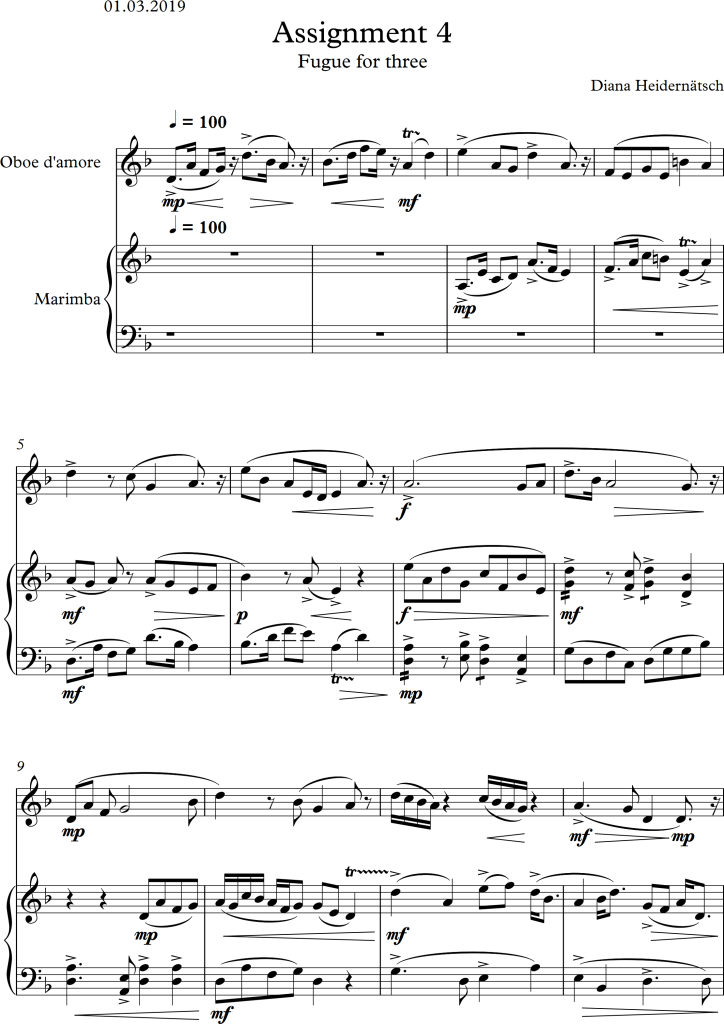
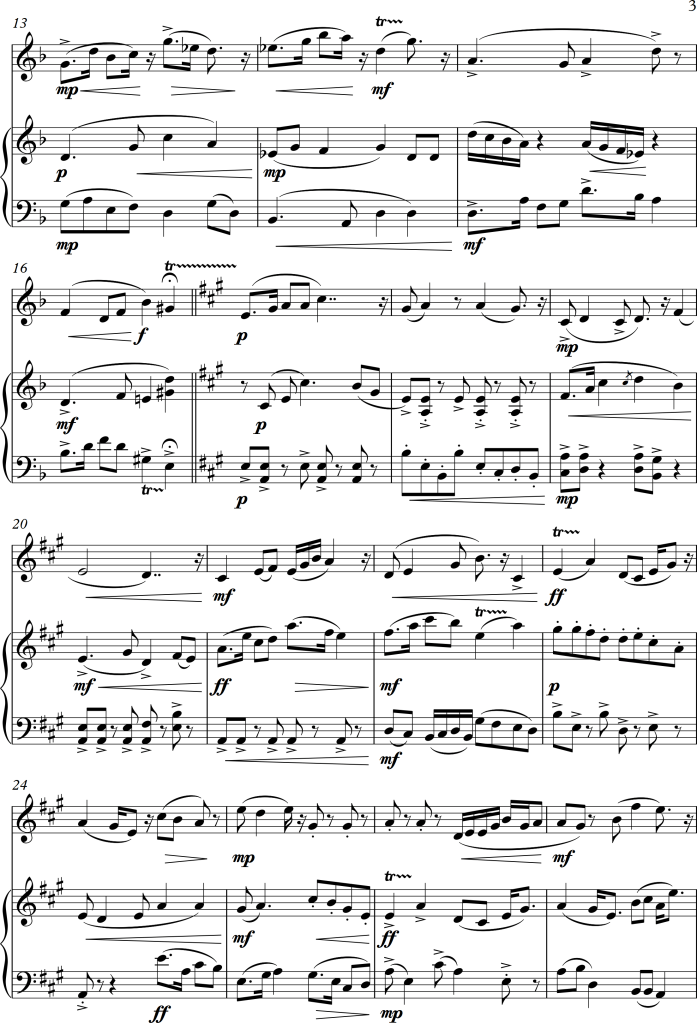
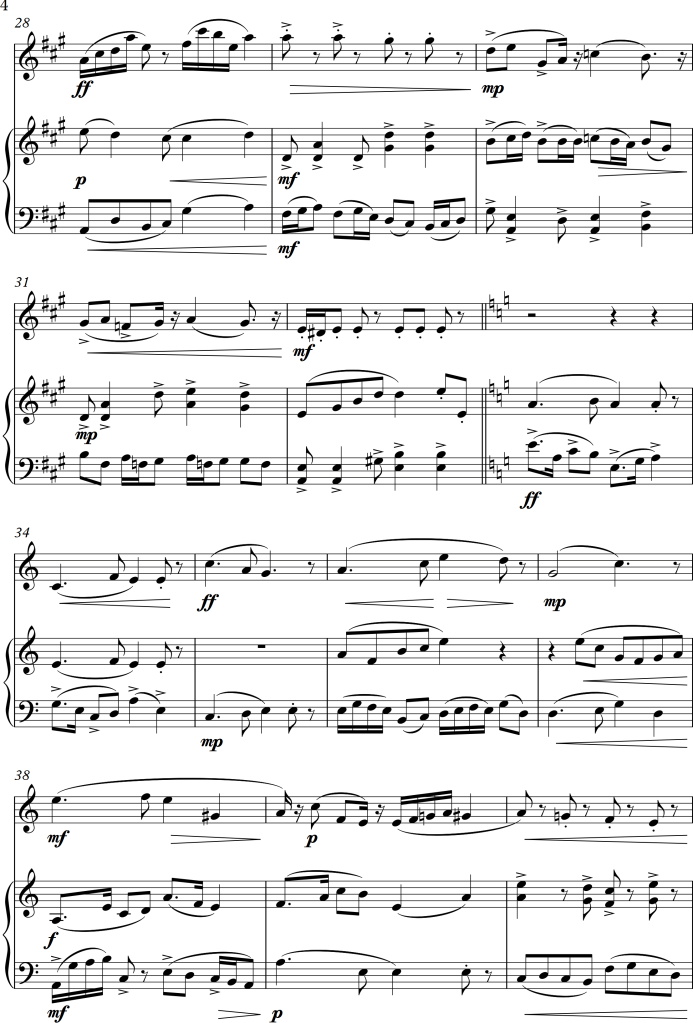
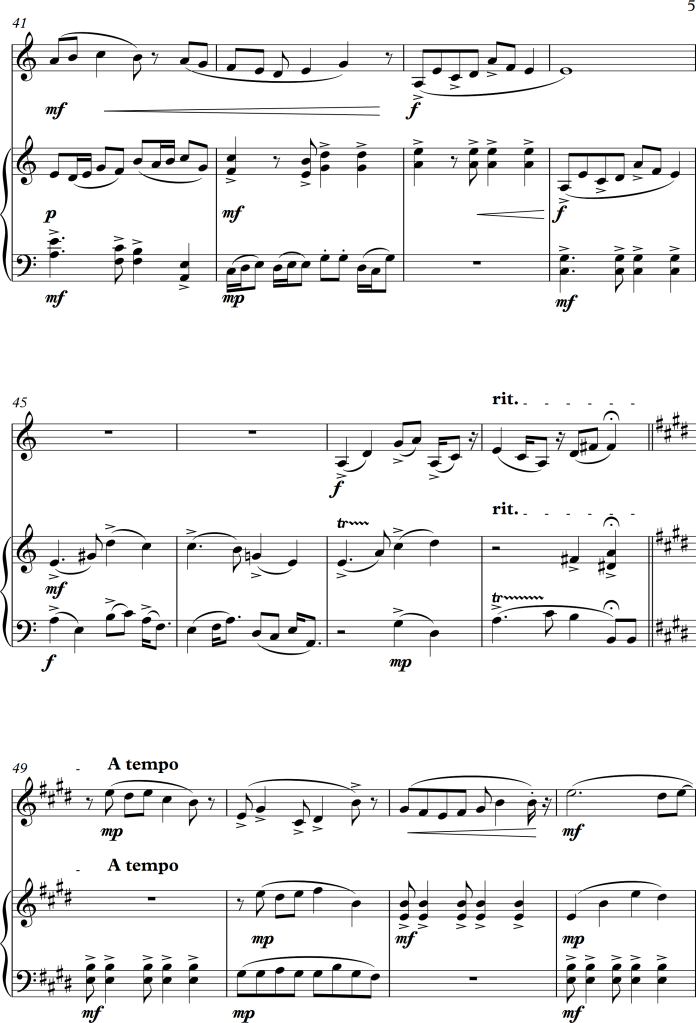
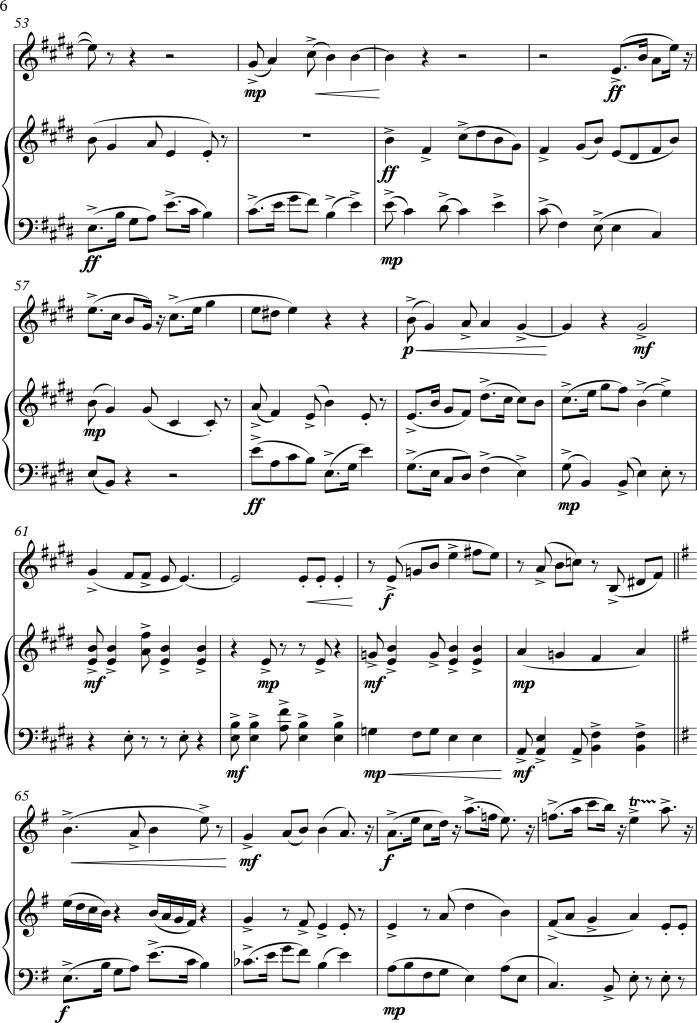
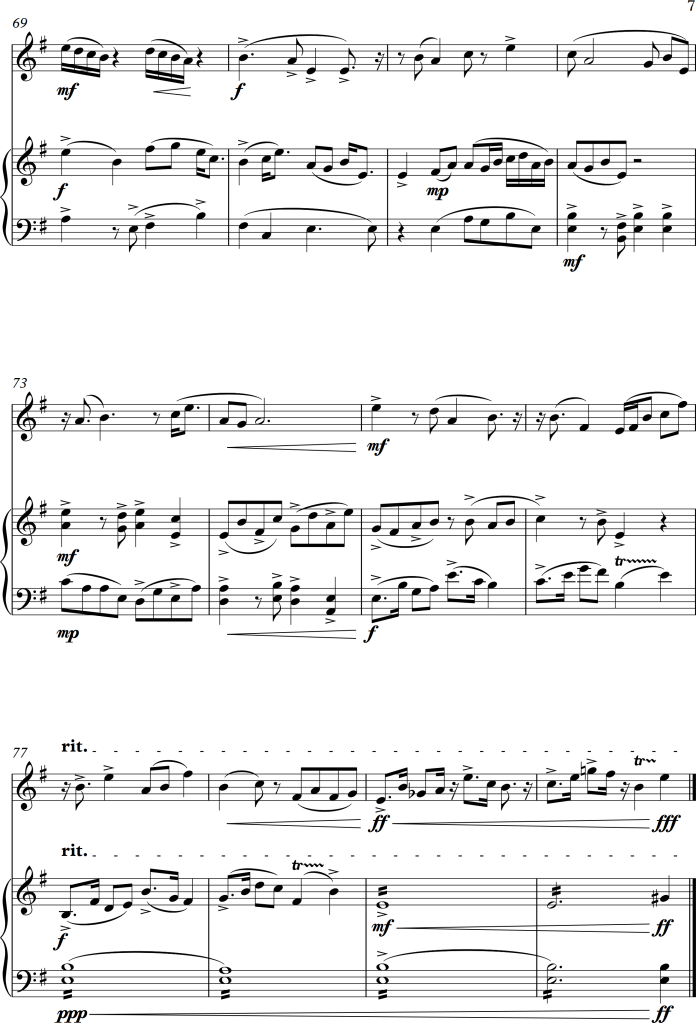
Reflection and compositional plan on ” Fugue for three”
Similar to the third assignments, I had difficulties getting started. After having made the decision of writing a fugue with the structure of a tango I started thinking about the main theme I would be using for the piece. Throughout the process of writing this short motive I realized, that after having worked this theme for roughly half a week, I myself actually was not too pleased with what I could hear, so I decided to start from the beginning again with a new theme.
As already mentioned in my research point “Structure of a tango (Assignment 4)” , most tangos have an “A-B-A’-C-A” form. Throughout the process of writing this piece it ended up being more or less a “A-B-C-D-A” – form, although the sections A and C do have the connection of being written in a minor key, whereas sections B and D are written in a major key. I have given the last section the letter “A” due to the whole section begin a reversed version of the first “A”-section. Ever bar of the last section is played as a retrograde, except for the ones that involve the main theme, the rhythm (explained in the 5th paragraph below) and a slight variation in the very last two bars of the piece.
The tango structure also gave me a good basic construct to start from. In the already mentioned research point I also explain why the A-B-A-C-A form is written in 80 bars, having exactly 16 bars for each section.
In terms of the key signatures I started on D-minor, working my way over the next ones always using the same structure : Minor – Dominant 5th in Major – Minor of the same note . Starting on D-minor I therefore had the order : D-minor, A – major, A-minor, E -major, E-minor.
For the rhythm I first had a look at typical tango rhythms, which are usually either :

or:

I decided to use both of them, the first one in the minor sections and the second one in the major sections. I used them by always (with a few exceptions) giving at least one voice one of the rhythms, suitable to the section and always with different pitches.
According to this part of the course, this piece should be about focusing on the counterpoint mainly. For this fugue I therefore always used a different counterpoint, to keep the variety high. (Usually a fugue has either different counterpoints throughout, or always the same.) Whilst writing the counterpoint I tried to mostly keep the intervals to the voice playing the main theme (or towards the rhythm) either perfect ( 4th, 5th or 8ve) or at least non-dissonant ones (3rd and 6th). Here I had to make some exceptions as well, mainly to be able to construct dominant sept-chords, but on a few occasions also to keep the sound of the piece interesting. Furthermore, I purposely did not include a climax in the middle parts of the piece, first of all, to keep it “flowing”, but also to keep it similar to Bach’s – Fugue in d-minor BWV 851, which was my very first introduction to fugues. Similar to Bach’s piece, I built up tension, by using a basso continuo* for the last for bars, and then finished with an E-major chord,
As already mentioned in my research point about the Fugue , the structure of it involves sections of the theme being played in different ways, and “episodes”, which are parts not involving the theme. The episodes of my piece usually have a length of four bars and often involve the according rhythm played by one voice of the marimba in an 5th interval.
I worked the theme in different ways 27 times throughout the fugue, in the following chart one can see, where, in which form I used it and what the starting note is.
| Bar | Oboe | Marimba I | Marimba II |
| 1 | Normal, D | ||
| 3 | Normal, A | ||
| 5 | Normal, D | ||
| 11 | Retrograde, D | ||
| 13 | Normal, G | ||
| 15 | Normal, D | ||
| 21 | Normal, A | ||
| 23 | Retrograde-Inversion, E | ||
| 24 | Inversion, E | ||
| 26 | Retrograde-inversion, E | ||
| 28 | Diminished variation, A | ||
| 33 | Inversion, E | ||
| 34 | Augmented variation,C | ||
| 38 | |||
| 45 | Retrograde, A | ||
| 47 | Retrograde-inversion,A | ||
| 53 | Normal, E | ||
| 55 | Retrograde, D | ||
| 56 | Variation, E | ||
| 58 | Inversion, E | ||
| 59 | Normal variation, E | ||
| 65 | Normal, E | ||
| 67 | Normal, A | ||
| 69 | Retrograde, E | ||
| 75 | Normal, E | ||
| 77 | Normal variation, B | ||
| 79 | Normal variation, E |
Initially, I wanted the marimba to be played with medium yarn-mallets, unfortunately the software Sibelius, which I use to write my pieces, only has the ability to make the marimba sound as if it were played with hard ones. I would have made a note saying, that the piece sounds different than initiated, but throughout writing it I realized, that had yarn mallets might be more suitable .
The choice of instruments was not too difficult. Due to me really liking the biting, strong sound of the oboe, especially the low notes, I chose the french version (oboe d’amore), which has a lower pitched range than the normal one. The marimba I chose due to the warm sound it can produce when being played on lower sounds. It also gave me the possibility to give the fugue three different voices, and create chords, when being played with two mallets in each hand.
Overall I felt really challenged writing this piece, even though I had with the structural mixture of a fugue and a tango a strong basic construct to start on. Like for my third assignment, the hardest part for me was to find an appropriate start, in this case a theme, which I’d be able to use in different ways. I nevertheless, really enjoyed working on the piece once I got started.
Assignment 5
Classical Jazz
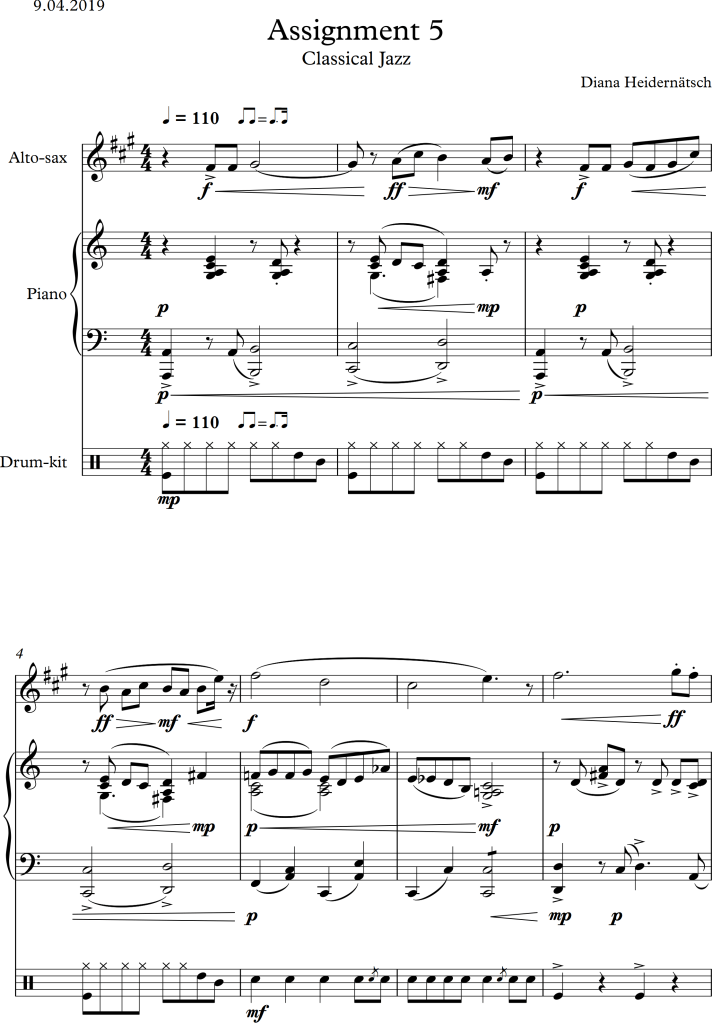
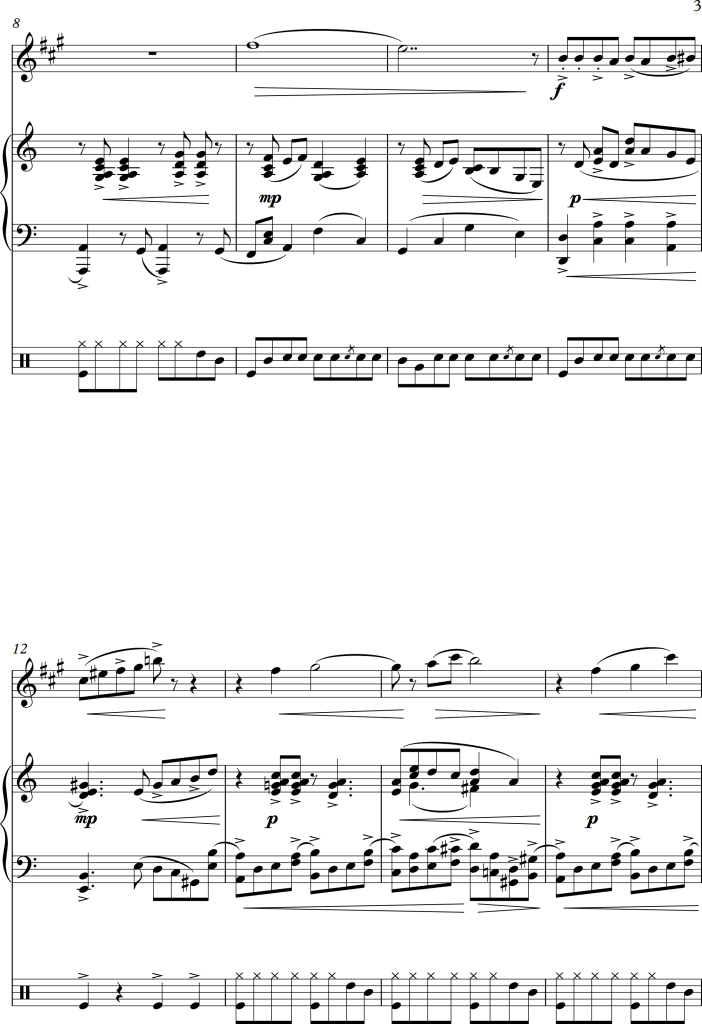
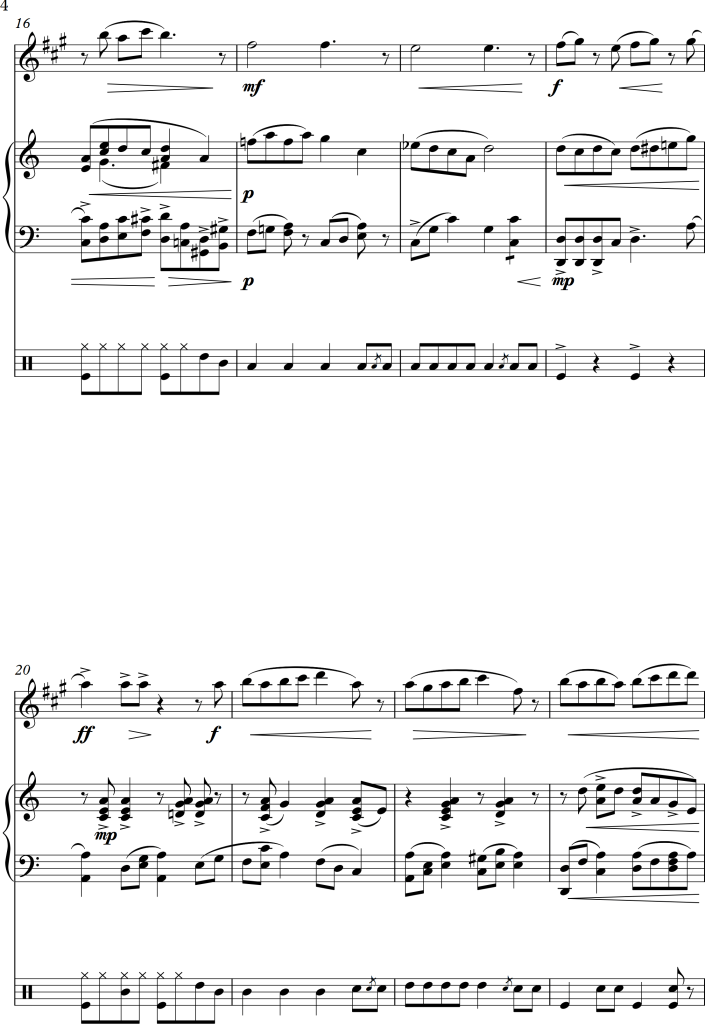
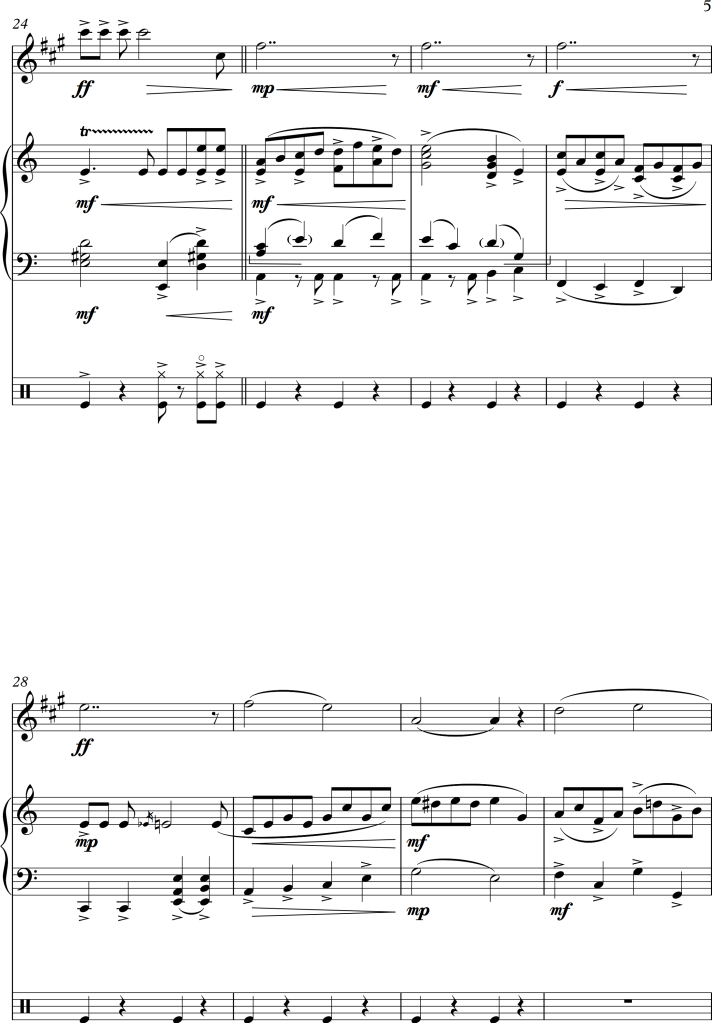
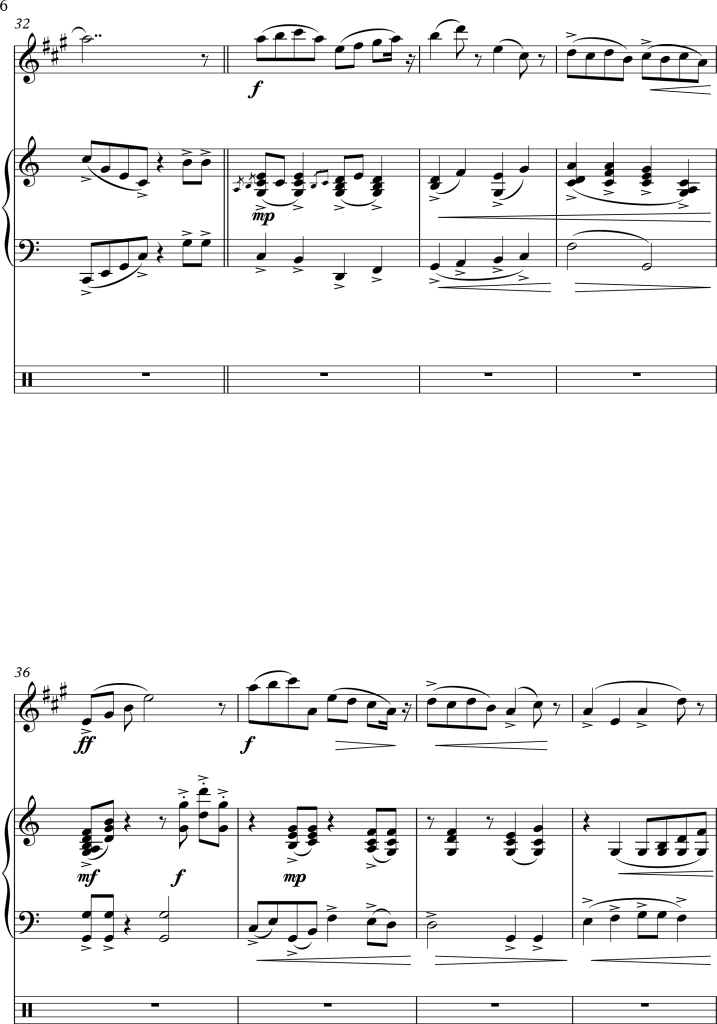
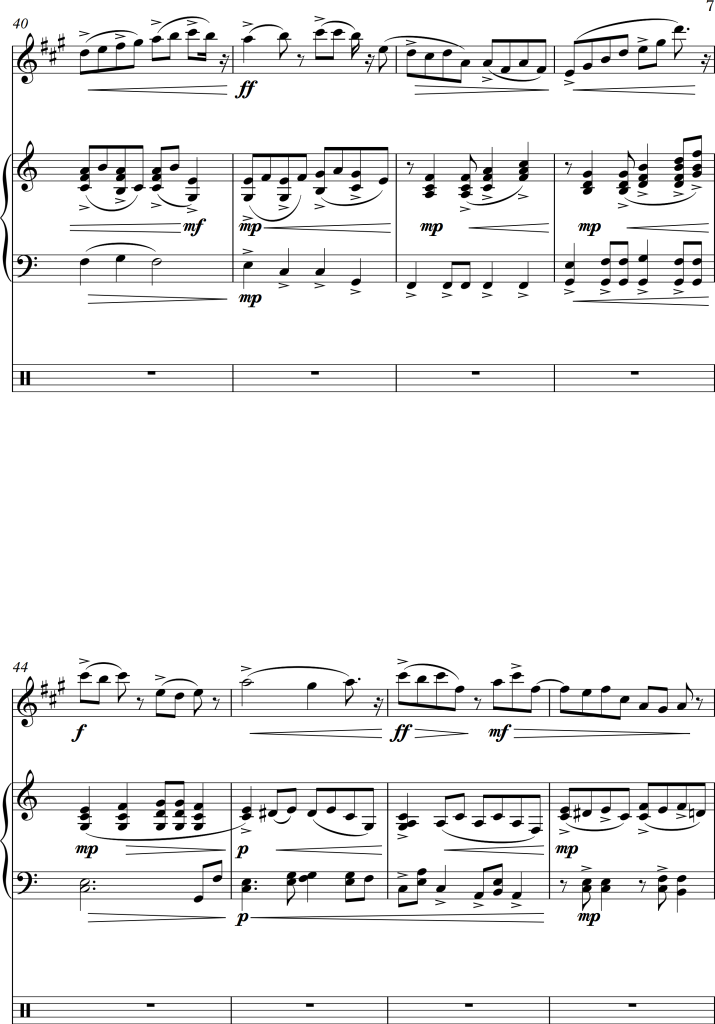
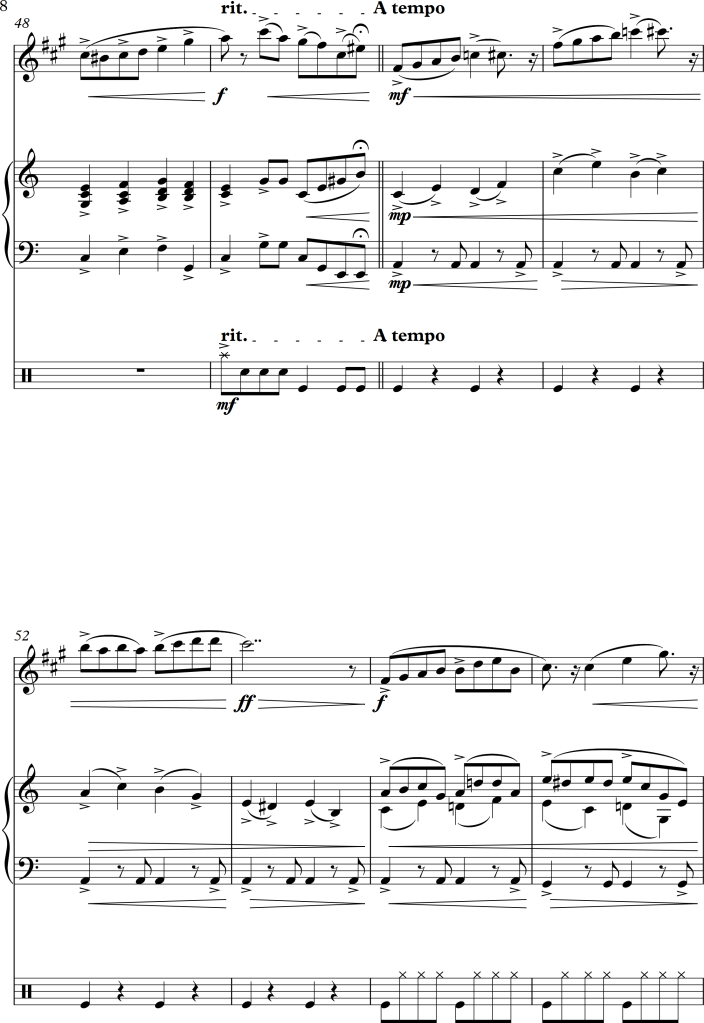
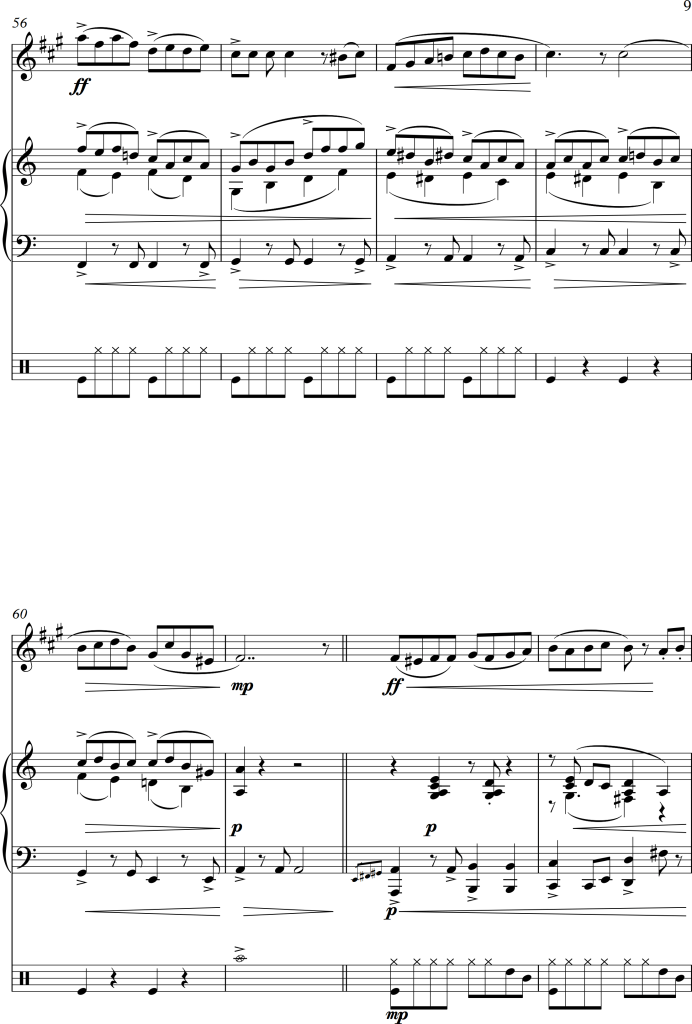
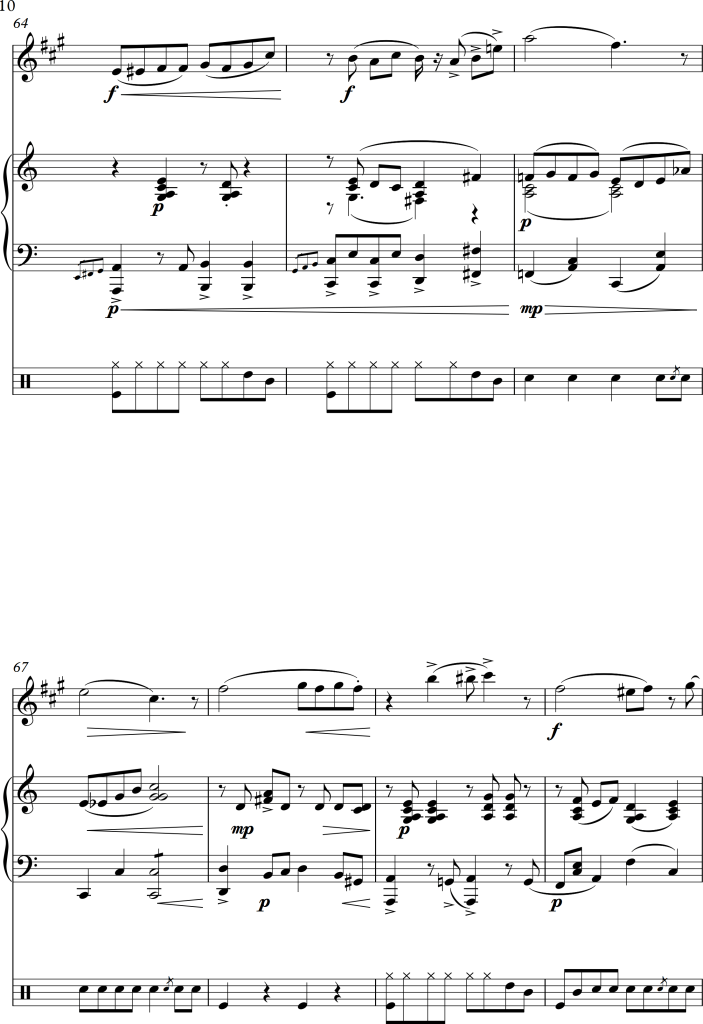
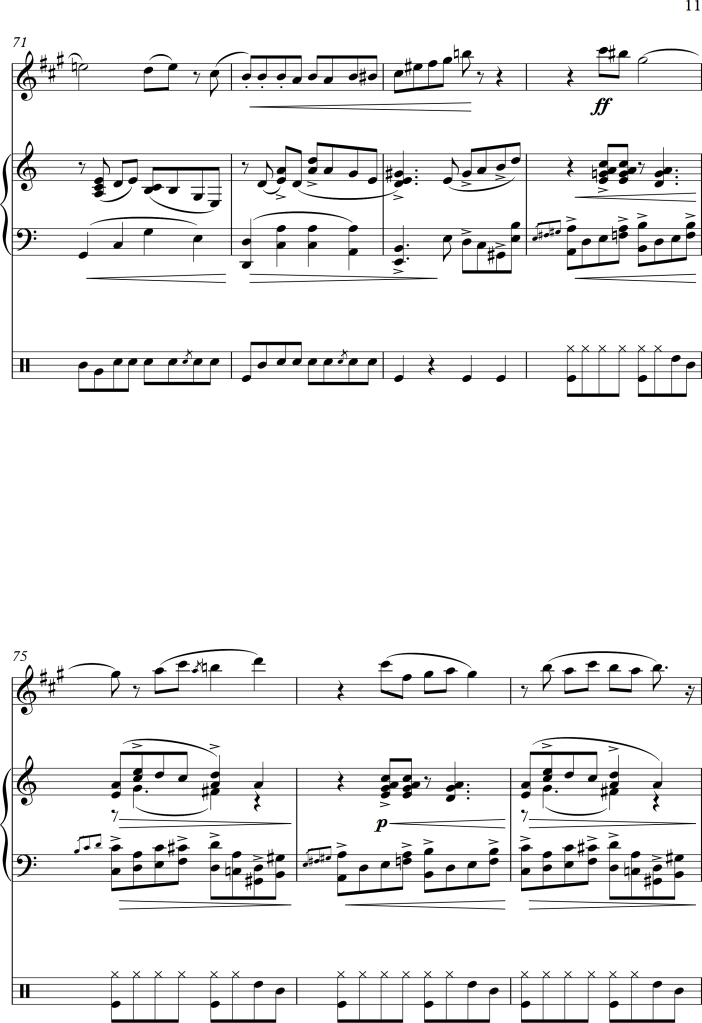
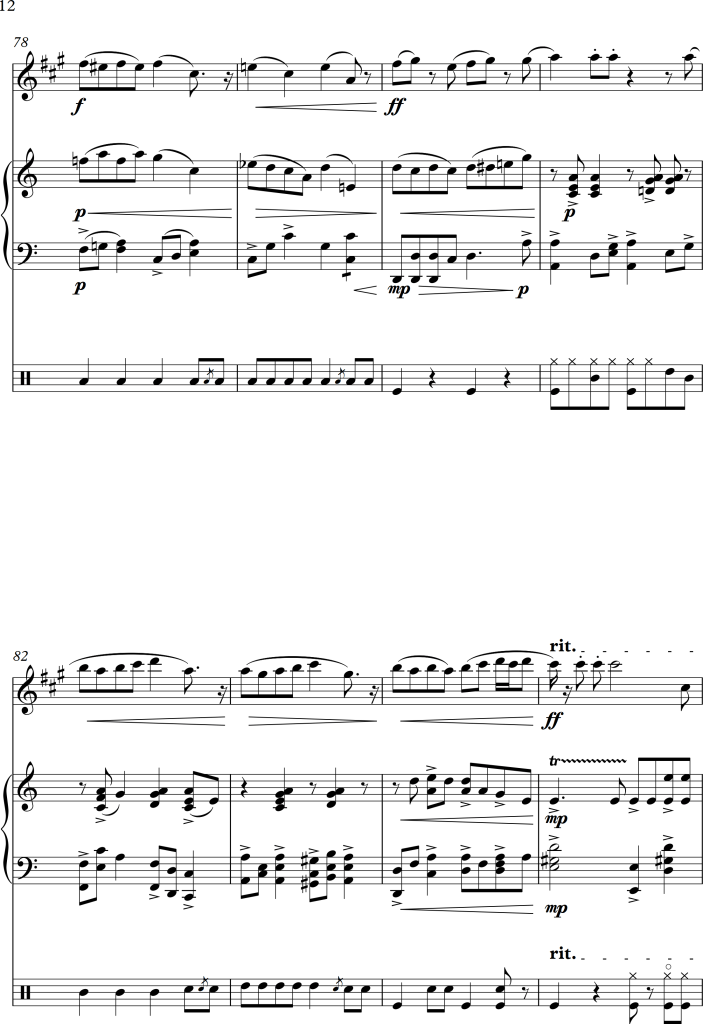
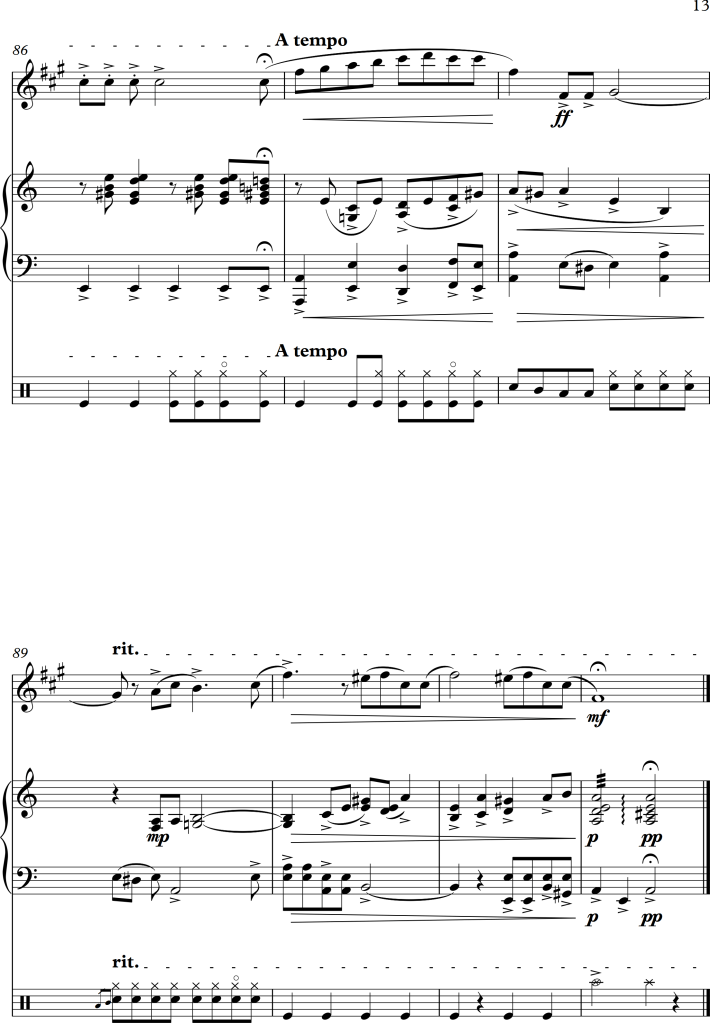
Compositional plan and reflection on “Classical Jazz”
For this assignment, I was asked to compose a piece, which should last for about three minutes and include the “Cyclic chord progression” at least four times. I was encouraged to work with a keyboard and other instruments I’ve used before, woodwinds and untuned percussion.
I was looking forward to be working with a piano, given that it is my main instrument. Initially, I decided to go for just the piano and the saxophone, but after I was about halfway through the piece, I added a drum kit as well, which is mainly just working in the background.
With the previous two Assignments, I struggled a bit, trying to find a start. Nevertheless, I also realised, that especially the piano often helped me to get over difficult passages, where I didn’t know how to continue a piece, or connect two parts of one. In order to find a good start for this last Assignment of the course, I therefore decided to improvise a short theme on the piano, which I then wrote down and continued to write electronically with Sibelius.
This first theme was only the first four bars of the piano-part, the following eight bars (bars 5-12) I continued with Sibelius, creating a small “B-theme” within the first part of the piece. Those 12 bars I repeated in a varied way, using a seventh chord on the dominant E at the end, to fill my first cyclic chord progression.
As already mentioned, I was asked to make the piece last for around three minutes. Having set the pace in with I wanted the piece to be in, I tried to find out how much time, or how many bars I would need to fill this length. I did this by checking the duration of the first part I already had, which was around 50 seconds. My initial plan was,to write the piece in an A-B-A’ – form, having short passages between the parts, which would help to change the key signature. Having put the first part A at the end again (with a few extra seconds in case I would include a ritardando or a few extra bars), I had roughly 70 seconds for the centered “B” – part. Within the process of writing the piece though, I decided to make the passages between the parts a bit longer (about 20 seconds on each side of the middle part), which turned the form to “A-B-C-B’-A'” instead, and left me with 30 seconds to fill on the middle section.
I usually tend to go for key signatures, which have at least 1 flat or sharp, in this case though, given that I started on the piano, looking for the most uncomplicated way, I decided to stick with a-minor. In terms of the instruments, I only added the saxophone after having finished part A. I wasn’t quite sure initially, whether I would have liked something on top of the voice of the piano, but I was able to alternate those two voices most of the time. The drum-kit I only added really late, and only to be played in the background. The title of the piece “Classical Jazz”, came to my mind due to the middle-section being in a bit of a “Mozart-Stlye”, for this part I also paused the drum- kid, so that only the piano and the saxophone could be heard.
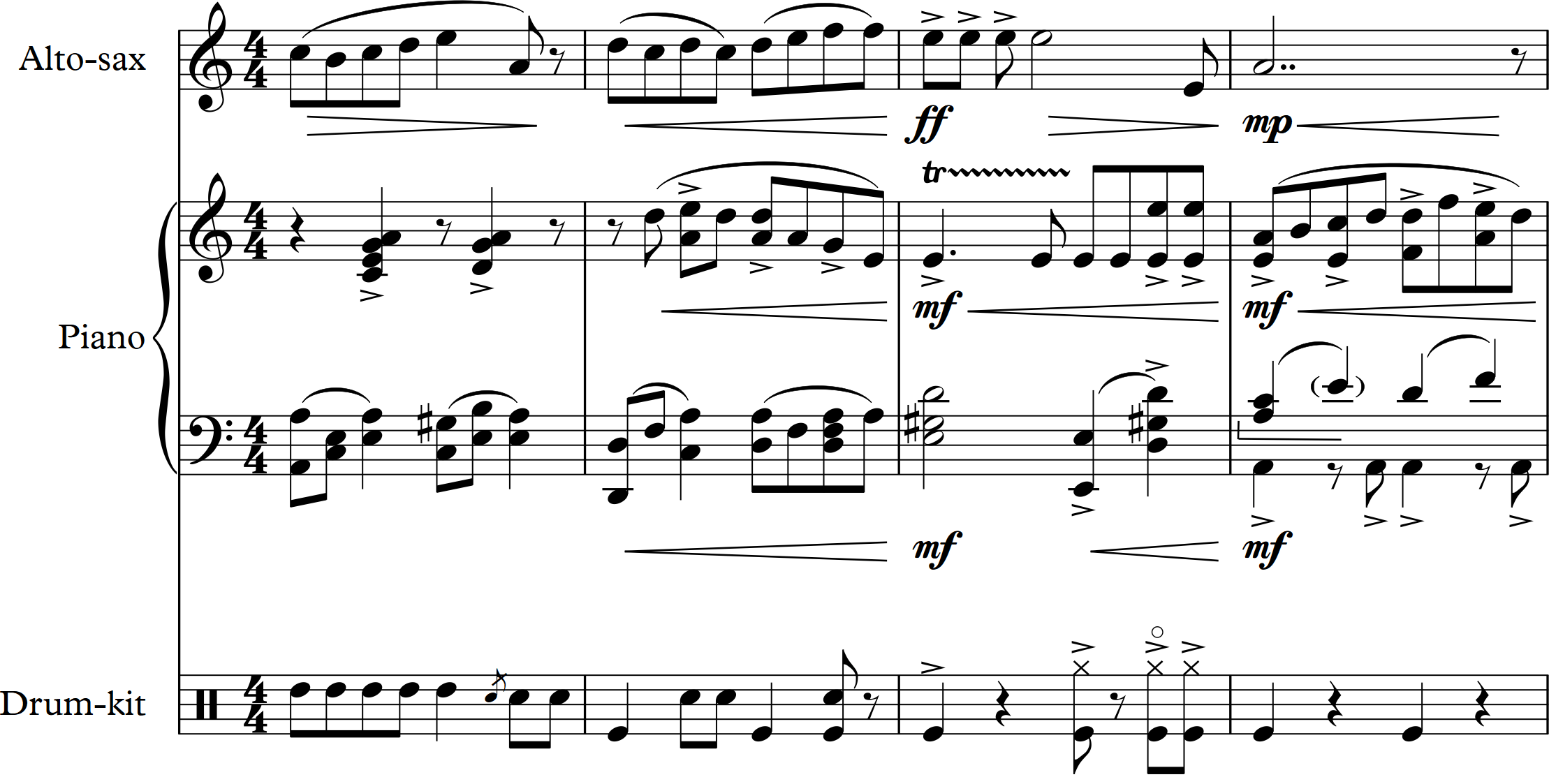
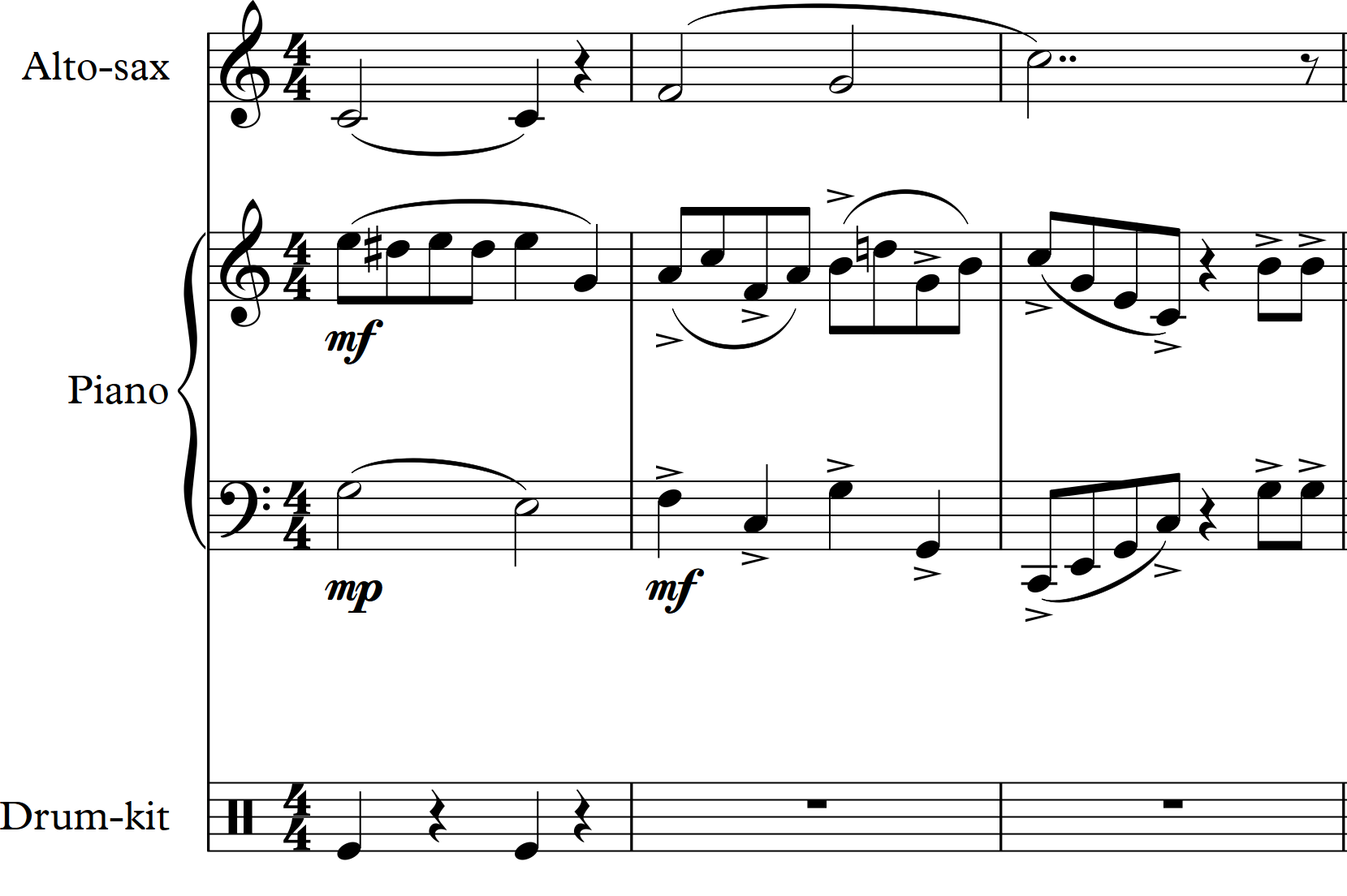
I also mentioned earlier, that the piece is supposed to have at least four rounds of a cyclic chord progression. I often interrupted cadences with the 6th chord, and also tried to find other ways to keep one section as long as possible in varied ways. Over the whole piece, I included the Cyclic chord progressionof I-IV-V-I (the perfect cadence) five times. The bars including them are the following :
- Bars 22-25 (One chord per bar ) ,in a-minor
2. Bars 30 – 32 (ChordsIV and V in one bar) ,in C-major
3. Bars 44-45 (chords I-IV and V in one bar), in C-major
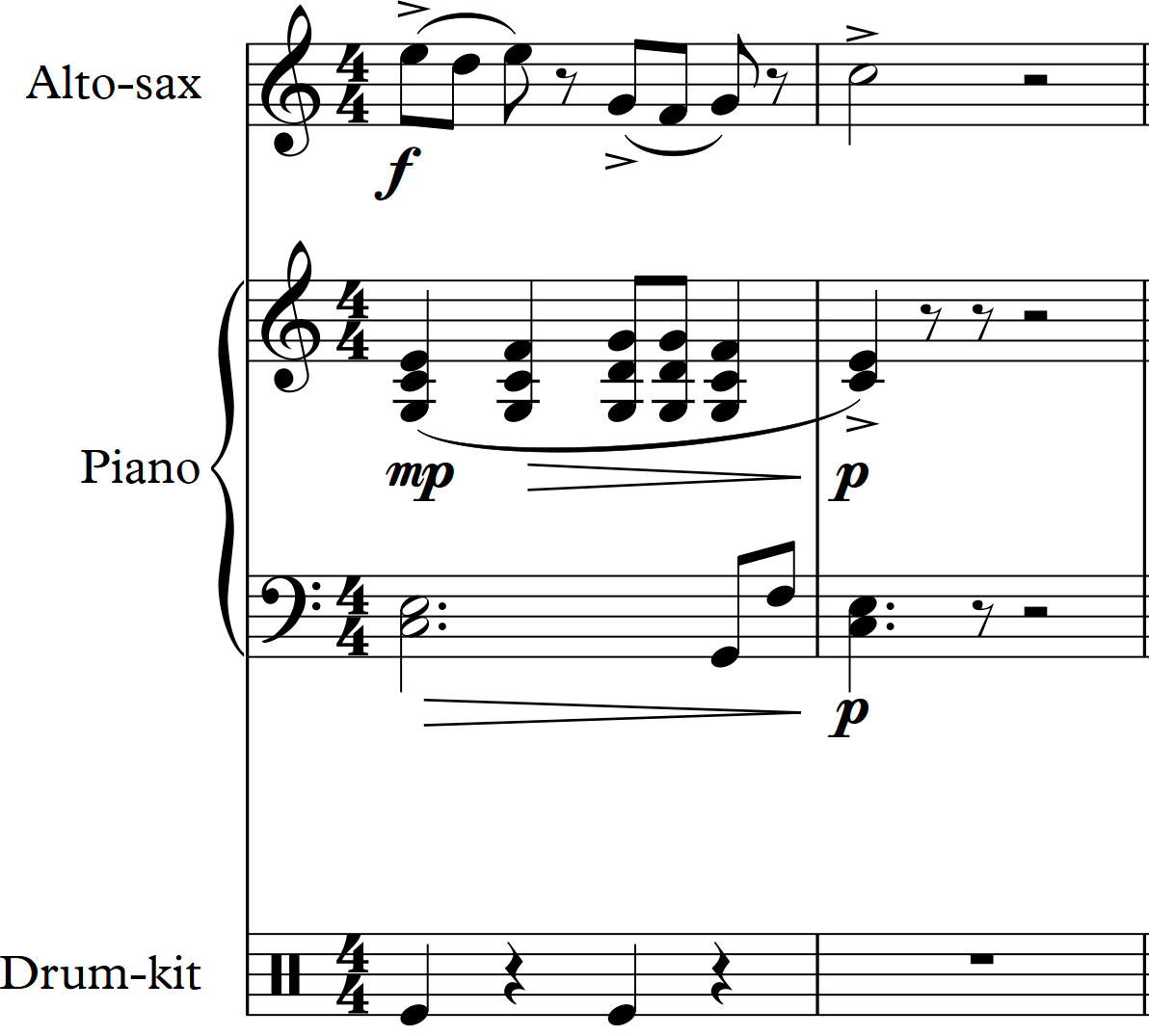
4. Bars 51-54 (one chord) per bar, in a-minor
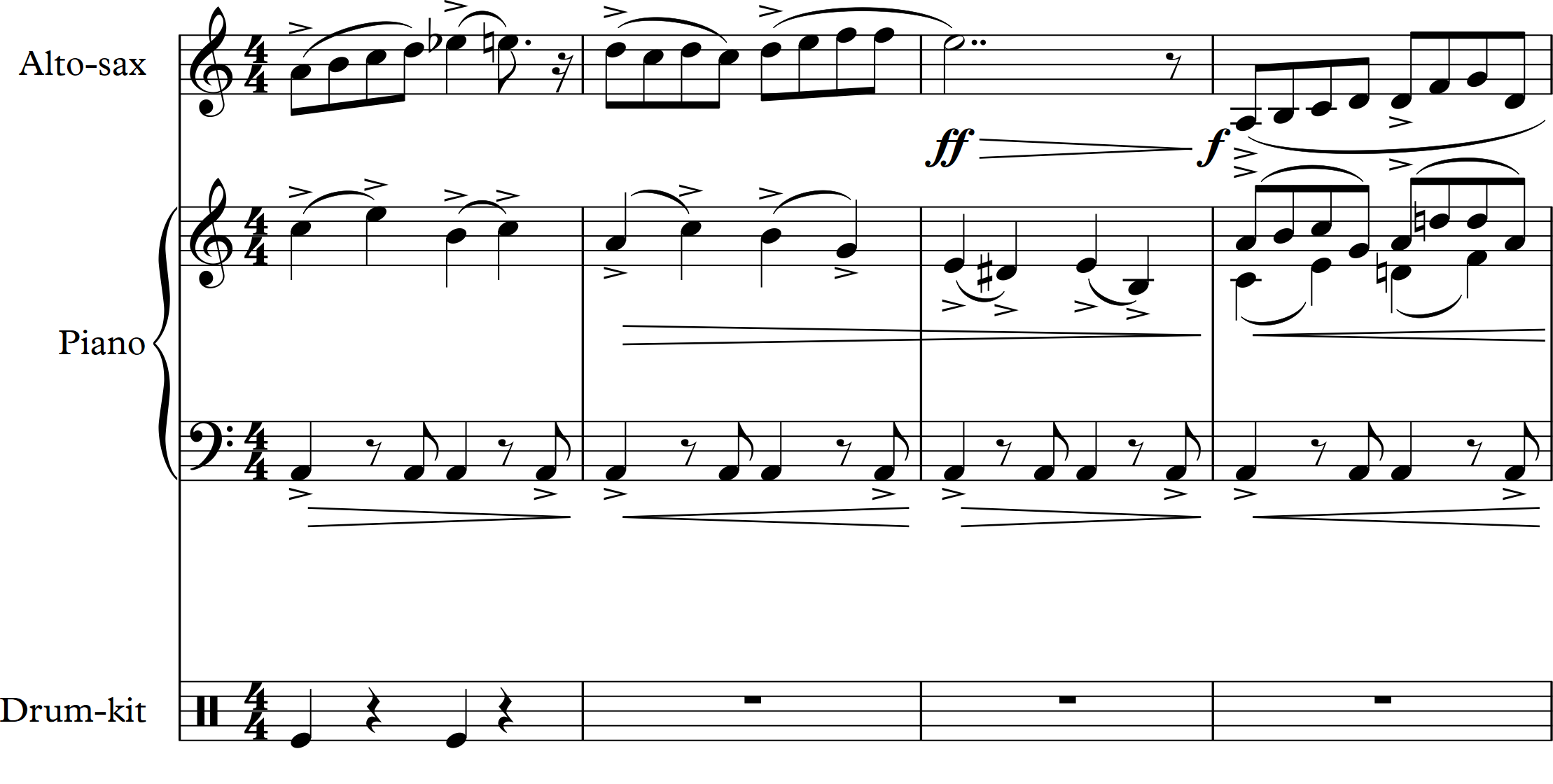
5. Bars 83-87 (Chord V goes over two bars), in a-minor
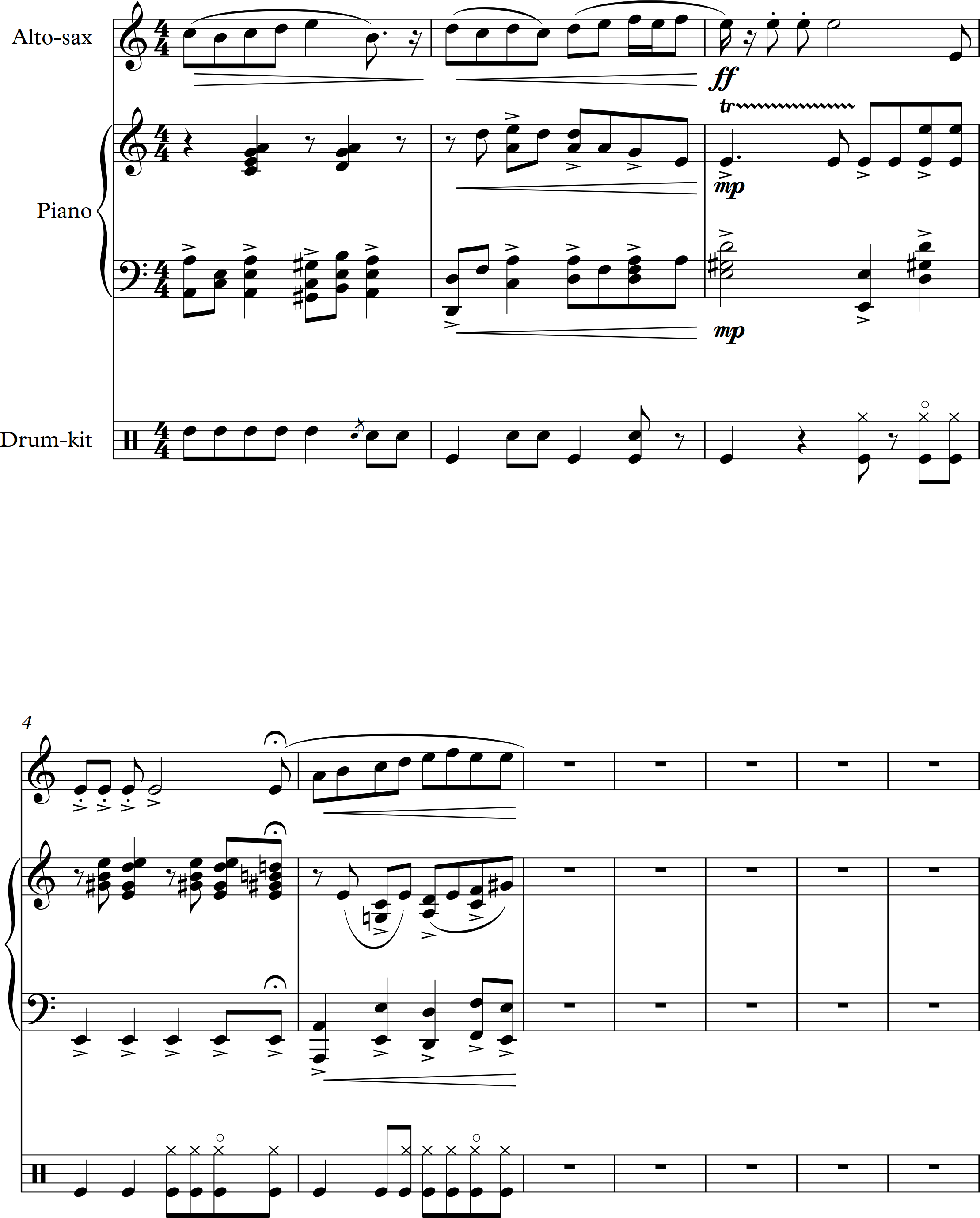
Overall I really enjoyed writing this piece. I would generally say, that this was the assignment I had most fun writing so far. I will try to keep the idea of starting compositions on the piano for the future, I thought that was incredibly helpful. There wasn’t a single bar where I had the feeling, that I didn’t know how to continue it. I also found it useful, to have time-wise quite a clearly structured base to start with.
 Bluefoxxmusic
Leave a comment