Exploring melody and scales
This part of the course focuses on the use of different scales, how to use them to create a melody and the varying colours of sound from several different wood wind instruments.
- Project 5: Pentatonic Melody
- Project 6: Analysing a solo composition
- Project 7: Exploring different scales
- Listening Log
- Jean Francis – Suite for Solo flute
- Gordon Jacob – Seven Bagatelles
- Alun Hoddinott – Lizard
- Malcom Arnold – Fantasy for Clarinet op. 87
- Paul Creston – Sonata op. 19 for alto Saxophone
- William Osbourne – Rhapsody fo Bassoon
- Anders Hagberg – Care
- Daniel Dorff – Tweet
- Ondrey Smeykal – Prameny
- Sandor Balassa – Ha szol a tarogato
Projects
Project 5: Pentatonic Melody
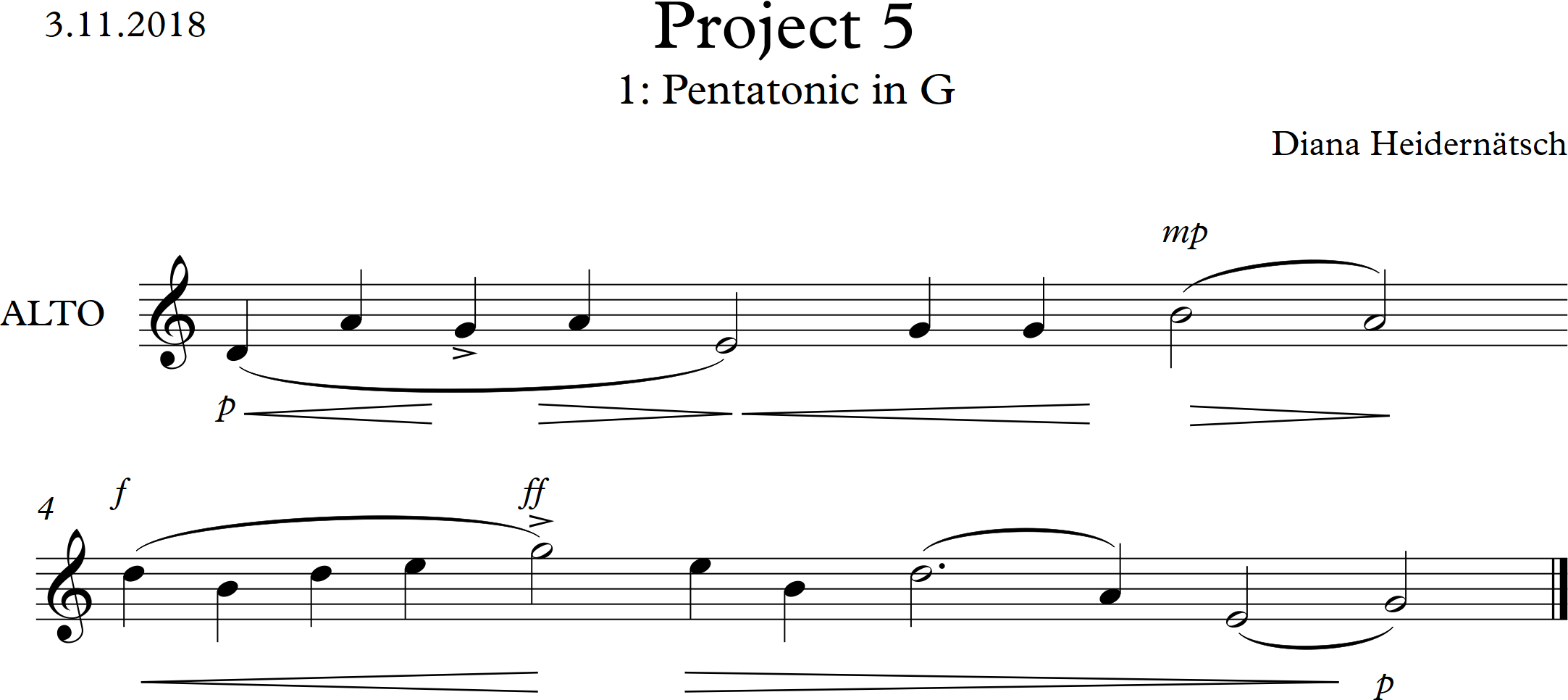
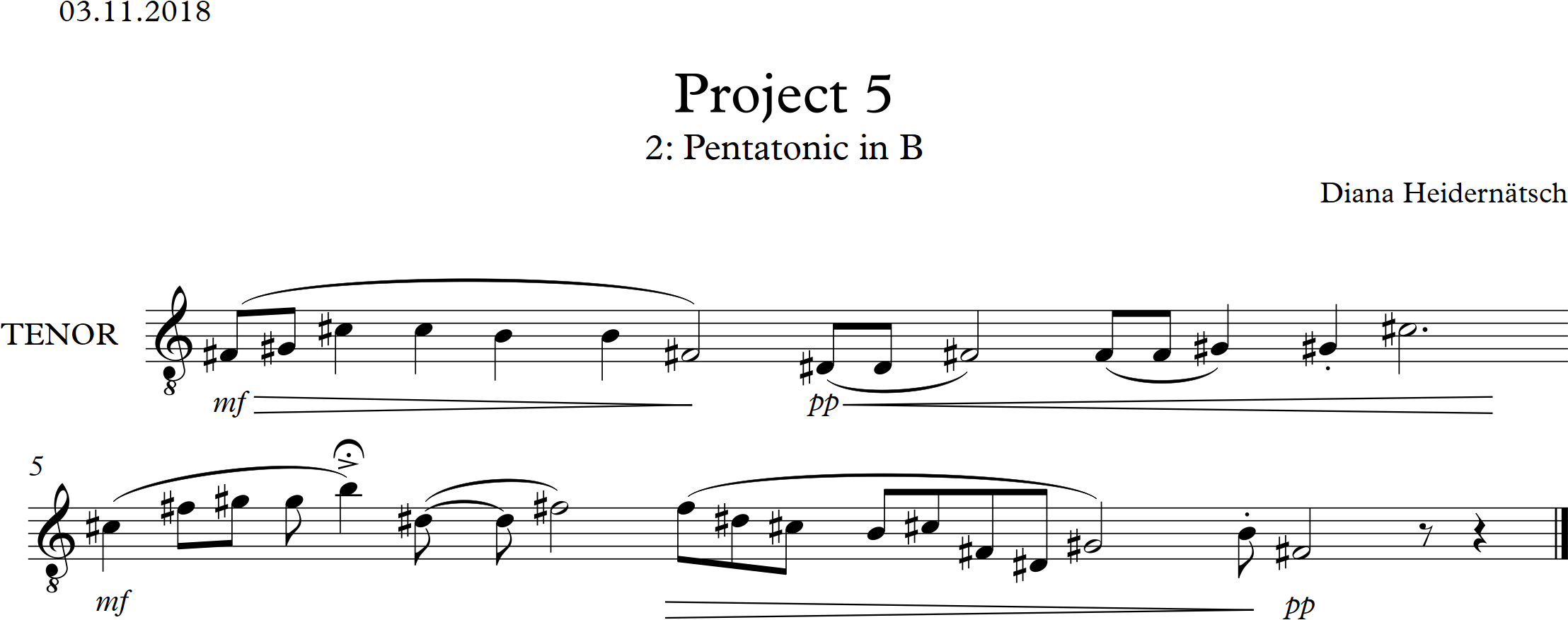
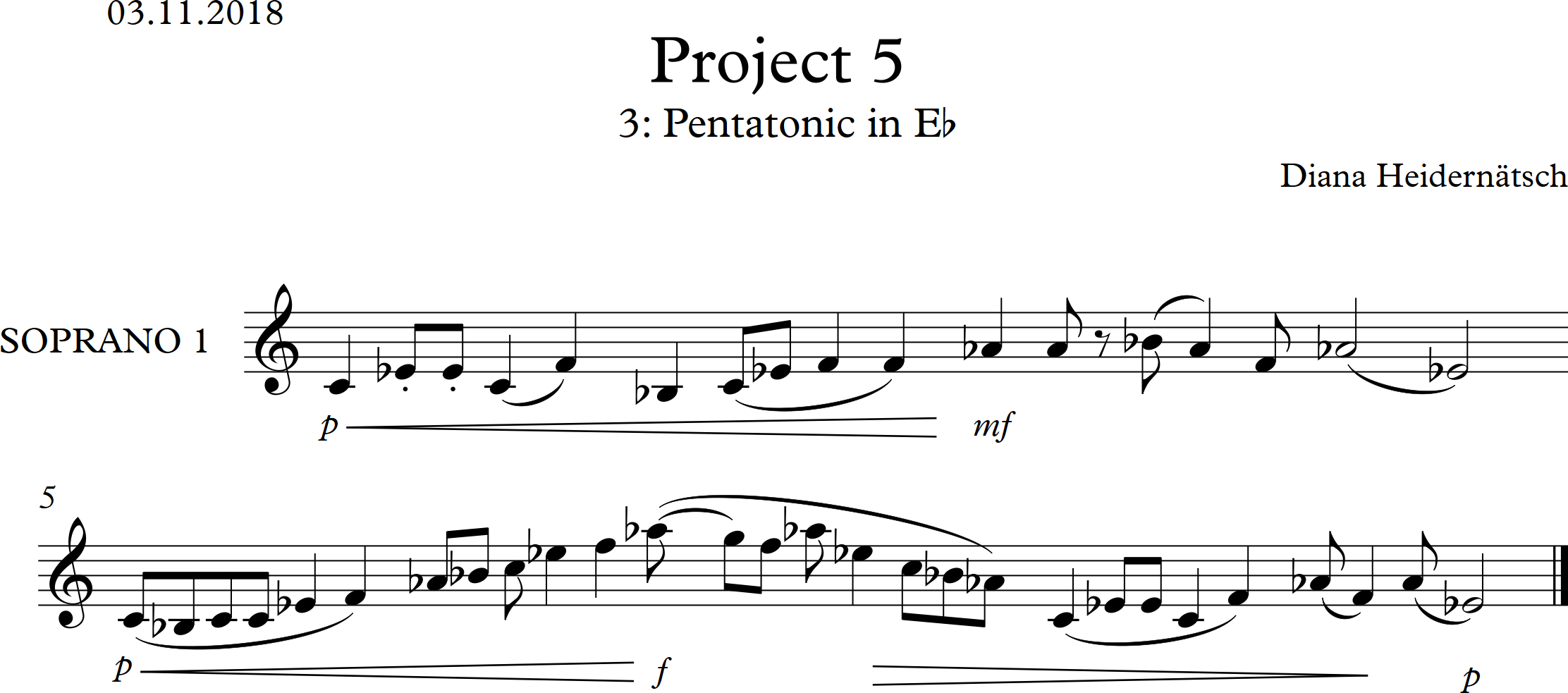
The task for this project is to compose three short contrasting pieces for singers using only pentatonic scales.
A pentatonic scale is made from five notes, which would be the same as the following notes taken out from the major scale of the same key: Tonic (2), Supertonic (2), Mediant (3), Dominant (5) and Submediant (6). In the OCA- study folder is explained that there are two different types of pentatonic scales. The fist one can be constructed, with the following schema: One leaves one tone between the first and the second as well as between the second and the third note, there i s a minor 3 between the third and the forth, and between the fourth and the fifth there is a tone again in between. The second type of the pentatonic scale is nearly the same, except for he fact, that the minor 3 is between the second and the third degree, everything else has one note in between.
It is possible ,of course, to just count the tones and semitones between those five notes and create a pentatonic scale, starting from any note. I myself was introduced to pentatonic scales in the following way:
One starts with any note and adds the dominant (5th degree) to it, from this point one takes the next dominant, etc… this needs to be done five times. Afterwards, the notes of the dominants need to be put in the right order, starting with the note from the beginning. To understand it in a better way, I made an example starting with C :
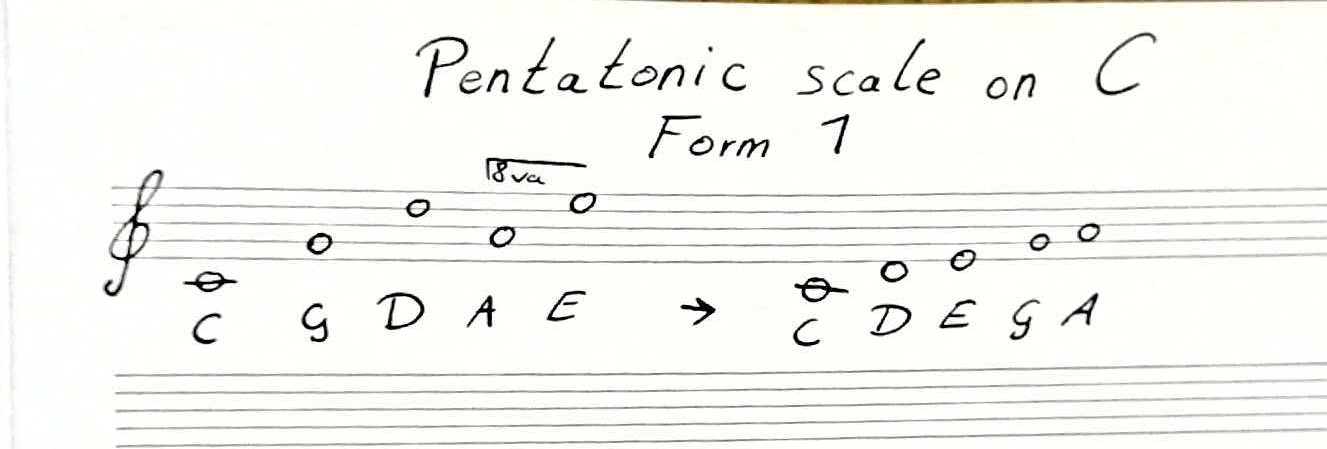
This of course, only shows the way on how to get to the first mentioned version of a pentatonic scale, for the second version one simply increases the last added dominant by one semitone, so as for this example, there would be an F instead of an E at the end.
The first two pieces are written in the first form of a pentatonic scale, the third piece is written in the second form. Being a choir singer (alto) myself , I composed the first for an alto- voice.
Project 6: Analysing a solo composition
Jaques Ibert – Pièce (Analysis)
The composition “pièce” written by Jaques Ibert in 1919, takes about five minutes and is written for only a flute. It can be divided in five parts : Intro, Principal section, subsidairy section, Principal reprise and a Closing section.
The introduction of the piece lasts for 15 bars, and is written in a 2/4 time signature. It gives the listener a rough idea of what will happen with the melody in the subsidiary section, but also gives ahead some hints of the principal section; The sextuplets in bars three and four introduce a variation of the main theme, whilst the fast played part in bar 5 as well as the scales in bar 6 show some material from the subsidiary section. Even though the piece doesn’t have any given key signature, one can clearly see, that the main theme is meant to be in g-flat, due to the many given accidentals. I wasn’t able to tell in which key signature the introduction is written in, because it involves several accidentals which are sharps as well as flats. Nevertheless it was quite clear, with more and more accidentals getting involved (especially flats), that the melody was working towards the g-flat for the start of the principal section.
Even though it involves the main theme, the principal section is quite short compared to the subsidiary section. The main theme starts in bar 16, where Ibert changed the time signature to 6/8. It can be recognized by the following melody :

This motive is played twice in the principal section, both times with a different ending, whereas the second ending is slightly longer, due to it going towardsan insinuation of a climax before the subsidiary section starts.
At the beginning of the second section the time signature changes again, to 9/8, but only for 7 bars. Those 7 bars include 4 bars of scales going up and down with semiquaver notes as well as a short two-bar-section which slightly resembles the main theme, followed by another semiquaver scale. If there are any given key signatures for the scales of this part then unfortunately I wasn’t able to figure them out.
The next part of the subsidiary section starts with the time signature 3/4, which is being swapped 5 times with a 2/4 time signature every time a new bar stars. This part of the section involves another “reminder” to the main theme, before the time signature changes a last time from 3/4 to 2/4, whilst the melody goes up a scale using only semiquaver-triplets:

Just looking at the notes, I personally wasn’t able to tell whether this scale can be named. After that a few scales of sextuplets, septuplets and nonuplets can be heard. And the very last bit of this rather wild part of the piece is made with one bar filled with an upwards going scale of appogiaturas. Starting on an e and followed by its minor third, its a chromatic scale ending on the e flat two octaves above:
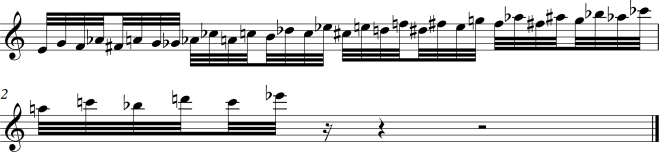
Having reached a climax, by coming to the highest point of this scale, the music suddenly starts getting slower and calmer again, until it changes the time signature back to 6/8 and starts with the principal reprise.
This reprise starts with the main theme, as shown in the first example, but is played an octave higher. The way to the repetition of the main theme (which is then on the original octave again) also takes a bit longer this time. This is because Ibert used some aspects from the secondary section once again and also because the melody had to move downwards to start the theme on its original height.
The atmosphere of the piece expands once more when the melody goes over several triplets at another variety at the end of the last repetition of the theme. Then, as if the composer would have wanted to make a conclusion, the time signature changes once again to 2/4, which it was at he very beginning. Those four bars are generally quite calm except for one thriller on e flat, this is one out of two thrillers which can be heard during the whole piece. The first one can be found in the introduction on a flat. The time signature changes a last time to 3/4 , which lets the piece end onto two long held notes (one bar each) on d flat one octave apart.
In terms of dynamics, Ibert chose to stay on a calm (pp) volume at the intro as well as the ending part of the composition. The principal section and the principal reprise are both in an average volume (mf). Only the secondary section, which is the section that stands out in this way as well, changes its dynamics several times. Working towards a climax it becomes louder and louder (ff), only having a few calm moments, before the everything suddenly gets quieter again and the time signature changes (as already written) to 6/8, with the mf – dynamic again to announce the start of the principal reprise.
Conclusion:
It often happens to me when I analyse pieces, that I find much more in the structure and background of it, that I originally thought there was. It took me a while to get into the structure of it, because it is written for a solo instrument, but I really enjoyed it in the end. I found especially interesting, that Ibert seemed to have put most of his effort into embellishing the subsidiary section of the piece, which is rather unusual. It was furthermore quite fascinating for me, that even though the short main theme has only been played four times throughout the composition, it was the only part I could still clearly remember after listening to it for the first time. All in all I would say, that Ibert seemed to have tried to get the most out of this particular instrument, which he managed quite well especially through the different scales as well as the sudden jumps in the melody going up and down.
Malcolm Arnold : Fantasy for clarinet op.87 (analysis)
“Fantasy for clarinet op.87”, written by Malcolm Arnold 1966 is a composition for a single clarinet, it takes up to about four minutes.
When looking at this piece one has to first of all mention, that it is written for a transposing instrument. In this case, it is composed for the most common type of clarinet; the b-flat clarinet. This means that everything the clarinet plays sounds one whole tone higher than it can be seen in the score. The other way round, everything that is written down can be heard one tone lower.
Arnold himself parted this piece into eight parts which he labeled from “A” to “H”. One thing which is quite interesting with those sections, is that, section A only starts after the main theme has been played for the first time. It is furthermore the case, that the tempo or sometimes even the time signature is changed when a new section starts. In the following paragraphs, I’ll try to analyse and explain those eight parts more detailed.
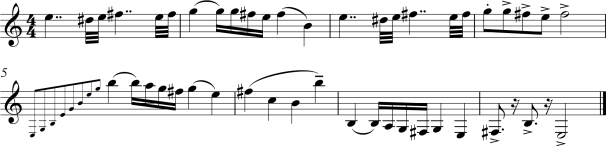
The very first part of “Fantasy for Clarinet”, is the only part of the composition that isn’t under any of the named sections. It lasts for eight bars and introduces the main theme of the piece. The time signature the composition starts with is 4/4, the first given tempo to it is given as  . Besides the fact, that the piece doesn’t have a key signature, one can see from the f-sharp accidentals, that it is meant to be in e-minor (which would then due to the clarinet being a transposing instrument sound like d-minor). The melody has a really heroic sounding character and can be remembered easily. It is build up with two motives, both of them have a first part (bars 1,3,5 and 7), which is being repeated (The second motive one octave lower) and a second part (bars 2,4,6 and 8) which is always slightly different :
Section A
This section has a length of another eight bars and is basically a repetition of the main theme (as it can be seen above) but with a “pp”-dynamic given, the previous section was in “ff”. The only other difference is, that the appoggiaturas from bar five in the score above aren’t played anymore.
Section B
At the beginning of this section the time signature changes to 3/8 and a change of tempo can be found as well ( ). The melody starts with repeating the notes from the last bar of the theme; four times it starts on an f-sharp as well. The four following repetitions each start one minor third higher than the previous one, thus the following motives start with a, c1, d1-sharp (which is enharmonic equivalent to e-flat, which is the “official” minor third on c) and the last played motive therefore lands on f1-sharp again. Arnold continues with this scheme for one more octave after that and eventually starts with a new motive by not going down to the e2 after the last motive, but to the c3 above.
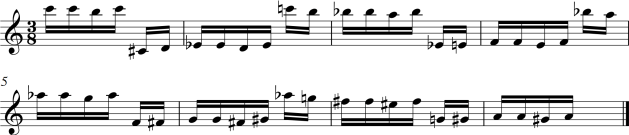
When one has a closer look at this following theme, it becomes visible that it has two motives, always a higher and a lower one, moving towards one-another by always going one whole tone lower, or, for the motive that starts on the e1-flat in bar 2 , one whole tone higher. The first four intervals at the start of every bar always stay the same, the only difference make those two semiquavers at the end of the bars, which not only function as anacruses, but are also inverted from one another. One bar after that Arnold continues with this scheme only for the lower melody, where it lands on a d2-sharp. This d2-sharp is the start of a short series of motives with a semi-quaver triplet, followed by a quaver note. The first three of those motives can be build up to a em-maj-7 chord, the next three to a d-m-maj-7 chord (shown below). The last two bars of this section are an introduction to section C.
 Em-maj7
  Dm-maj7
Section C
The first four bars of section C involve the motive that can be seen above, except for that the upper voice starts on c3-sharp, and the lower voice on g. After that the motive is being continued for another six times, but without the anacruses, until the upper voice lands on e2-flat. For the next five bars the melody mainly focuses on this e2-flat, the sound intensity is being increased, and it comes to a very loud end of this part with a thriller being played on the e-flat.
Section D
This section is basically a mixture of the themes that can be seen above. It starts with the first seven notes of the main theme followed by a really loudly played, low pitched part. This is being repeated right afterwards, even though the low played part varies. A B-7 arppegio made from appoggiaturas is used to come to a high pitched B, which, again, makes the start of the second given theme. The lower voice starts on a c1 this time. The interesting thing with especially this theme, is that the two voices are not moving towards one another, but away from each other. Thus, the higher voice moves up for one whole tone after one motive has been played and the lower voice moves down. When the upper voice reaches the e3, it is being played very loundly several times over three octaves, until section E starts.
Section E
The time signature is changed back to 4/4, the tempo is given as  . Section E again starts with the main theme by playing the first 11 notes, but instead of starting on e2 it starts on the a2 above. This theme is interrupted by 4 aggressively played low “e”s. After a repetition of the just named sequence, the melody slowly moves its way down to c2. Besides it being interrupted by a quick deep pitched part, the pitch suddenly makes a huge jump from the c2 to the e1, which moves up five notes as an introduction for the next section.
Section F
This section mainly consists of sextuplets, except for several short “interruptions”, which refer to previous motives. The first section of sextuplets is made from the notes of an a-minor arpeggio, followed by an e-major arpeggio. After one short interruption which resembles to the main theme once more, this section is repeated. The following row of sextuplets involves an upwards going scale, which is build only with minor thirds, which is,again, followed by a short interruption and then repeated. The melody then moves a scale down which I wasn’t able to identify, until the tempo becomes slower and the melody focuses on g-sharp and b.
Section G
Surprisingly I wasn’t able to find any connection between this section and the others. After the loudly and fast played previous sections, this one makes a really strong contrast with its slow, calm melody. This is the only section of the whole piece which doesn’t seem to be connected to the other ones in any way.
Section H
As with most pieces, Arnold finished the composition the way he started it by playing a slight variation of the first main theme at the very end.
Conclusion
I personally found it really interesting how Arnold worked only with two themes for this piece. Every time a new motive came up it is being repeated several times in varied ways for the ongoing sections. The only section that made an exception was G. Furthermore, Arnold often used sudden changes in dynamics and also the pitch. I couldn’t really tell, whether this piece has a proper subsidiary section or not due to the fact, that the melody mainly focuses on the main theme.
All in all I really enjoyed analyzing this piece, especially because I made a listening log entry to it before. From all the pieces I have listened to before “fantasy for clarinet ” was my personal favorite, that’s why I chose to analyse it.
Project 7: Exploring different scales
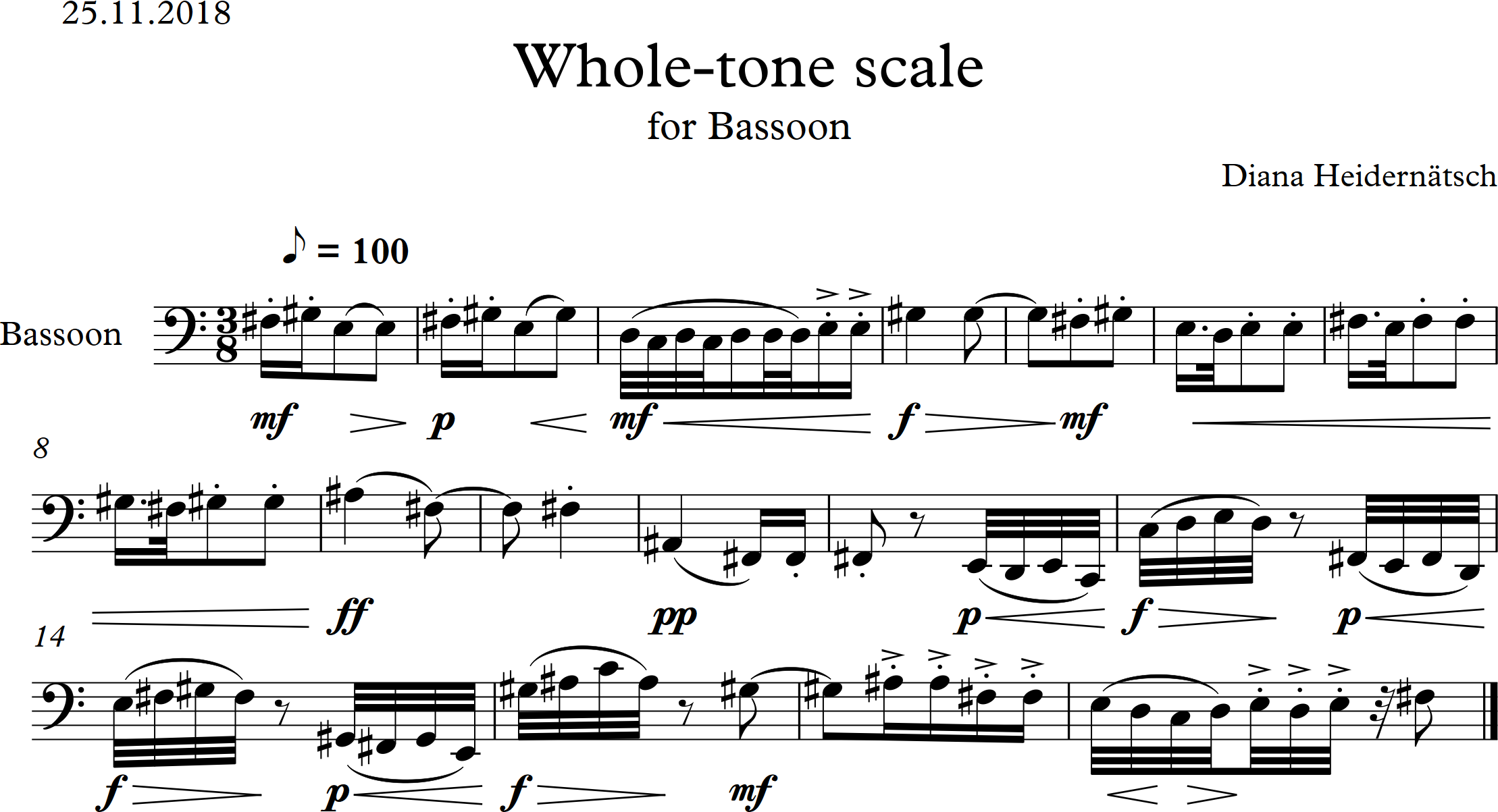
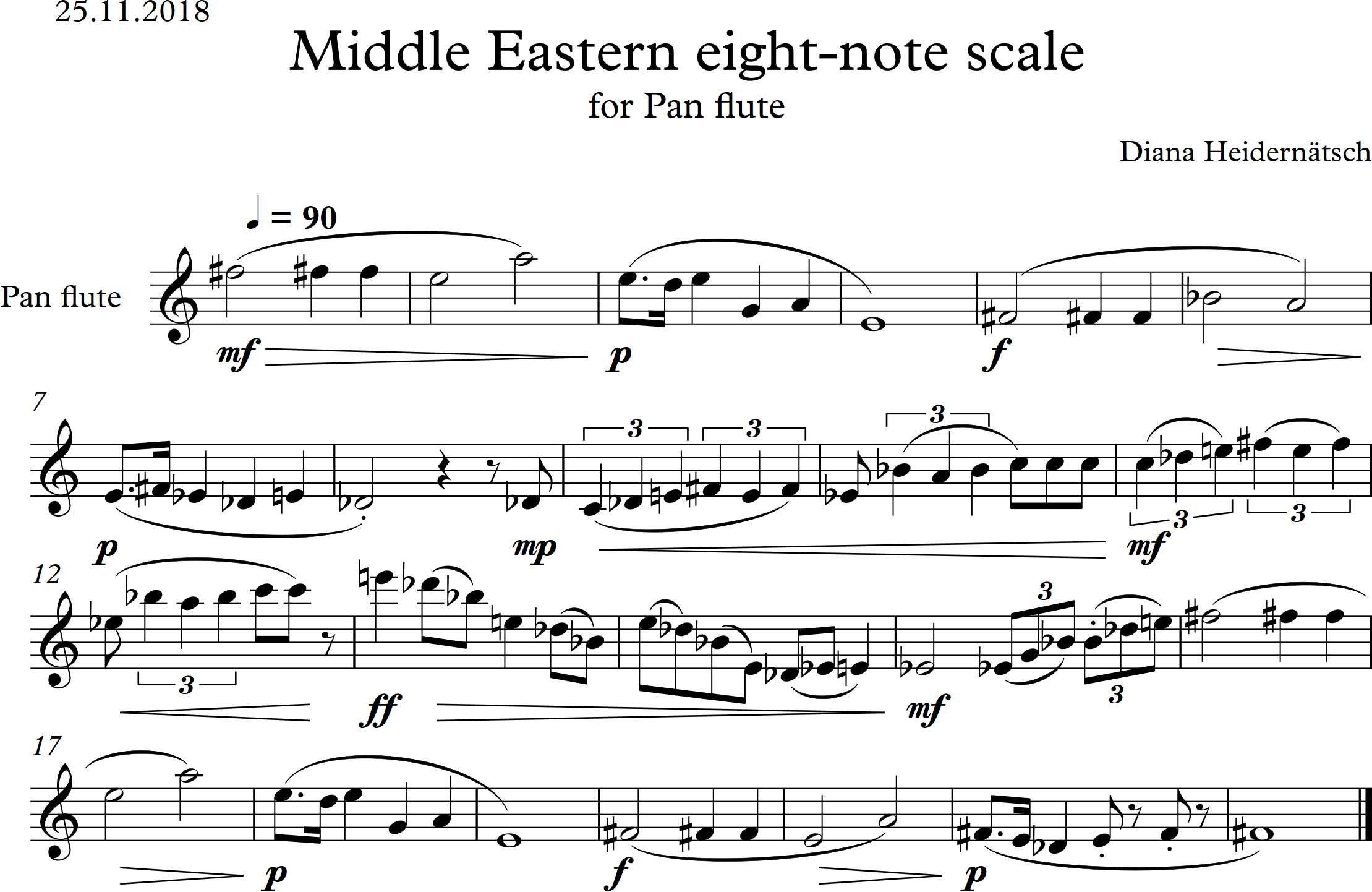
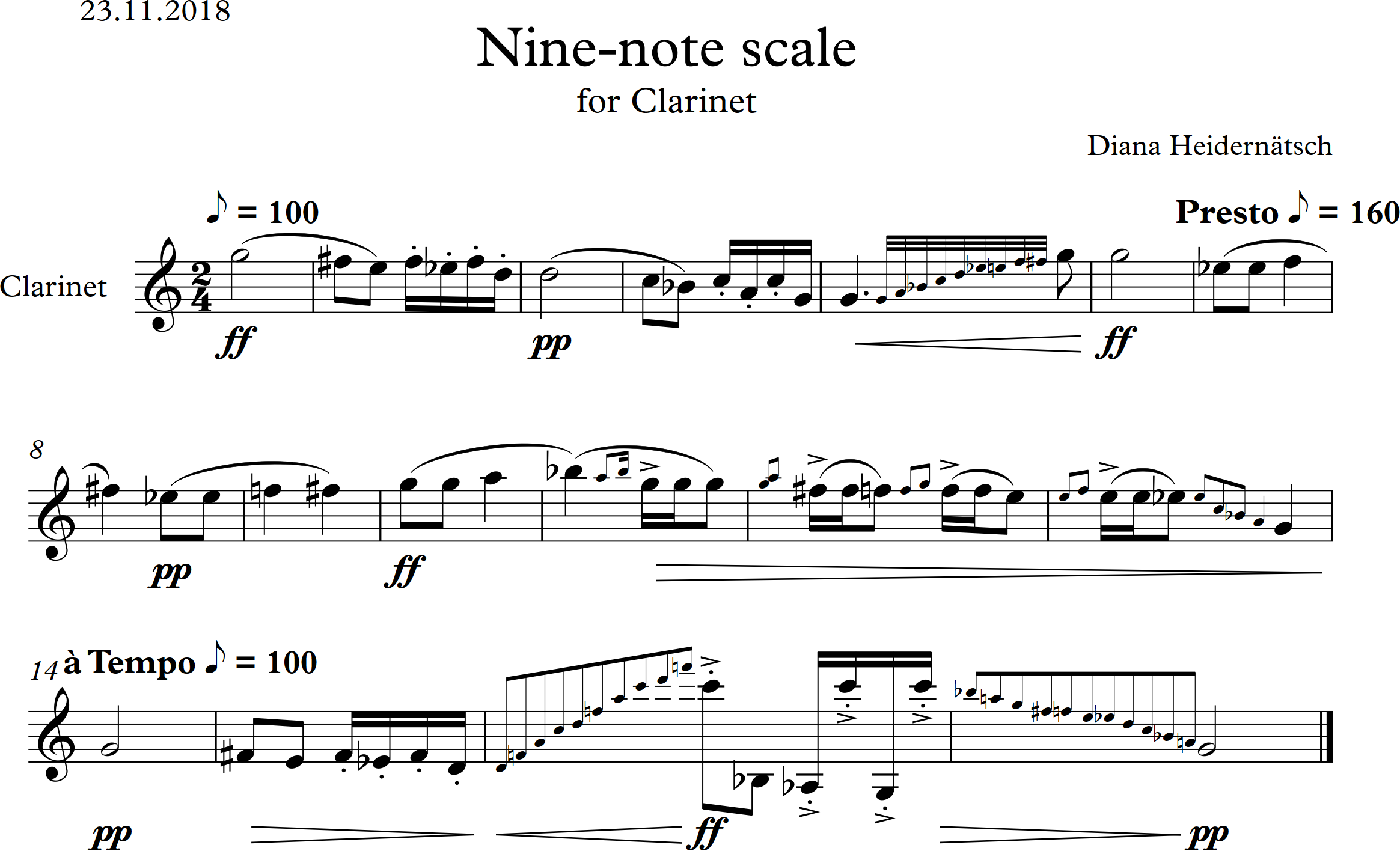
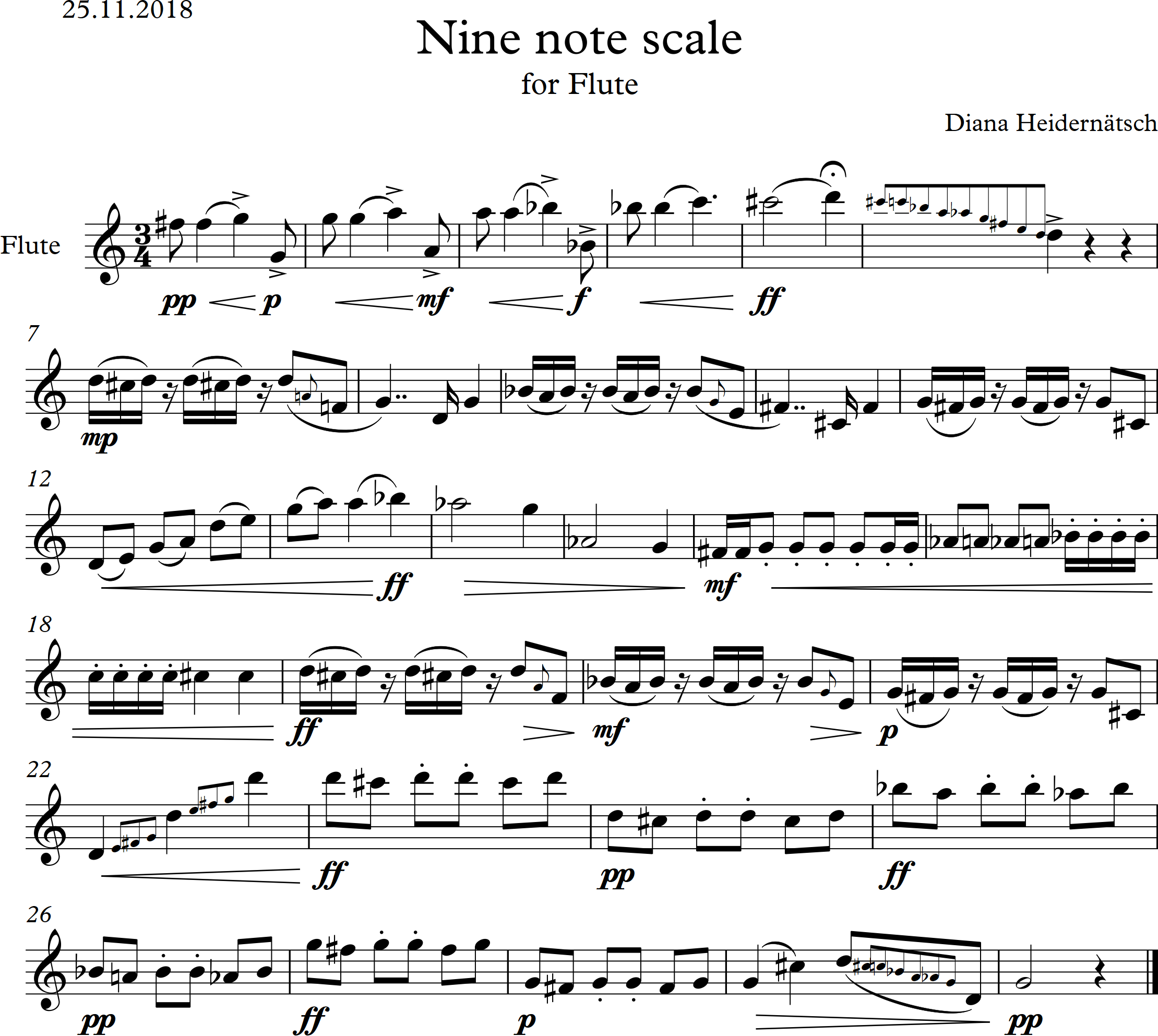
The task for this project was to compose nine pieces for woodwind instruments for nine different scales. The scales I used are always given above the pieces.
Whole-tone scale a

2. Whole tone scale b

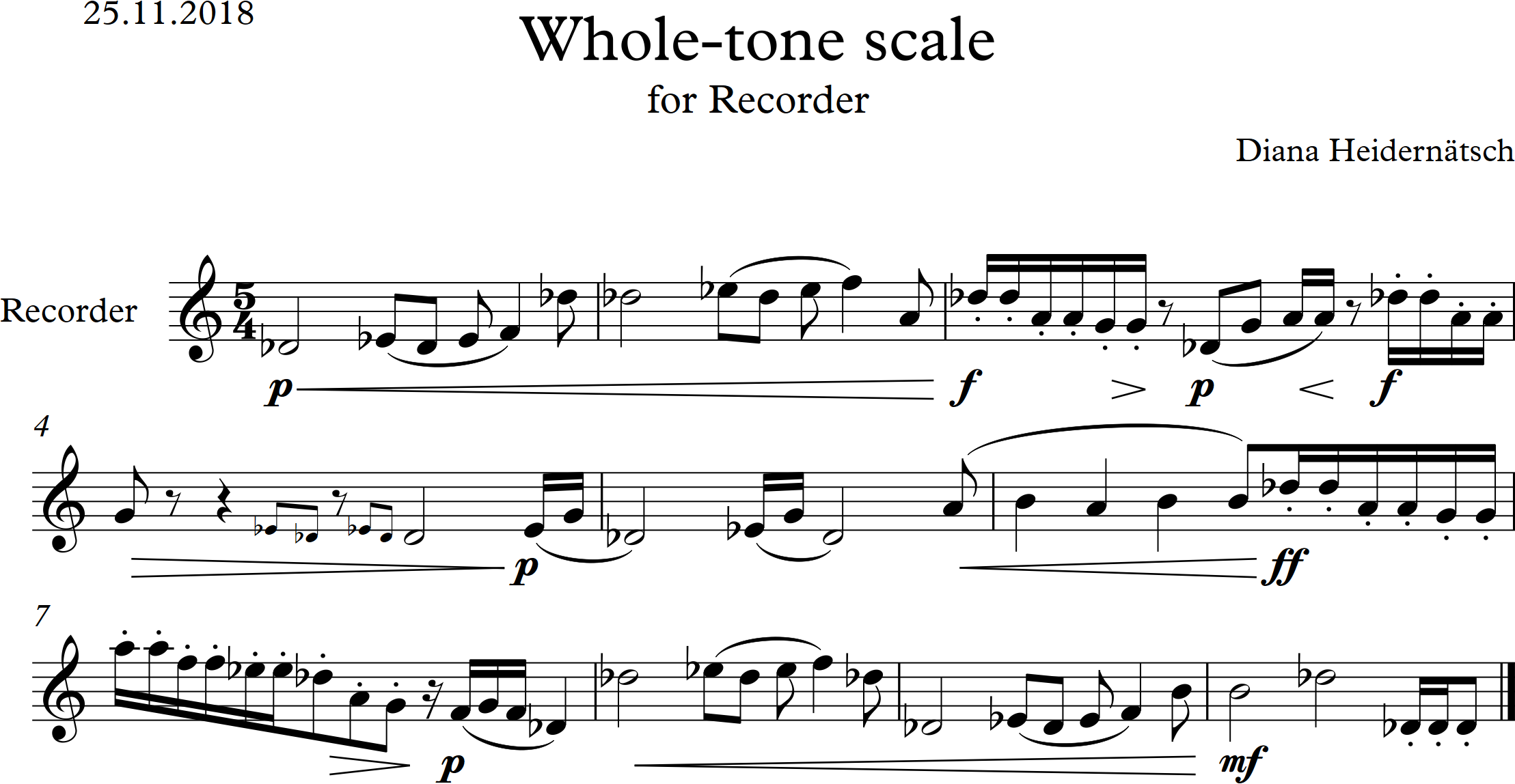
3. East European Major Scale

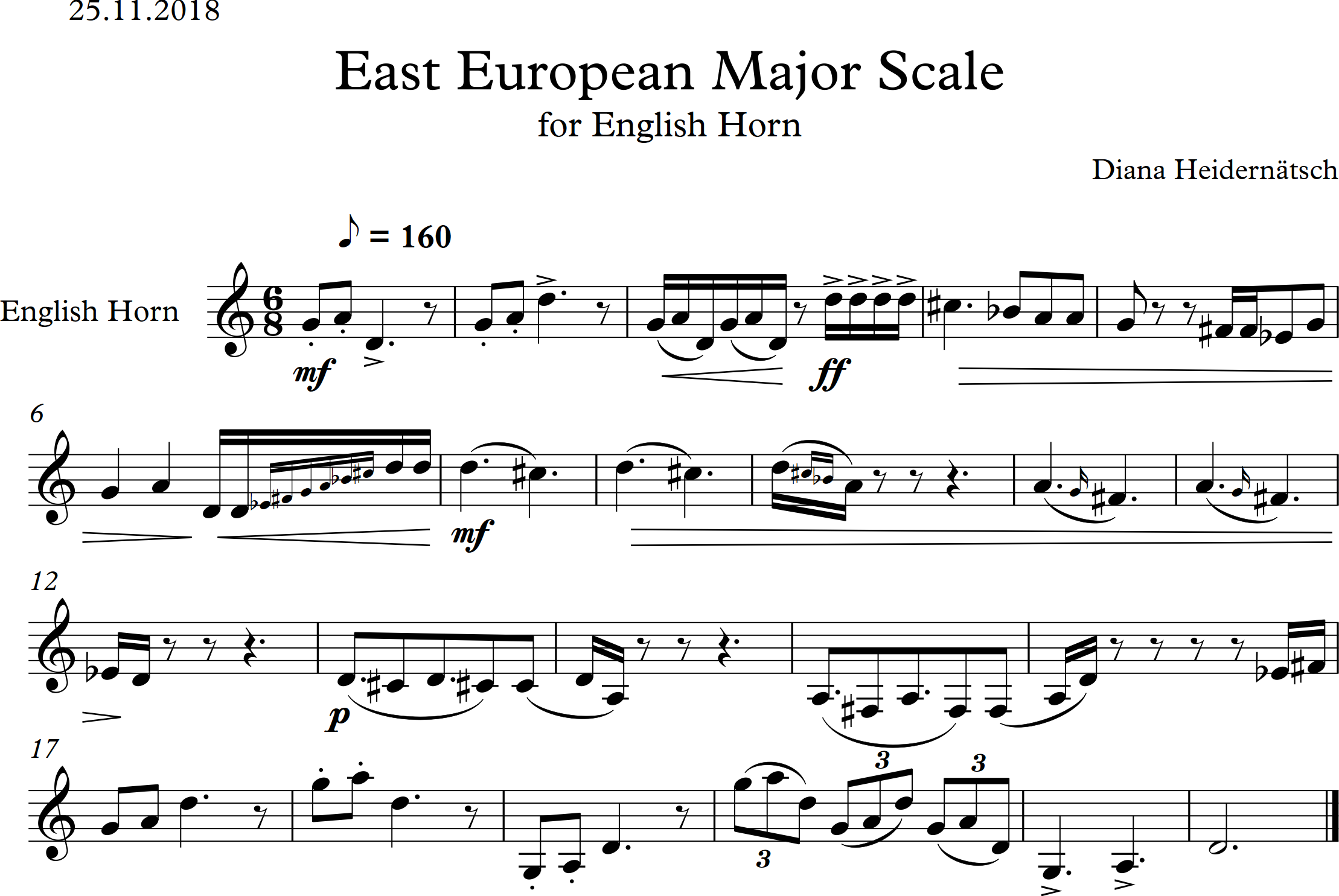
4. East European minor scale

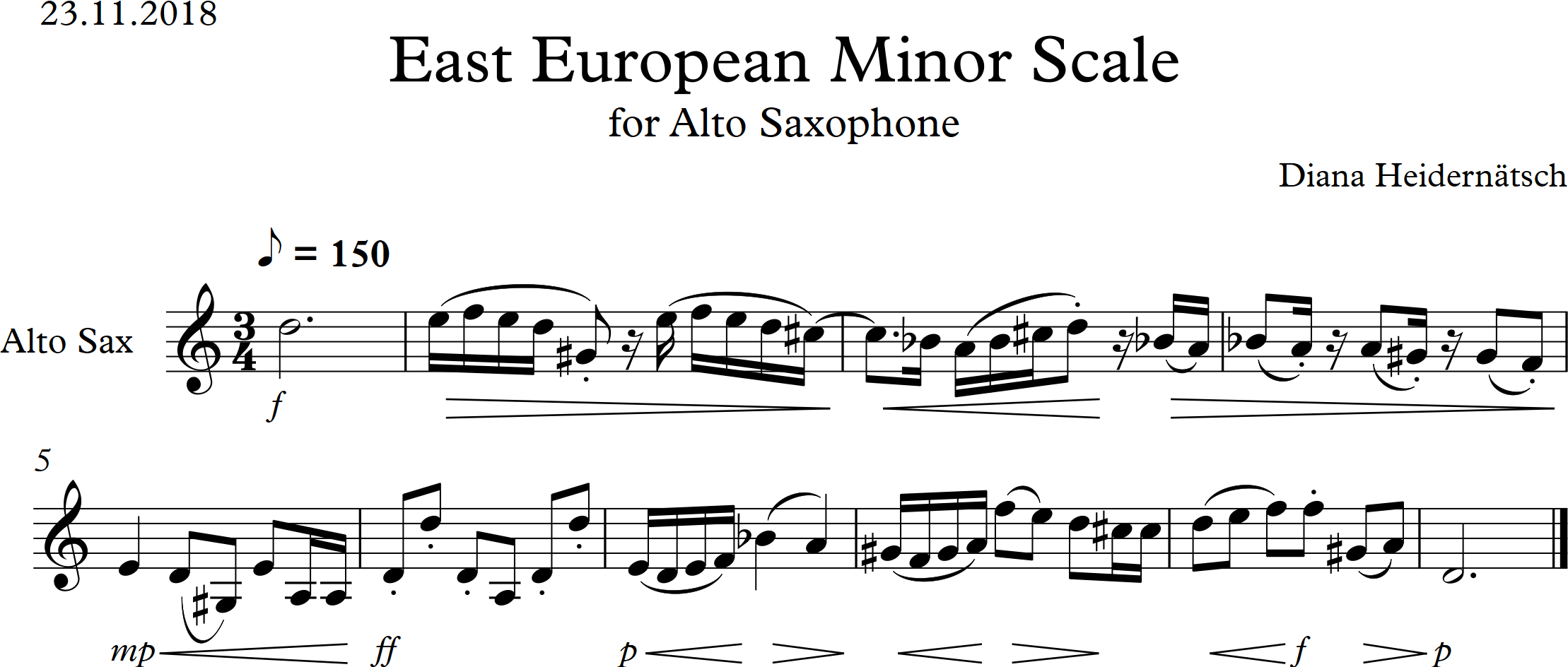
5. Middle Eastern eight-note scale a

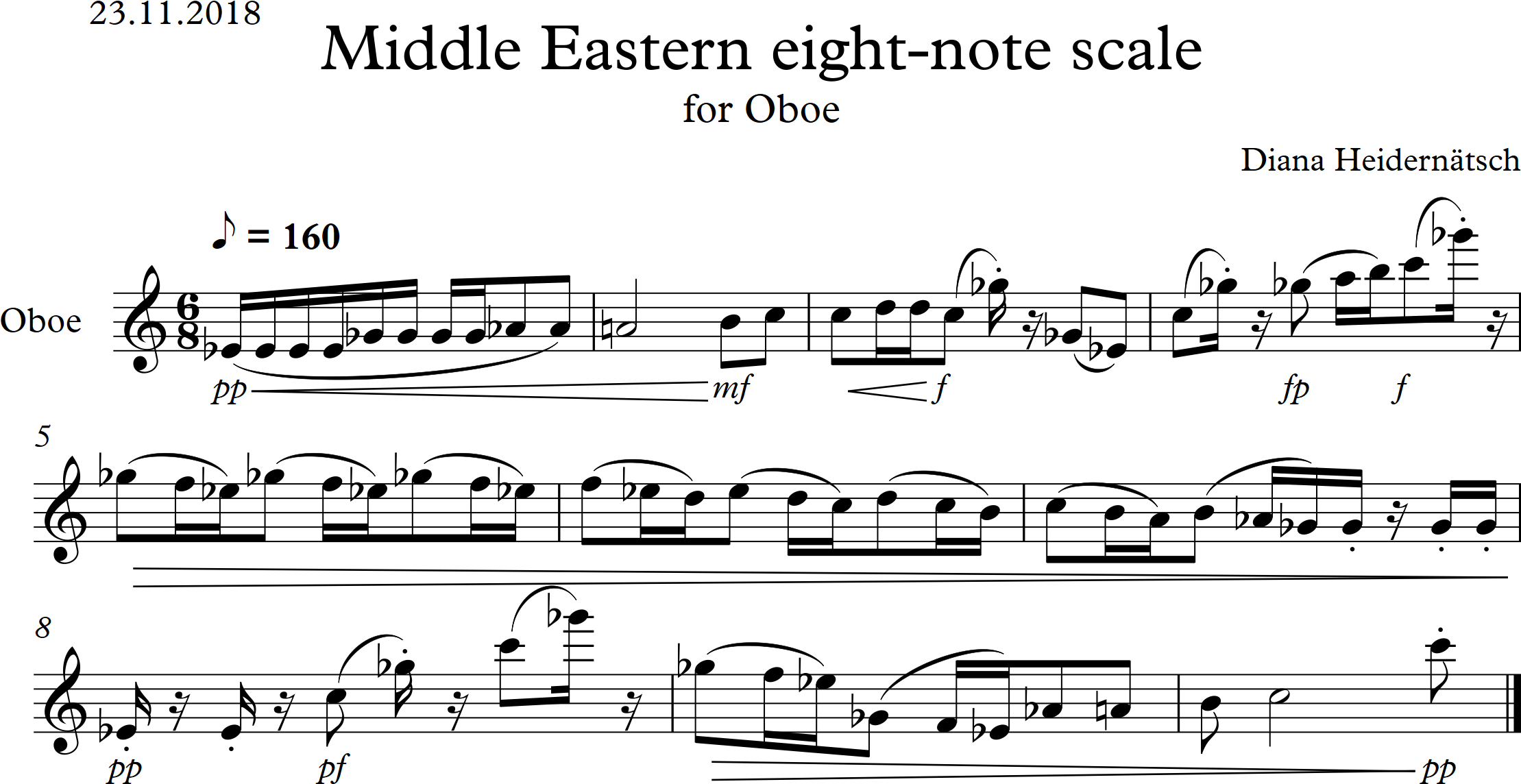
6. Middle Eastern eight note scale b

7. Nine-note scale a

8. Nine-note scale b

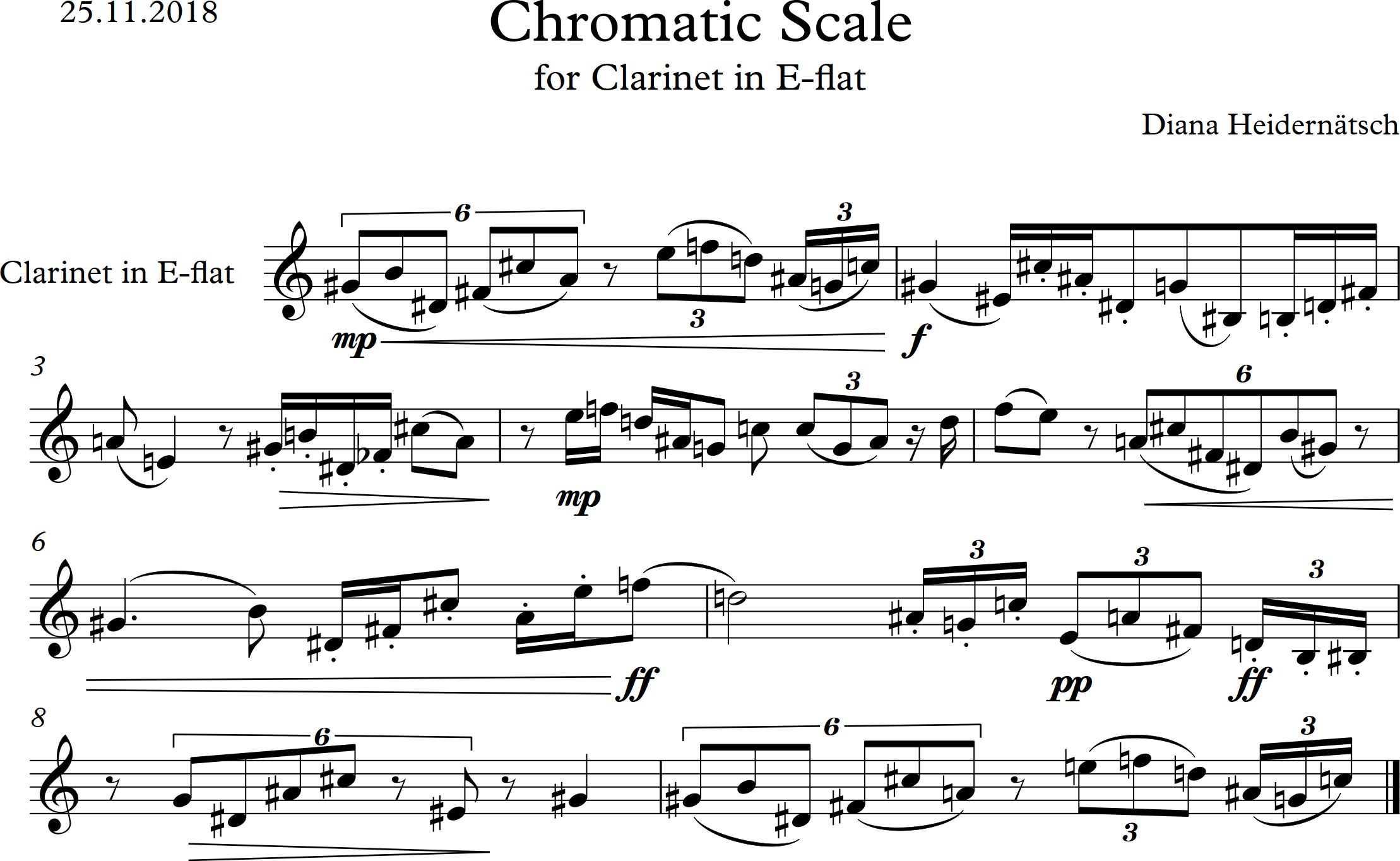
9. Chromatic Scale

With this scale I allowed myself to use Arnold Schönbergs “Twelve-tone-technique”, which doesn’t allow a note to be played a second time unless all the other eleven notes have been played before. This technique has a defined row of the given twelve notes. The row can be reversed (called retrograde), played with mirrored intervals (inversion) or both of them combined (retrograde inversion).
This is furthermore a piece, where I chose to use the Clarinet a second time, simply because of its wide range and its ability to swap between fff and ppp very rapidly.
Listening Log
- Jean Francis – Suite for Solo flute
- Gordon Jacob – Seven Bagatelles
- Alun Hoddinott – Lizard
- Malcom Arnold – Fantasy for Clarinet op. 87
- Paul Creston – Sonata op. 19 for alto Saxophone
- William Osbourne – Rhapsody fo Bassoon
- Anders Hagberg – Care
- Daniel Dorff – Tweet
- Ondrey Smeykal – Prameny
- Sandor Balassa – Ha szol a tarogato
Jean Francis – Suite for solo flute
This piece from Jean Francaix, which is generally fast has overall an incredibly skittish/ vivid mood. The pitch moves up and down very rapidly throughout the whole composition which makes it sound quite jumpy as well, but in a cheerful way. Only when the piece comes near the end the melody starts to get a little bit slower,calmer until the flutist can eventually rest on one single note. This very last note, is the tone that is played for the longest from the whole composition.
One motive, that seems to be repeating itself all the time, is an arpeggio moving upwards, followed by jumps of the pitch going down and then up again. There are very few moments in this piece, where this theme isn’t played.
As the heading already explains, this piece is being played by only one flute.
“Suite for solo flute” kept me more interested as a listener than I thought it would. Due to the fact that only one instrument is being used, I did not expect too much at the beginning. I quite liked the idea of the often used arpeggios, those are the main reason why the piece didn’t become boring. The arpeggios are probably also used regularly because, according to a short description for the flute in my OCA-folder, it becomes easier for the flutist to reach the high pitched notes.
The piece is not necessarily my personal favorite, but I really enjoyed analyzing it.
A link for the audio of the piece (provided by Laurel Zucker on Youtube) can be found here.
Gordon Jacob – Seven Bagatelles
This composition involves a short series of very short pieces, which are played by an oboe only.
1) March
Suiting to the title, Jacob uses the motive of a repetitively playing note, which reminds the listener of a march, this effect is being strengthened by him using a staccato rhythm going faster every time the motive comes to an end.
2) Elegy
This bagatelle is a complete contrast to the first one. It consists, except for a few moments, only of legato notes and has a moderate pace. Even though the piece is high pitched (due to the instrument), the melody makes it sound sad.
3) Walz
Despite the fact that this composition is, as well as the others, very short, one can clearly hear a rough compositional structure. The first motive is being repeated several times in varied versions until a very short subsidiary section starts, which reminds the listener of the main theme but still makes a bit of a contrast. A third and final part follows afterwards,where the first motive is played again. The general mood of the piece is joyful an thrilling.
4) Slow air
This piece as a very mysterious mood. It is played with legato-notes only, most of them have the same length, it only occurs a few times in the piece, that one note is shorter or longer than the ones which are being played more often.
5) Limerick
Except for the last two notes, this piece is played very hastily. Due to the melody jumping up and down, the piece sounds rather amusing. Seeing that this piece is the shortest one from the seven bagatelles, the composition reflects its name very well. ( A Limerick is a “humorous poem consisting of five lines” ( Your Dictionary, 2018), which also has a given amount of syllables it must include.) If Jacob put a certain amount of notes into this piece, which would then reflect the syllables, I was not able to hear it.
6) Chinese Tune
The composition basically involves two themes, which could be divided in another two motives. The piece repeats itself in a slightly different way after the first half with a different ending. Due to its slow pace it sounds rather phlegmatic. The pentatonic scale gives this composition the right mood to fit to its name. Although, especially this pentatonic scale doesn’t involve five notes as usually, but six. In this case just Jacob added a sixth dominant at the end of the fifth. Thus, he didn’t only use the normal pentanonic scale on C , which involves the notes C – G – D – A – E (those notes are all a dominant ( 5 notes ) apart from each other). Jacob also added a sixth note, the Dominant from the last tone E, which is B. ( A more detailed description of pentatonic scales can be found alongside with my fifth project here.)
7) Galop
This piece changes between short staccato notes, which are used to reflecting the title, and legato notes. The main theme can be heard three times always with a slightly different following section. The third and last motive (after the main theme has been played) comes to a climax until the piece ends on one long note. Due to it being so diversified it has a really vivid mood. Those seven bagatelles gave me a very good understanding how many different ways there are to shape a melody and also what a high variety of techniques there can be for just one instrument.I personally preferred the second piece “elegy” because of its ability to put the listener in a rather melancholic mood. I was quite surprised at that, because I did’t think that one single instrument can create so many different emotions.
Alun Hoddinott – Lizard
The general mood of the piece ( frantic, nervous, anxious) perfectly reflects the title. It is played by only one recorder. The main theme, which is being played at the very first and the very last part of the composition is very hectic, whilst the subsidairy section (B-Part) creates a strong contrast, with longer notes the piece sounds much calmer but, due to the melody, still cautious.
It starts off very fast, gradually becomes slower towards the middle part , and jumps to a rapid pace again at the end, where the exact same theme from the beginning is played. One technique which is used quite often is a thriller, this played by a recorder can give the listener a feeling of a very dry environment. (The natural habitat of a lizard).
What I personally found quite interesting, is the fact that the music, combined with the title, gave me a really clear image in the head of a lizard running up and down, being afraid of being chased by bigger animals in a dry environment. The adjustment of a title is something that I will consider for future compositions as well.
Nevertheless, the piece still gave me a feeling of being stressed and is therefore not something I would personally listen to.
A link to it (from Youtube provided by The Orchard Enterprises ) can be found here.
Malcom Arnold – Fantasy for Clarinet op. 87
This composition can be divided into four parts; A slow memorable melody, which is clearly the main theme can be heard at the beginning and the end of the piece, it is repeated several times throughout the piece. The second part is a strong contrast to the first, the clarinet is being played much faster here and it becomes really hard to follow the structure of the piece. One tiny section of this “wild” second part reminds the listener of the main theme. The melody comes to a climax, where it suddenly stops and an incredibly slowly played third section can be heard, this gradually leads the listener back to the main theme from the beginning.
The slowly played main theme of this piece in combination with the clarinet gives the piece a very heroic and dramatic sound. The first, third and last part of this composition are mainly played quietly, whilst the second part is played loudly. Nevertheless, at some parts were a motive is played really quietly, a sudden, short forte section can be heard. Therefore some really loud sections include short moments of the clarinet playing softer.
Arnold often uses fast played arpeggios to go up or down a scale. Seeing that the clarinet has a very high range, which goes almost up to four octaves, the composer tried to present every variety of the instrument, not only with the melody going up and down, but also with the dynamics.
This piece was the first one from the series of one instrument-pieces, where the main theme was catchy enough for me to still clearly remember it after listening to it. Even though the second part was a bit confusing at times, I liked those small hints that reminded the listener of the first theme. I really enjoyed listening to it.
The composition also showed me how many different “colours” one instrument – in this case the clarinet – can produce. I was furthermore quite surprised by the sudden changes of the dynamics.
Paul Creston – Sonata op. 19 for alto Saxophone
This piece is the only one out of the given section of solo woodwind instrument pieces, which is being accompanied by another instrument, the piano. The melody gives away a jazzy sounding mood, it also sounds slightly oriental, due to the unregulated use of a pentatonic scale.
It starts rather fast and presents a jolly sounding melody, the short second part makes a strong contrast with long noted and a rather melancholic melody, but the melody quickly comes back to its original mood. In a third part, which comes after the fist repetition of the main theme, a variation of the main theme can be heard, which then leads to a third repetition with a different ending.
It is hard to tell whether the piano is only supposed to play in the background. There are parts, where the piano plays the main theme, whilst the saxophone accompanies as well. Both of them work very well together throughout the whole piece, not only with the harmony and dynamics, but they also provide a “warm colored” sound.
I personally really enjoyed listening to this piece, because,eventhough it’ generally very fast, it still has a calm, relaxing atmosphere, especially at the second part of the piece. Otherwise I think that Creston created a great climate by letting the piano mostly playing chords, often very softly, instead of just one note.
William Osbourne – Rhapsody fo Bassoon
The low sound of the instrument combined with the slowly played melody give this piece a weary and sad sound. Due to the melody going up and down around one note in several sections, some parts sounded really oriental. There are a few moments, where the melody suddenly becomes faster, but only for a short period of time. Throughout the whole composition the piece barely has any changes in dynamics.
This piece seemed to be really monotonic to me, therefore I had difficulties to find a structure. It was also not easy to follow, because each section sounded differently, but not different enough from each other to be separated.
Anders Hagberg – Care
“Care” takes around three minutes and is meant to be performed only with a contrabass-flute.
The most interesting thing about this piece, is, that the composer also used other techniques to create sound than just playing the flute in a normal way. The main theme of “Care”, for example, is only played by the flutist pushing the keys down, without blowing into the flute, the flutist makes some various other sounds with his mouth instead.
The main theme of this piece is has a very inviting, yet somehow mysterious character. When it is played for the first time, one can only hear the keys being pushed down, which gives the theme a low pitched staccato sound. Overall the theme can be heard three times. For the second and the third repetition, some other staccato sounds/noises, which the flutist produces with his mouth can be heard as well.
The structure of the piece is a simple A-B-A’ form. In this case the first “A” includes a really short middle section, which gives the listener a rough idea of the long “B”- part. So the first “A” is basically made out of the main theme played normally, followed by a short side theme, reflecting the “B”- section and with the varied main theme again.
The “B”-part is, quite interestingly the longest part of the piece, and is really contrasting to the hard, staccato main theme. This part starts with the flutist playing a very slow and low pitched melody, is accompanied by some humming from the flutist after a while. This slow theme is shortly being interrupted by a variation of a part of the main theme until it continues with the flutist singing a major third (+one octave) above the melody of the flute, whilst blowing into it. Except for a short part in between, where the flute is being played in a normal way, this part of the piece ends with the flutist singing, whilst playing, having the tempo still at a very slow pace.
The start of the second “A” part comes abrupt, is very short, and only repeats the main theme one last time.
I really enjoyed listening to this piece, it was entertaining and interesting to analyse, one of my favourites so far. I especially liked the “B” part of the composition, with its slow, deep melody, it gave away quite a relaxing atmosphere, the singing contributed to that as well.
I found it really interesting to see, that so many different sounds can be produced with the flute, without having to play it the normal way. I’m quite sure there are many more techniques to explore and use, and I will try to explore this “unusual” ways of using an instrument a bit more for my own compositions.
Daniel Dorff – Tweet
Appropriate to the title, the piece “Tweet” sounds really cheery, is high pitched and, being played by a solo-piccolo reminds the listener of birds. It is separated in 3 main parts, The first and the last part each include the main theme, being played twice with a short side theme in the middle and give a clear idea of a structure. Whilst, on the other hand, the second part of the piece seemed to include several different ideas, it varies between slow and fast as well as staccato and legato.
The main theme can be easily recognized by two really shortly played notes (probably appoggiaturas) followed by one slightly longer note. This short three-note-motive repetitively works its way up and down on a scale, which builds the main theme. Both side motives in part 1, consists of scales being played upwards, which are not always fully completed.
The second part of “tweet” starts with the same motive that can be heard in the middle sections of parts 1 and 3. This is being followed by a very short motive which slightly resembles to the main theme. After that a contrasting, comparatively slow staccato theme is being played, which is shortly interrupted by a fast played downwards going scale until it continues. The theme becomes faster and louder towards the end, two more downwards scales are being included, but the melody always immediately jumps back to very high notes. This part of the piece eventually ends as it started, slowly.
I personally had the feeling, that Dorff gave quite a clear image of a small bird flying around. Especially in parts 1 and 3 with the main theme. One can imagine that every short 3-note-motive could symbolize one wing beat of the bird, seeing that especially small birds have to flap their wings often the tempo in which Dorff decided to have the main part in, seems absolutely appropriate.
I wouldn’t add the piece to my personal collection of music, but I nevertheless really enjoyed listening to it because of its’ cheery mood and nice character.
Ondrey Smeykal – Prameny
This short piece (about two minutes), which is meant to be played by only a didgeridoo, has an incredibly hectic character. The structure is interesting, but simple :
The composition starts with some hollow tones first, which only sound like air being blown through the instrument by the performer, without being on any particular note. After the very first, and longest breath, the blown air gets into a fast rhythm. Even though the hectic breathing noises continues, a singing voice can be heard after another short while, giving the piece its first melody. A third noise, which I unfortunately wasn’t able to identify, joins in, until the didgeridoo actually starts being played in a normal way. This middle part of the piece sounds rather disharmonious and chaotic, but after awhile first the rhythm and then the tune of a part of the melody, which the performer sang initially, can be heard much lower pitched, played by the instrument. This rhythm with the melody is being repeat several times, until the performer starts singing the same melody again. It seems that towards the end one or two other singers join in and sing the melody as well, but a tiny bit lagged.
The word “Prameny” is Czech and means headwaters. Listening to this piece one can imagine quite well how the water comes down from a mountain, uneven, fast and loud in form of a river for example
This piece shows again, that there a several other ways to use an instrument, especially with this piece, Smeykal used the instruments’ original way of being played once for a very short time in the center of the composition. I have to honestly say, due to its fast pace and disharmonious, uneven melody, I had a feeling of stress listening to it.
Sandor Balassa – Ha szol a tarogato
This short piece is quite monotonous, really slow and is being played by a solo tarogato. It has a sleepy, relaxed mood and is in a slow tempo, which stays the same throughout the whole composition.
The structure of the piece is unusual compared to the structure of the other pieces I’ve observed so far. The whole composition basically consists of one theme which is being repeated in varied ways five times.
At the first repetition, the only small changes were made, but it seems as if the melody were giving an answer to an open question, which was “asked” when the theme was played for the first time. The second and third repetitions start one octave lower than the original one, whereas the third theme again has an open ending, which is being completed, by the fourth. This “completion” is due to a very small change at the end of the fourth theme, which is otherwise identical to the third. The fourth and fifth repetitions are a bit shorter than the previous ones, but work with this question-answer-scheme as well as the others did. But this time the fourth repetition starts on the high,first octave again, and the fifth repetition on the lower one.
The title of the composition is Hungarian an can be translated to ” When the tarogato plays”. As already mentioned, the piece has a rather calming, relaxed atmosphere, which made it, for my personal interest,actually not very interesting. I do prefer it to a fast played, hesitant piece, but it still became boring after a while.
 Bluefoxxmusic
Leave a comment