The third part of the course is called “Rounds, descants, polyphony” .
- Project 8: Rounds and catches
- Project 9: Descants
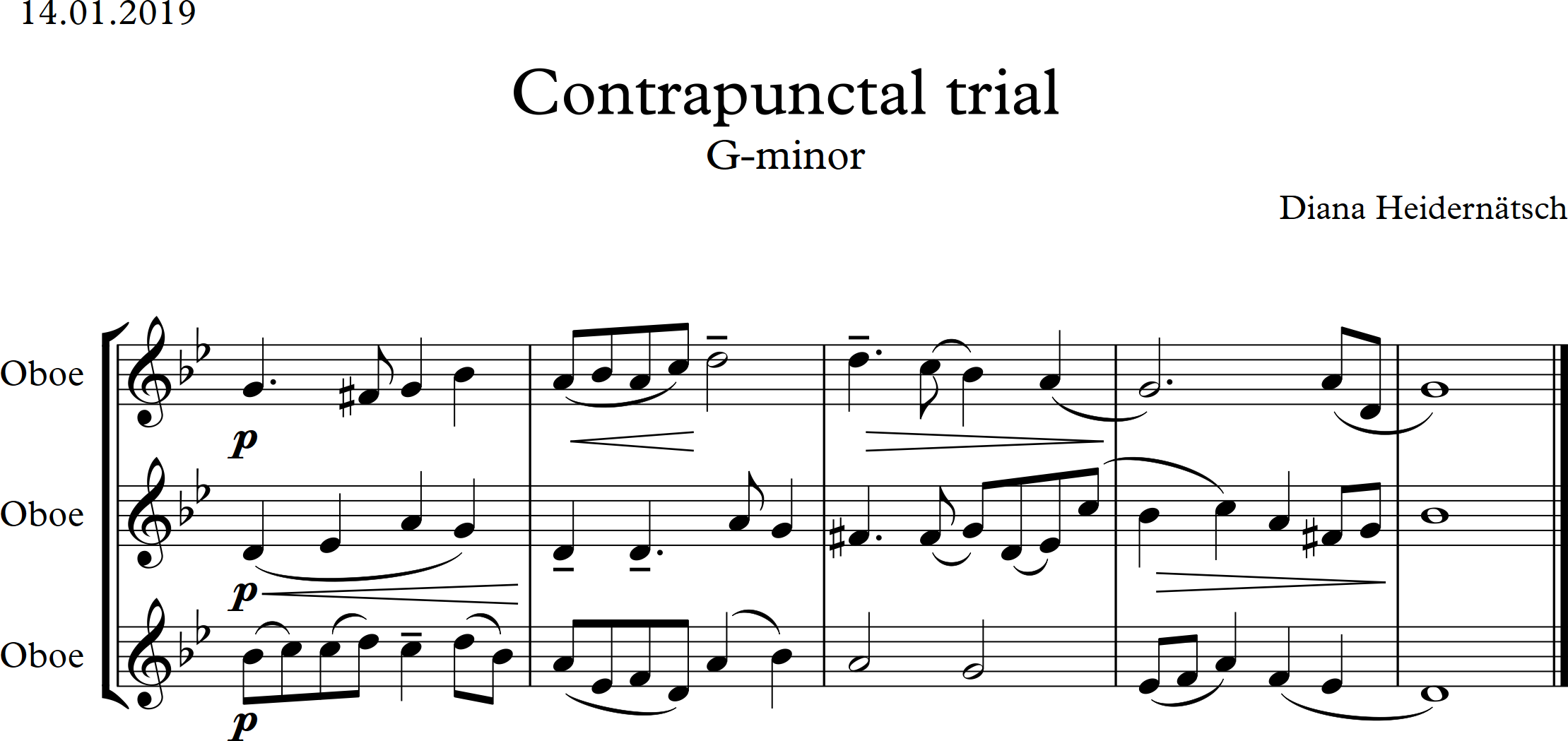
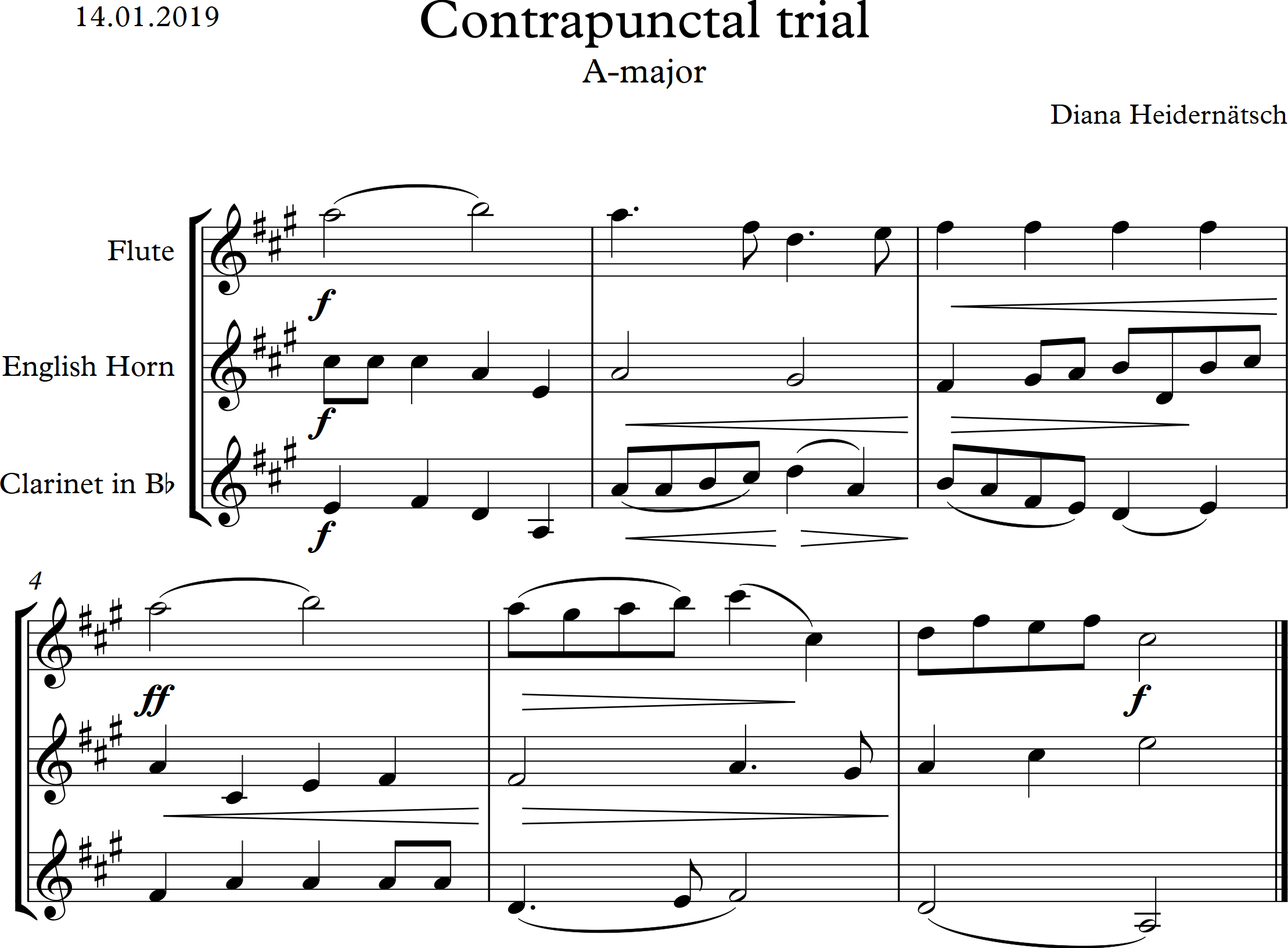
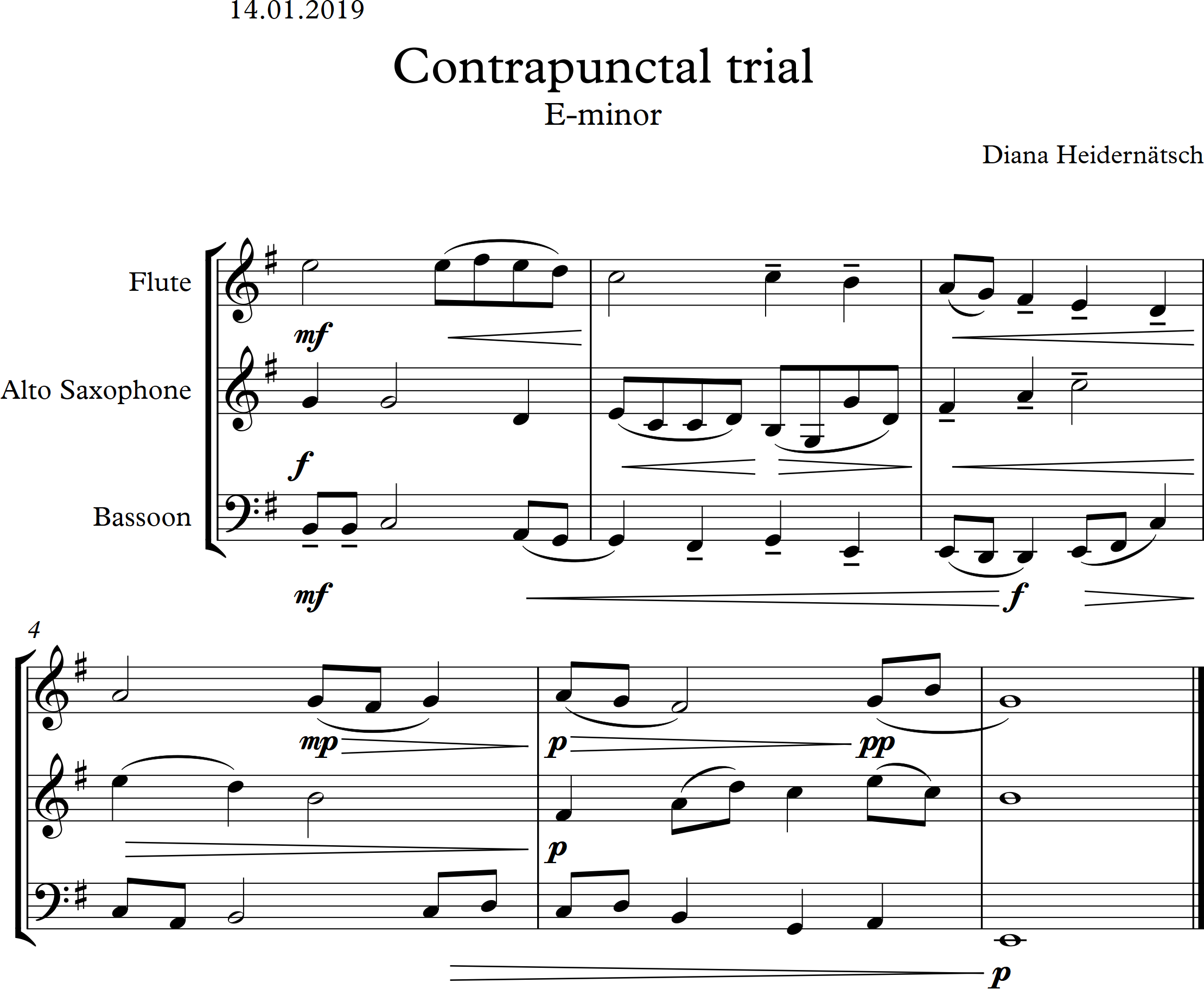
- Project 10: A contrapuntal trial
- Research Points
- Listening Log
Projects
Project 8: Rounds and catches
For this project I was asked to create a perpetual round for four groups of triads. Those rounds could either be for a small instrumental group, or for singers. Whilst writing those pieces, I always followed the same pattern : I wrote down the given triads and separated it for several voices. Those given triads I then divided and spread out staggered. Sometimes I added a new chord (mostly 7th chords) to make the piece sound more interesting. This project is furthermore my first one, where I had the opportunity to add a text to my compositions. I’m not very experienced at thinking of my own words and found it especially difficult due to English not being my first language. Having listened to several other rounds, I realized, that I can address any subject of my choice, even when it ends up being a bit bawdy.
When I started reading through this project, I thought it would be rather difficult to write a perpetual round myself. It took me a while to understand that it is basically just a separation of chords played one after another (when just one voice is singing), which therefore sound consonant again, when being played or sung together. This simplicity surprised me, I therefore really enjoyed working on this project.
For the first round I had the following triads given : 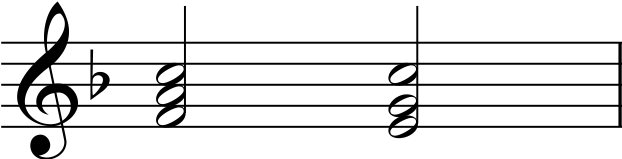
Seen above : An F-major triad in the root position, followed by a C-major triad in the first inversion
Those two triads I separated for three voices. I tried to mainly stick to only F and C, but allowed myself to also include a C-7th-chord, which is normally resolved back into a F-chord.
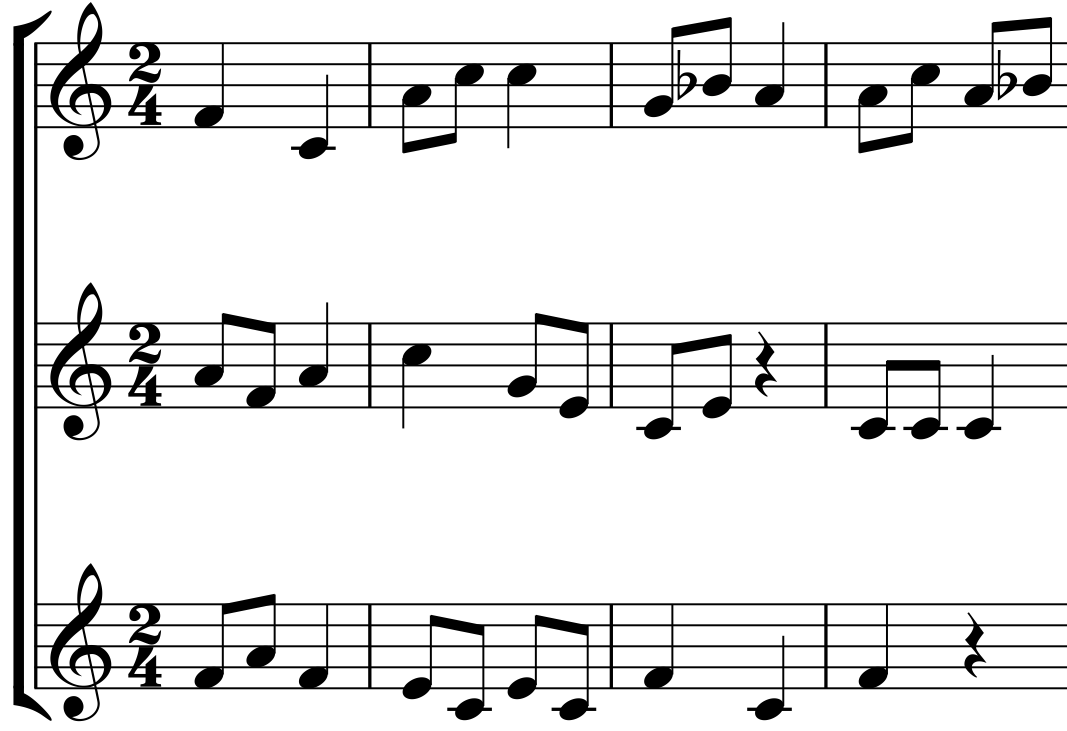
Having thought of a text, I had to adjust the number and duration of several notes a little bit. It may not be the most inspiring text, but it’s a simple idea for a content which ironically came to my mind first thing, as I was sitting in a kitchen whilst writing this piece.
It is structured as most of the other pieces, which I added to my listening log: The first round is sung by just one voice and when the second round starts, the other two voices join in, each one after the fourth bar of the voice above.
The triads for the second round where the following :
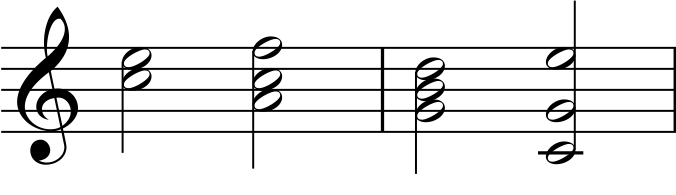
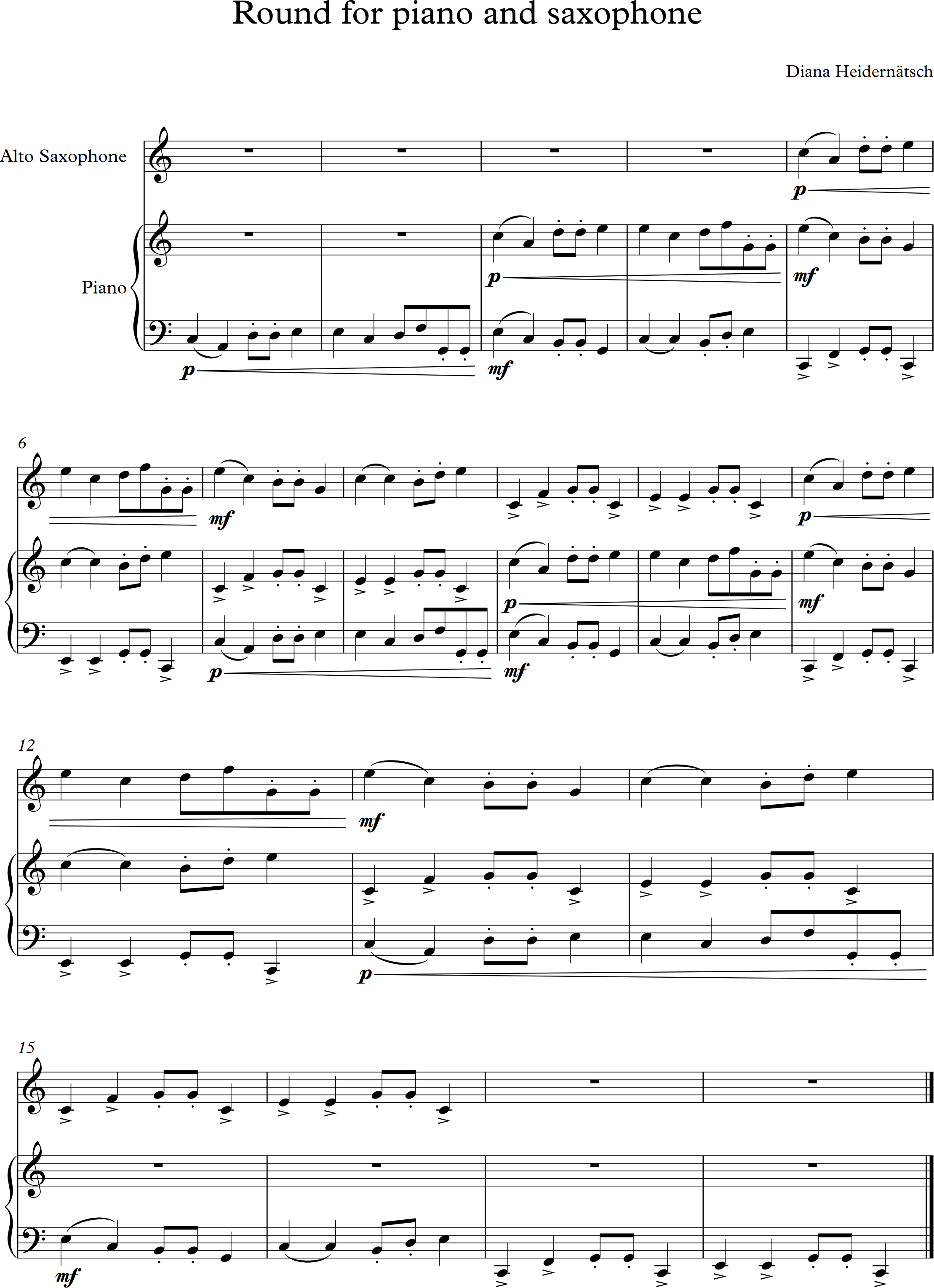
A simple I-IV-V-I cadence, separated looking like this :
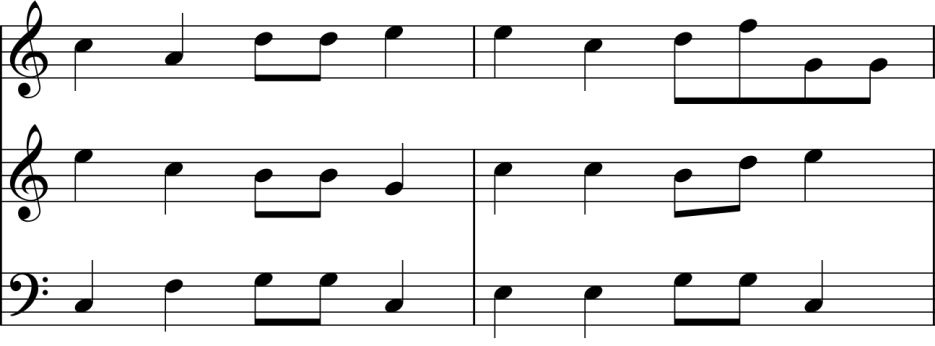
A simple I-IV-V-I cadence, separated looking like this :
Unlike the first piece, this one has the same rhythm pattern in every bar, (except for the very last note in the first voice). It is also written for instruments instead of singers, in this case for a piano and a saxophone.
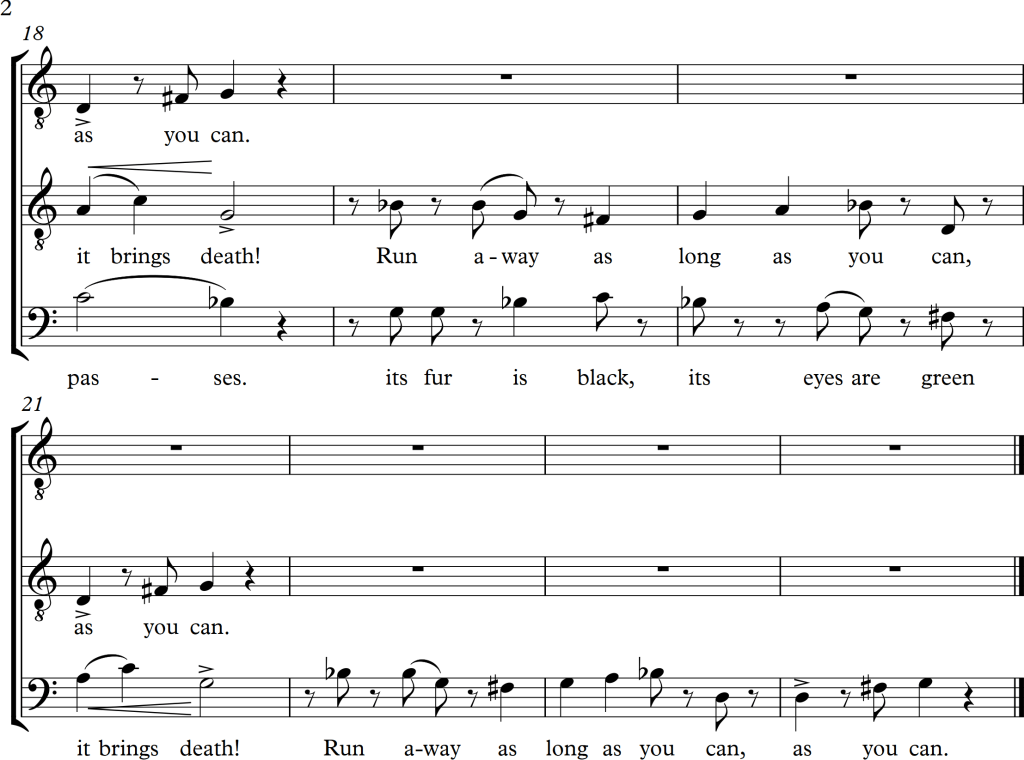
For the third round I had the following triads to start with :
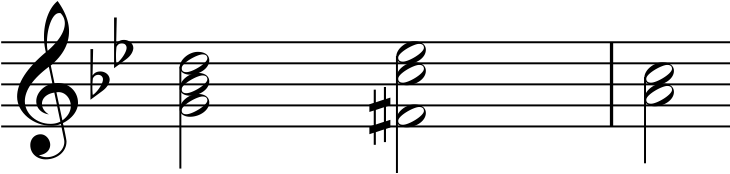
Separated :
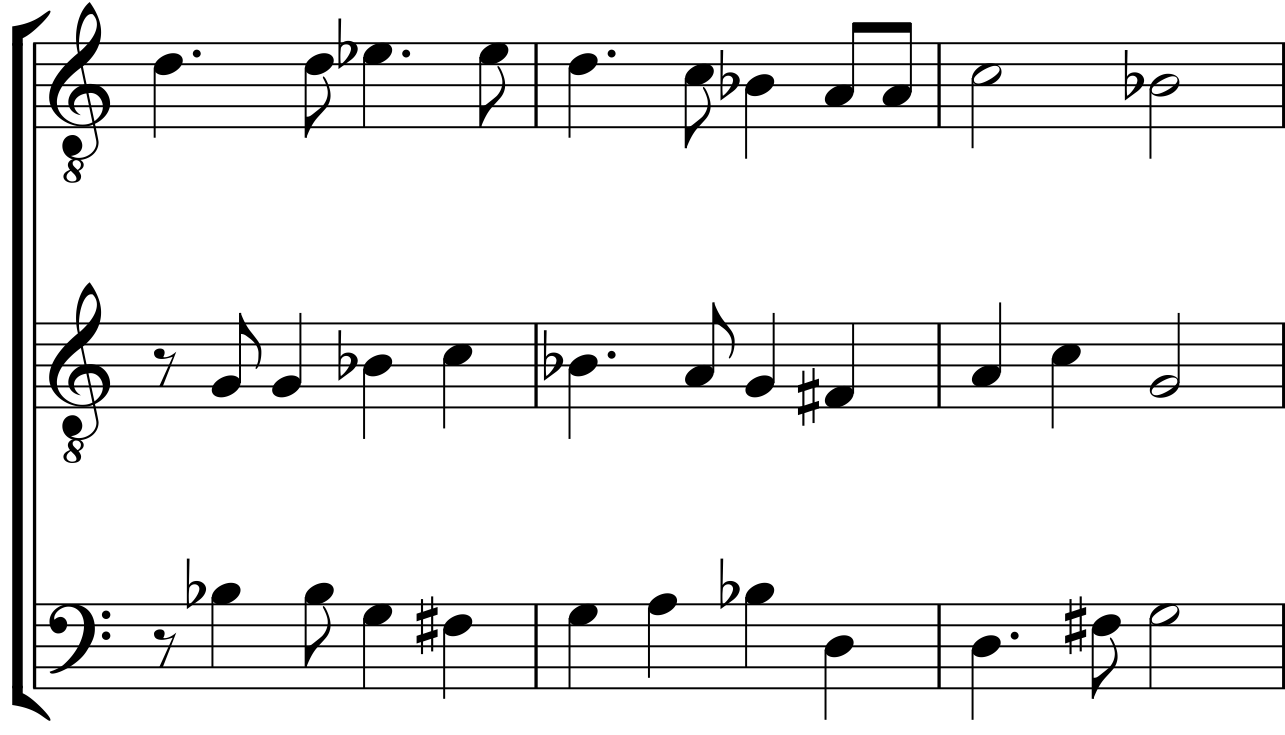
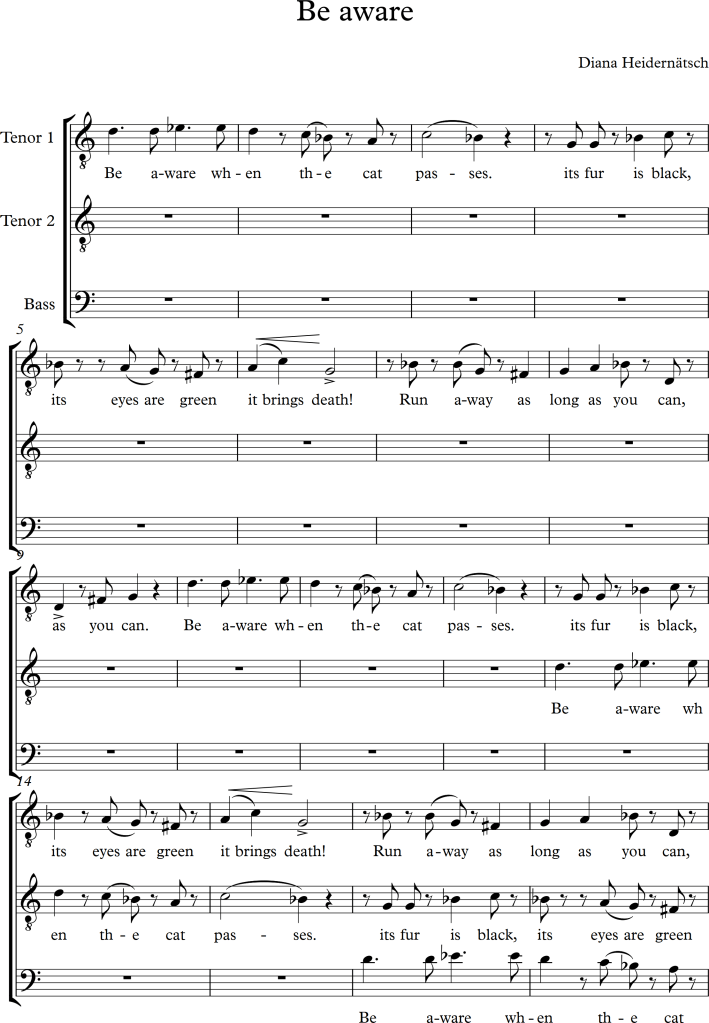
Written for three voices with added text. (Seeing that the triads build a minor cadence, I wanted to make the text a bit more serious as well). To be honest, the subject I’ve chosen may seem a bit excessive and dark, but it was, for some reason, the first thing that came to my mind when I thought about a “dark” subject, that would fit to a minor-piece.
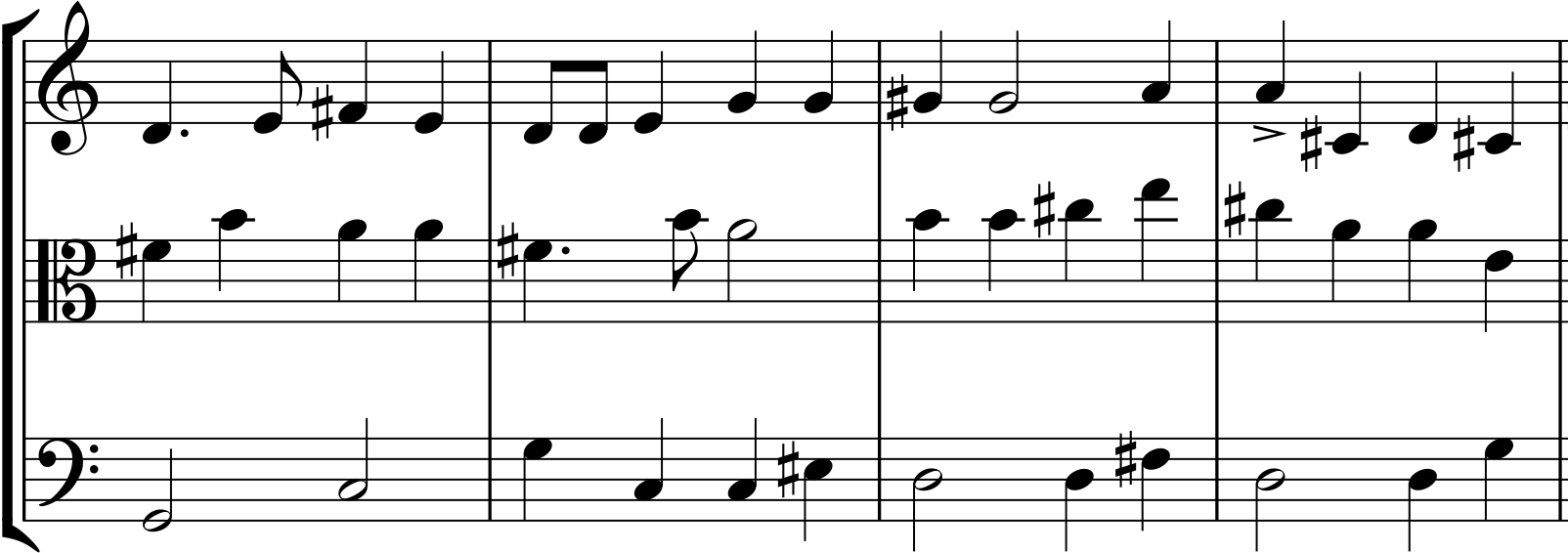
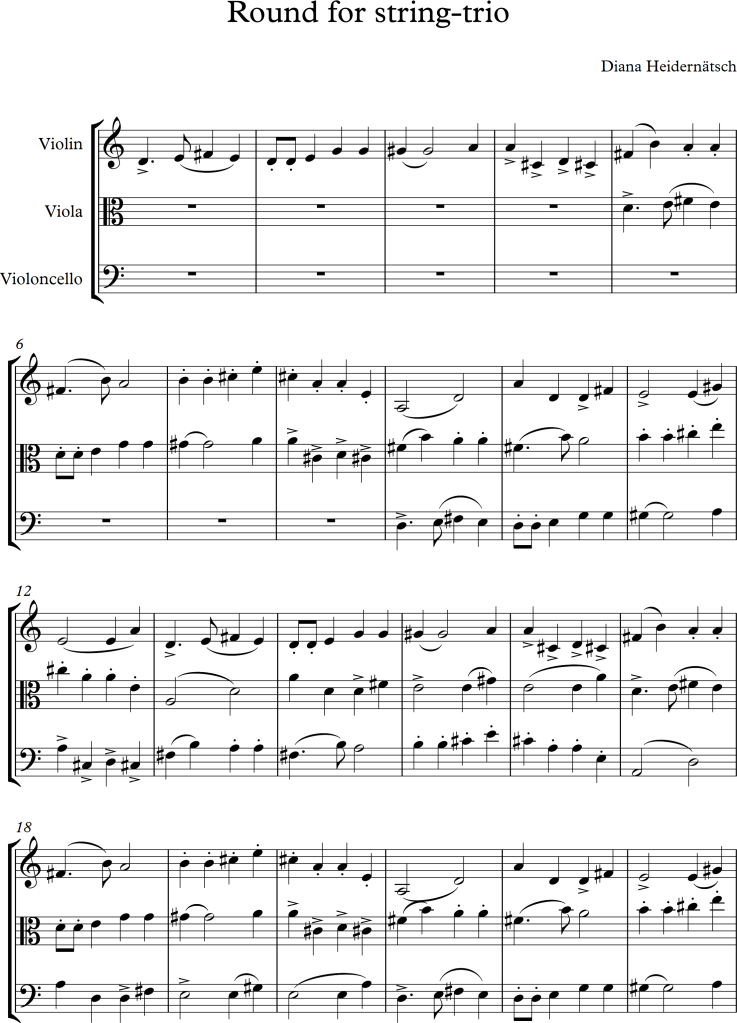
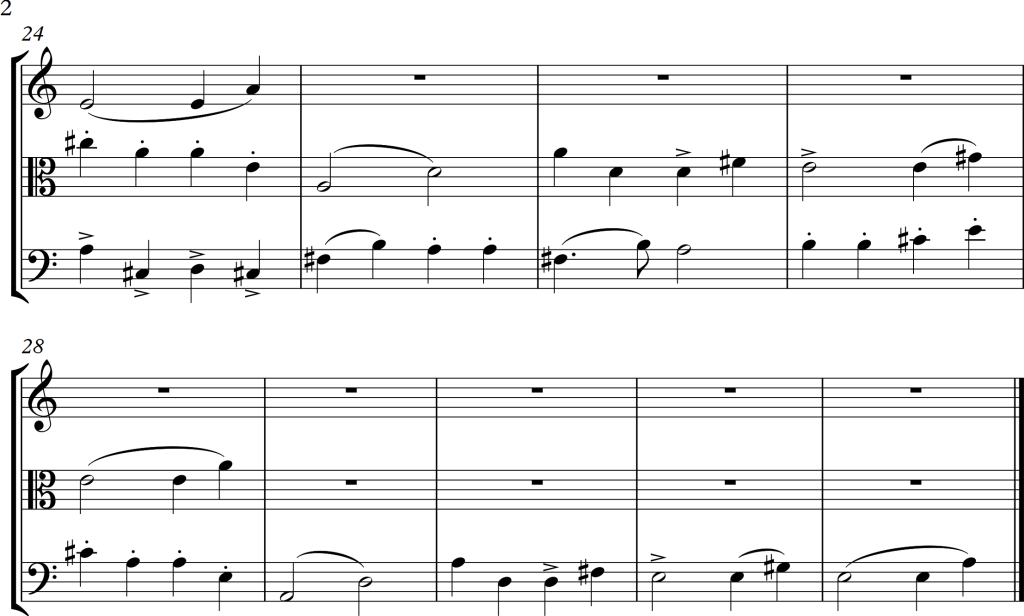
The fourth round I wrote for a string trio.
Given triads are :

Separated :
Project 9: Descants
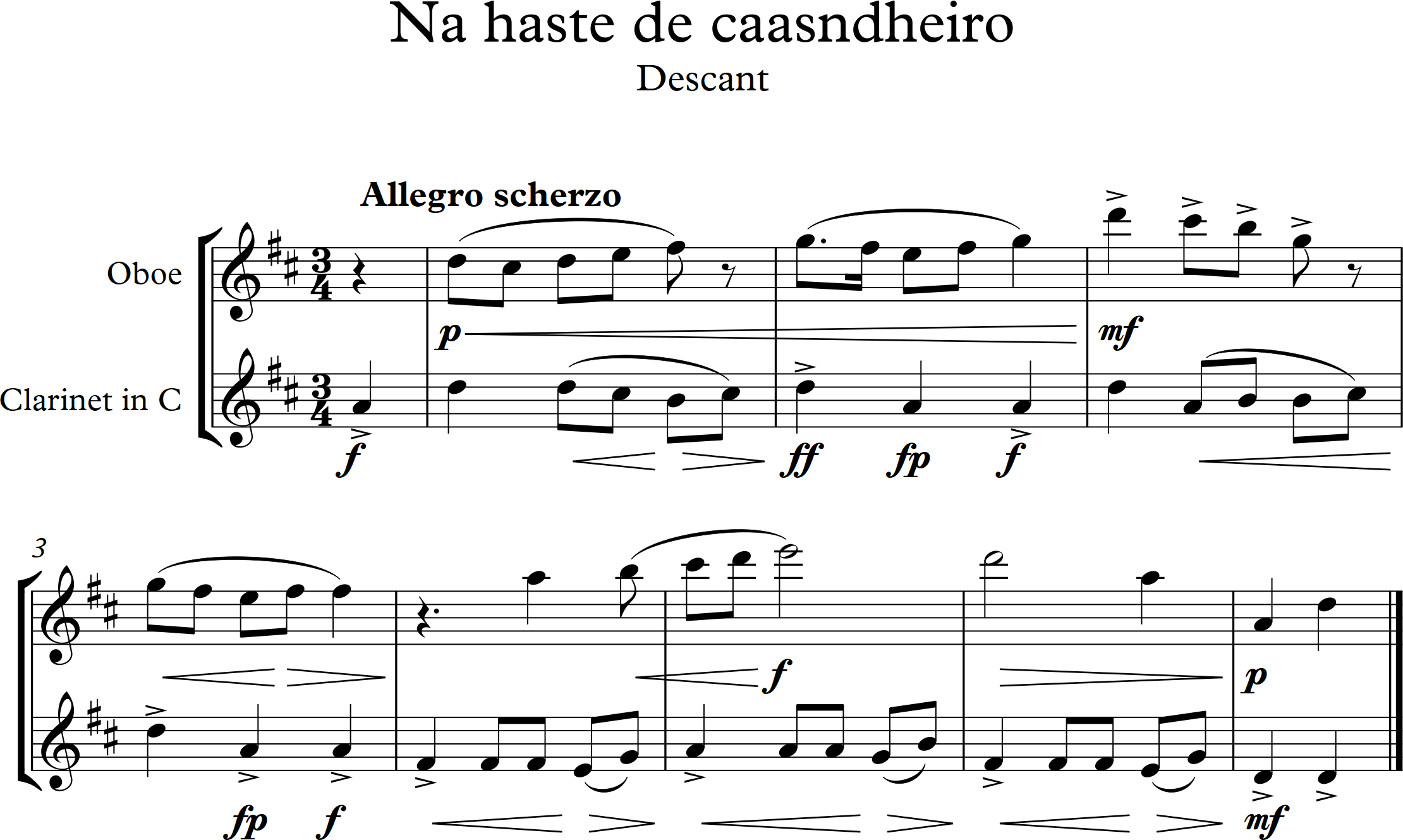
The task for this project was to compose a descant for three out of five given pieces. (mostly simple structured folk songs). Seeing that I quite enjoyed doing the first three, I decided to do all of them.
The definition of a descant from my study folder is “ vocal improvisations, which were added over an existing tune sung by another singer“. From my former musical education, I know several other things about a descant already, which I tried to include or avoid. For example, that one shouldn’t have a 5th or a 8ve consecutive. It is furthermore important to include a contrary movement, to make the piece sound more interesting, but one should be careful to not make the descant voice more important than the main one.
In the following examples the descant is always written above the main voice, which I adjusted with different dynamics. For the very first piece “Queen Pastores” , I had to change the key-signature from F-major to G-major in order to make it playable for the oboe, otherwise the tune would have been to low.
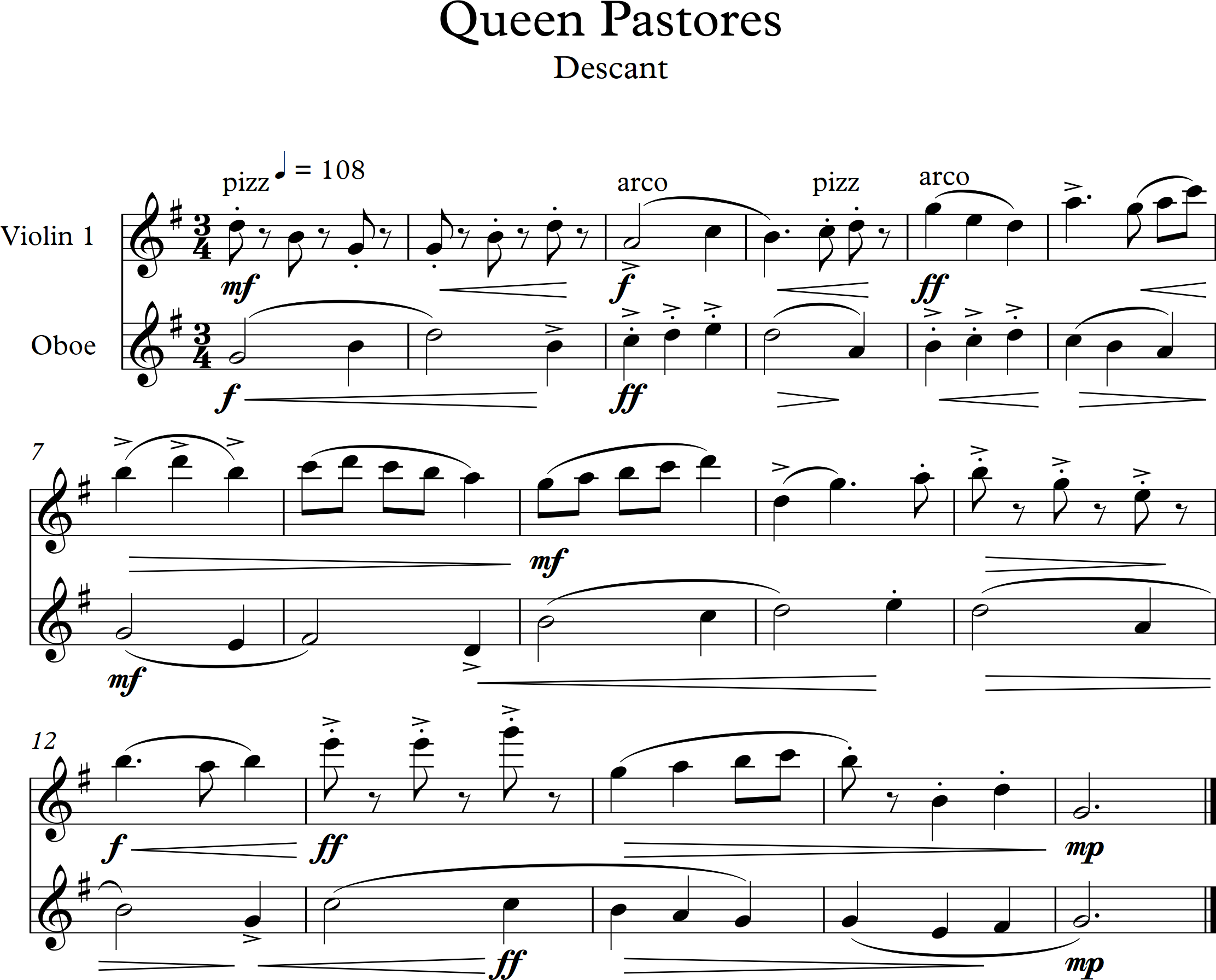
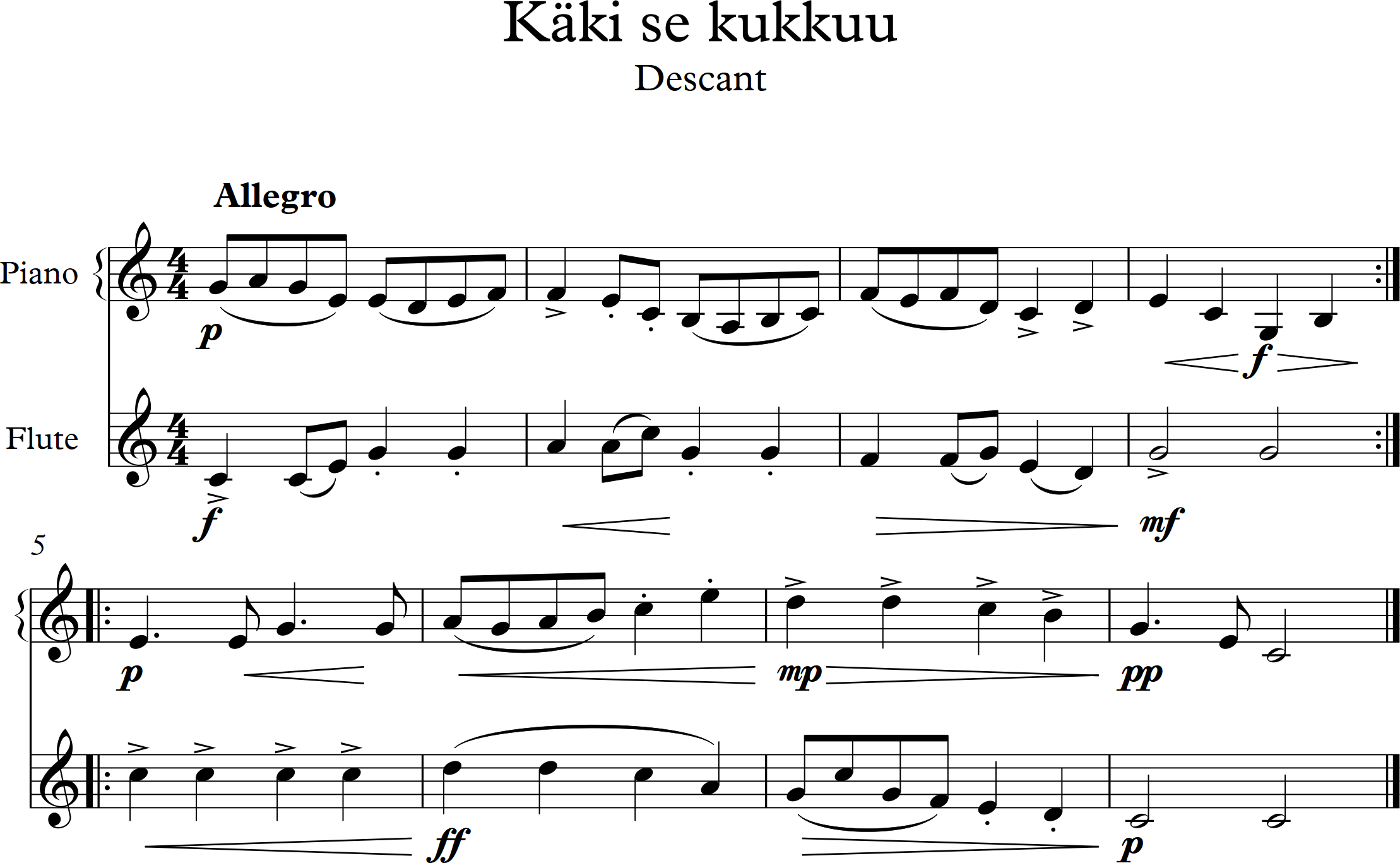
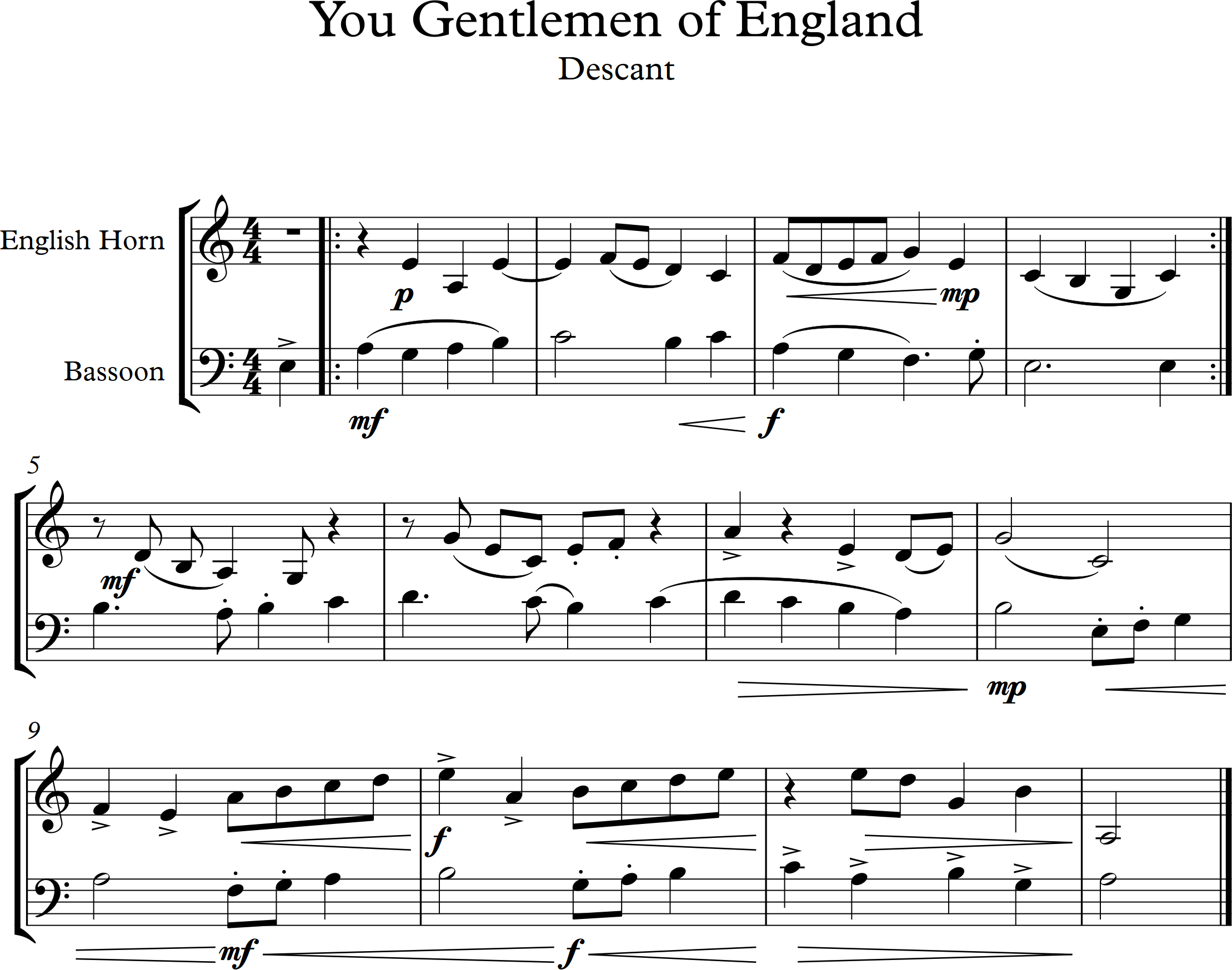
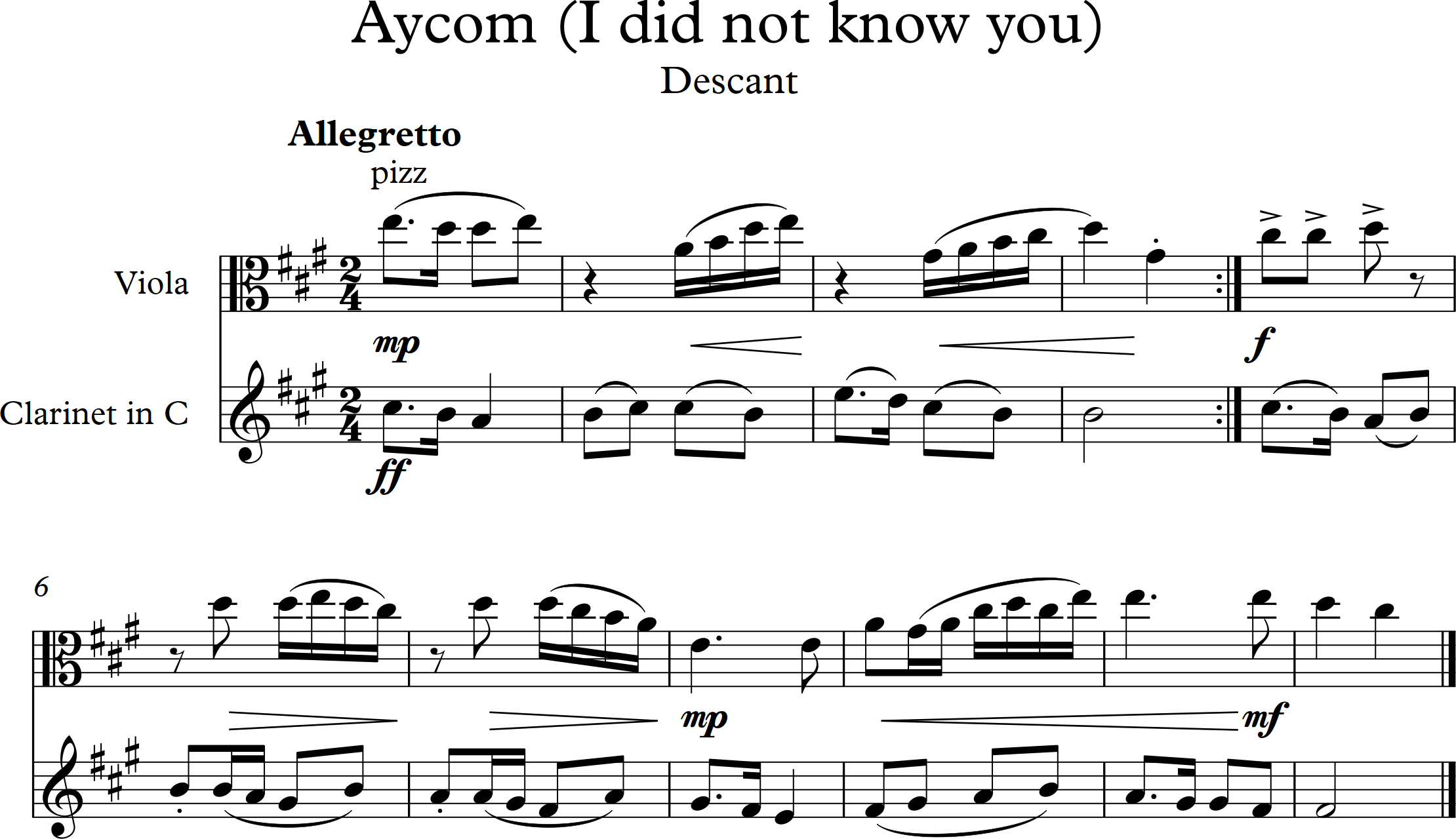
Project 10: A contrapuntal trial
Research Points
Rounds/Catches
At the first research point of this part of the course, I was asked to look out for some examples of rounds. ( A round or catch is a piece of music , with at least three voices, which all sing repetitively the same piece, the voices all start with the same melody but at different times.) I was also encouraged to sing or play some of the examples I’ve found on my own.
Through my own musical experience, I was able to learn, sing and play several rounds already, some of which I couldn’t even find online. The ones I knew from my personal experience already are :
- Baby Just
- Hejo, spann den Wagen an (= Hey Ho, Nobody Home)
- Froh zu sein
- Guten Morgen (same melody as “London’s burning” )
- Dona Nobis Pacem
- Bojeje
Then there are of course the well-known rounds such as
- Row, row , row your boat
- Frère Jaques
- Coffee Canon
A Listening Log entry can be found for some of those pieces as well as several others from other centuries, which I will try to either sing or play on the piano.
I’ve noticed that a certain chord sequence is used quite often. A round is basically made out of a short series of chords, where each played note gets its own voice (and text, when sung). This particular chord series is going downwards four notes, starting from the (minor) tonica ( 1st degree) to the (major) dominat (5th degree). From the list above this chord sequence is used for “Baby just” ; Hejo, spann den Wagen an ( and therefore also ” Hey Ho , Nobody Home” ); and Bojeje. It is furthermore used for the whole, very well-known song “Hit the road Jack”.
One more thing I have to mention here, is that modern pop music often, (not always) uses an average amount of four chords for their pieces. Those chords are being repeated until the end of the song, just always with a different melody (verse or refrain). One could therefore, just sing or play two verses at the same time or verse and refrain together and it would still sound consonant. This would , in a certain way, make some pop-songs to rounds as well. The repetitive simple chord-sequence is also the reason, why most of those songs are incredibly catchy.
Polyphony
At this research point I was asked to listen to some polyphonic vocal music by William Byrd, Orlando Gibbons, Thomas Morley and Thomas Tallis and write about the pieces in my listening log. All the entries concerning polyphony can be found here.
Listening Log
Rounds and catches:
- August Mühling – Froh zu sein
- Dona Nobis Pacem
- Gisbert Brandt – Baby Just
- Henry Harington – Poor Thomas Day
- Henry Purcell – I gave her cake
- Joanne Hammer – Popcorn
- Thomas Ravenscroft – Hey ho, nobody home
Polyphony:
- Thomas Morley – April is in my Mistress’ face
- Thomas Morley – Fyer, fyer
- Thomas Tallis – Spem in alium
- Orlando Gibbons – Hosanna to the Son of David
- Orlando Gibbons – O Lord, in thy wrath
- William Byrd – Though Amaryllis dance in green
Rounds and Catches
August Mühling – Froh zu sein
This round is for four voices and is incredibly short compared to other rounds. The time signature, as well as the structure of the piece are really simple. Except for the first bar, which starts with a dotted crotchet-note, followed by a quaver note, the piece only includes crotchets.
The translation of this quite cheery sounding piece is ” It doesn’t require much to be happy and the one who is happy, is a king.” It was written by August Mühling, in the 19th century and was part of a childrens-songbook called “Alpenrose”. (1)
It is easy to learn and fun to sing along with, especially for younger people, but yet again, it can become boring after a while due to its technical simplicity.
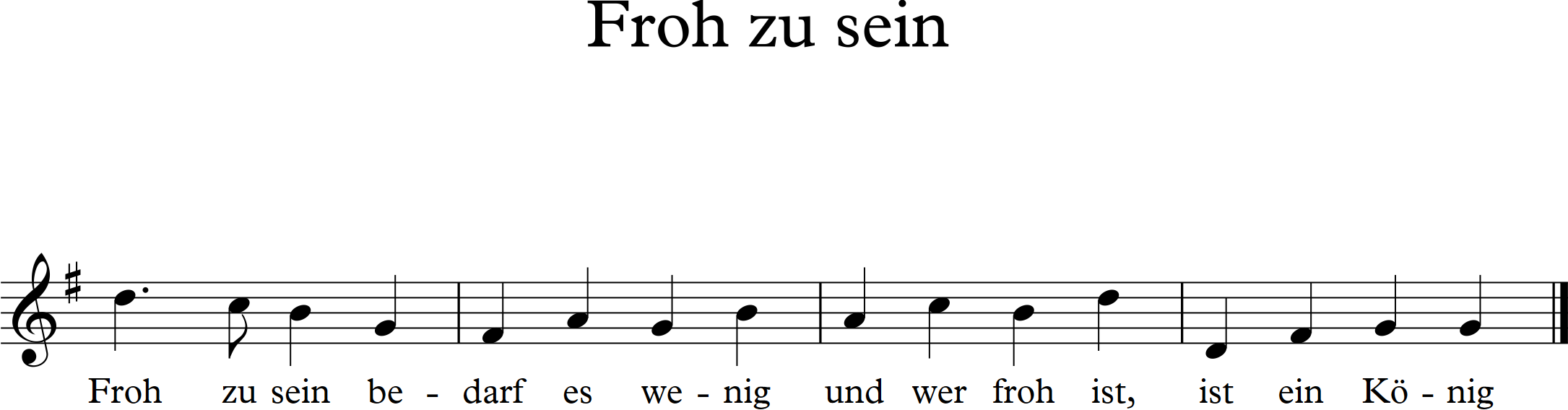
-for one voice, one part is as long as one bar
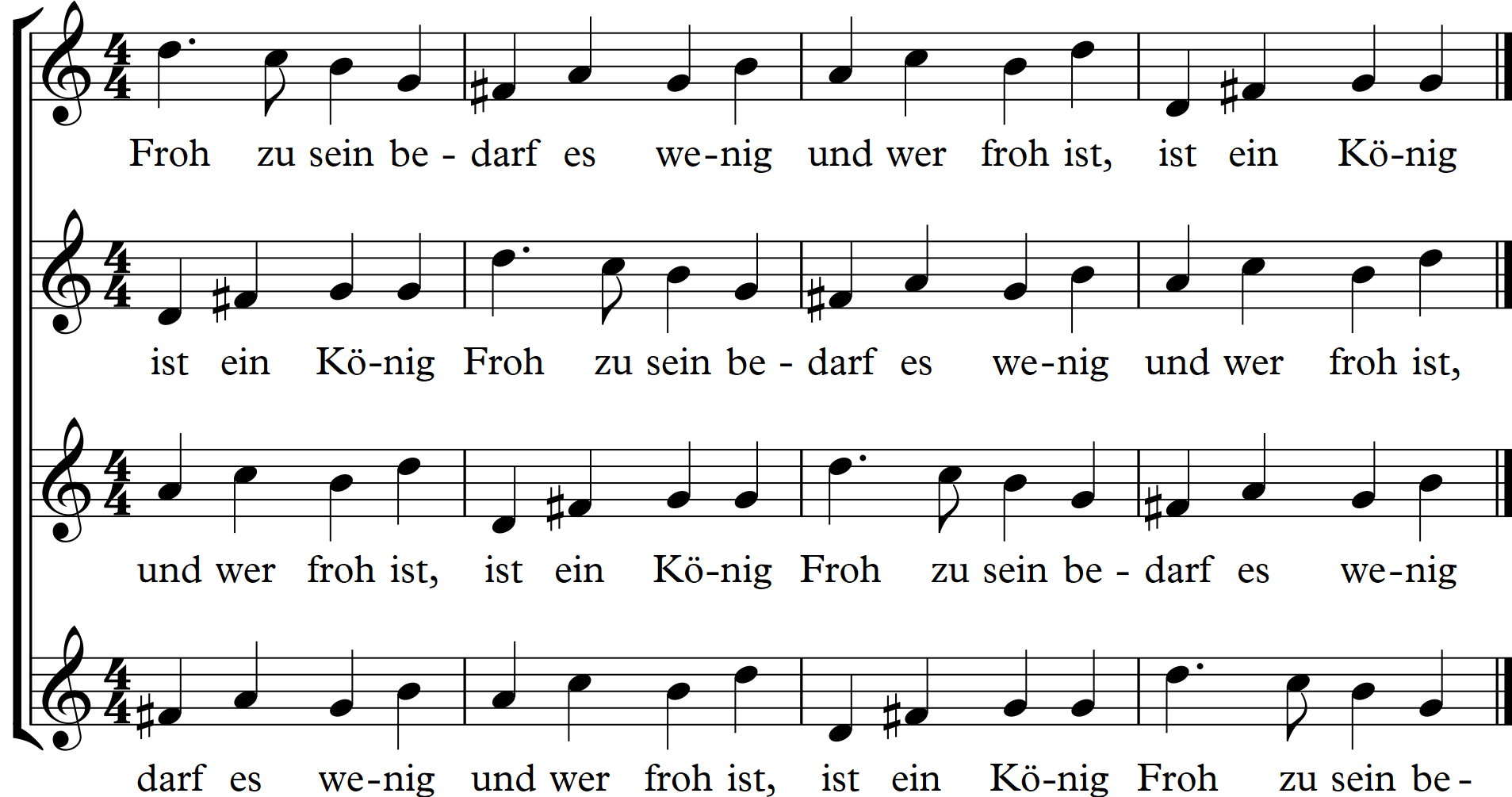
-for four voices
1) Volksliederarchiv, (2018), Froh zu sein bedarf es wenig (online) Available at:https://www.volksliederarchiv.de/lexikon/alpenrose/
Dona Nobis Pacem
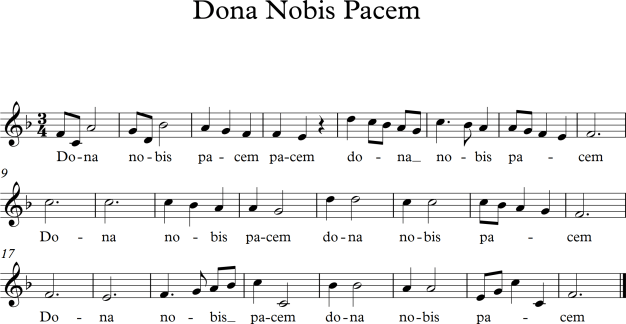
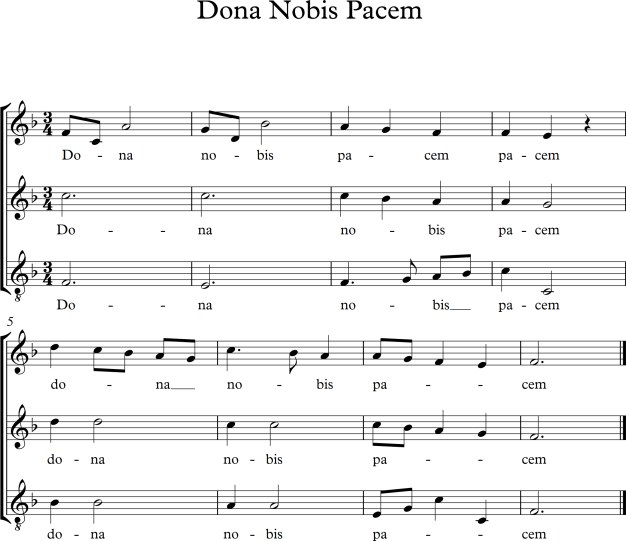
This piece is a round for three voices, its origin as well as its composer are unknown, therefore it is officially put under the category of traditional songs. Some researches show, that the piece was probably written in the 16th or 17th century by an unknown German composer. The title “Dona Nobis Pacem” is Latin and means “Grant us Piece” (1).
As well as other traditional/ folk songs this round has a really simple structure. It may be due to this simplicity, that it has a warm, harmonic sound. The disadvantage of this structure is though, that the round tends to become boring after a while, at least for my own personal liking.
Unlike many other rounds, this one has (except for a slight delay in a few bars in the first part) the same words sung at the same time, when all three voices sing together.
The following two scores will show the piece, first sung by one voice and then by three voices together. A good example of the piece can be found under the following link : https://www.youtube.com/watch?v=mvhzm3rWf9w
Clasical history, (2017). Dona Nobis Pacem (online). Available at : http://www.classichistory.net/archives/dona-nobis-pacem-de
Gisbert Brandt – Baby Just
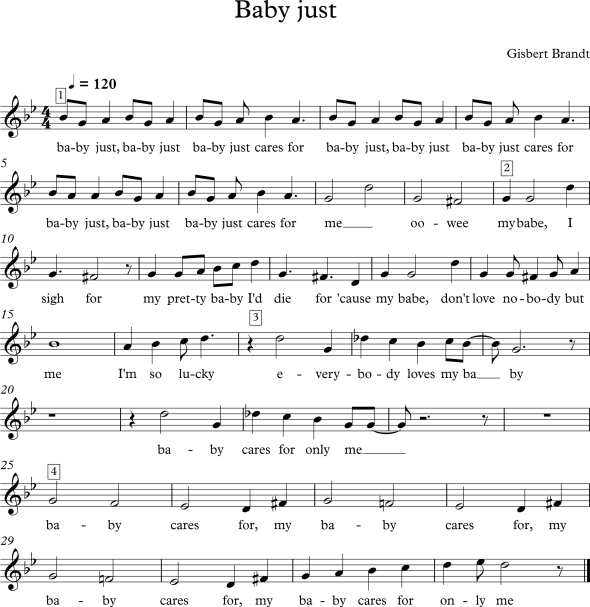
This “jazz-round” is written for four voices and has, compared to other modern rounds unusually long verses. With the third verse making an exception, by having one motive which just repeats itself (slightly varied), verses 1,2 and 4 all have the same structure : The beginning motive of the verse is repeated a second (for the 4th verse) or even a third time (for the first and second verse) , the ending always varies.
The piece itself has, as already mentioned, a very jazzy flair, which especially emerges through the two d-flat-accidentals in the third verse. I really like this round, mostly because it’s a minor-piece ( I usually prefer minor to major). I’m a huge Jazz- fan as well and this is the only round I’ve known (so far), which falls into this genre. Unfortunately, I wasn’t able to find any good examples on any platform, of the version I know. The only interpretation of it, which still has differences with the one below (the scat-singing at the end for example), I found on YouTube under the following link : https://www.youtube.com/watch?v=4PNma7XmchU
My own version is the following one : I put the numbers 1-4 on top of the beginning of every new verse, that’s if they where sung by just one voice :
If four voices (in this case soprano, alto, tenor and bass, but it isn’t specified which voices are needed) would sing every phrase at the same time, it would look like the following :
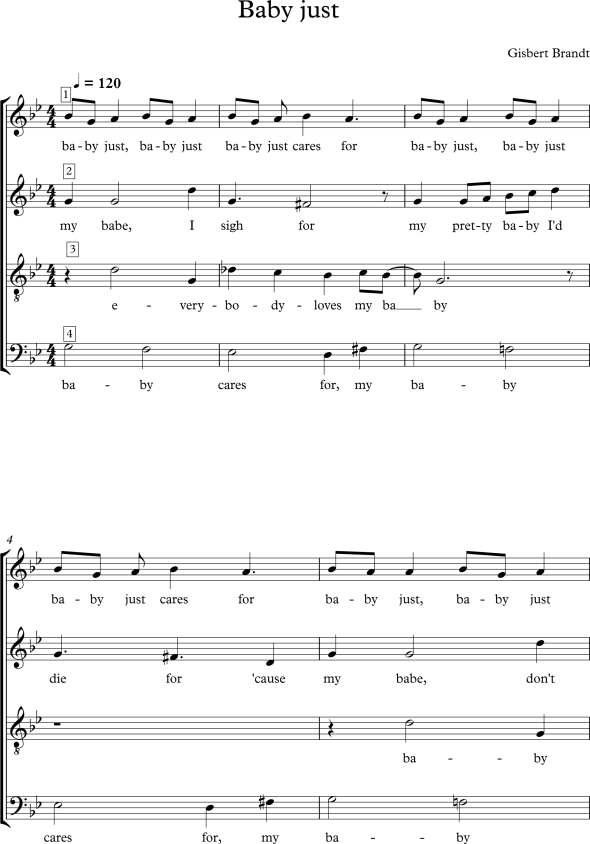
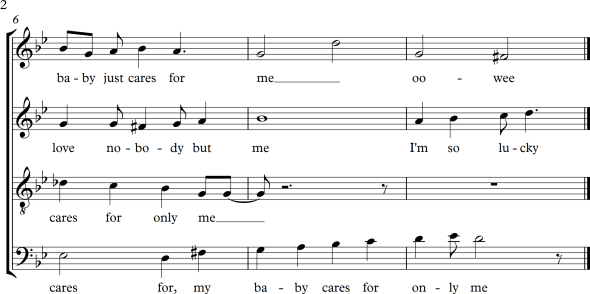
If the score above were arranged for a pianist and put into its basic chords, one would get a chord sequence, which can be played repetitively (in rounds) throughout the whole piece.

The lowest notes of each of these chords build a downwards going sequence from G to D (except for the last bar). This motive, as I found (and already mentioned in the research point for rounds) is used quite often, for several other rounds I know as well as 2-3 pop-songs.
Henry Harington – Poor Thomas Day
This round for three voices was written by Henry Harington. The date of when it was composed is unknown, but it is from the classical period. (1)
I wasn’t able to find an audio of the piece, but found a score in the Petrucci music-library. As suggested in my study-folder I tried to play the piece on the piano, first the three voices after one-another and then together. That I found, was quite helpful in terms of getting to know the structure and character of the piece.
The piece is meant to be sung slow and even though it is in a G-major Key-signature, I would describe its character as slightly dramatic and curious. Even though the sections are quite short, the round has a interesting chord sequence.
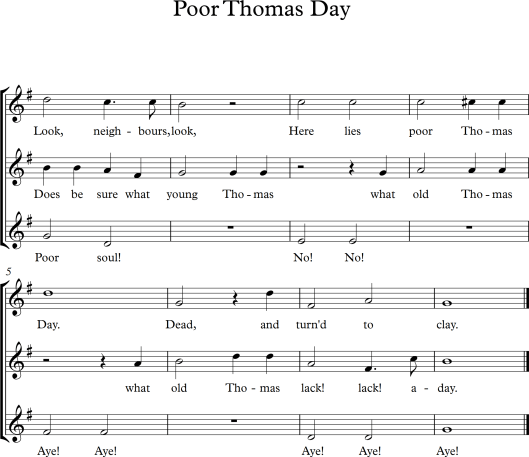
I wrote the piece down a second time to make it more legible, the original version was povided from the Petrucci music library.
1) IMSLP (2012), Poor Thomas Day (Harington, Henry) (online). Available at : https://imslp.org/wiki/Poor_Thomas_Day_(Harington%2C_Henry)
Henry Purcell – I gave her cake
Unfortunately I wasn’t able to find a score of the piece online. It is written for three voices in a 6/8 – time signature and has quite long sections compared to most other pieces I’ve put into my listening log so far.
The text is the following :
- I gave her cakes, and I gave her ale,
and I gave her sack and sherry,
kiss’d her once, and I kissed her twice,
And we were wondrous merry. - I gave her beads and bracelets fine,
And I gave her gold, down derry.
I thought she was afear’d, till she stroked my beard,
And we were wondrous merry - Merry, my heart’s merry,
my cock’s merry,
my spright’s merry,
merry, merry.
Suitable to the text, the round has a really cheery character, and is sung by men. A appropriate version of it can be found under the following link : https://www.youtube.com/watch?v=LvGp6FE8CHQ. I tried to play the melody on the piano, but due to the rather fast tempo in the first and second part, it was hard for me to follow and find the right notes. Nevertheless I really enjoyed listening to it, due to the cheery tune and the obscure text.
Joanne Hammer – Popcorn
Listening to this fast paced round was incredibly entertaining. It is a modern piece, written for six voices. It has a really cheery, amusing mood. Unfortunately I wasn’t able to find the score nor the text of the piece online, but an audio of it can be found here : https://www.youtube.com/watch?v=5U9y_H3ygg8
One thing that made me choose this piece, is that the singers also use other ways of making sounds with their bodies. In this case claps, snaps and even a “pop” sound, produced with the mouth and matching the text can be heard.
I tried to play the melody on the piano myself, which wasn’t easy at first, due to the fast tempo of the piece, but after a while I memorized the structure and was even able to play two voices time wise separately from one- another.
Thomas Ravenscroft – Hey ho, nobody home
This piece was written in the 17th century by Thomas Ravenscroft. It is slightly unusual compared to other rounds, because there are two ways of performing it.
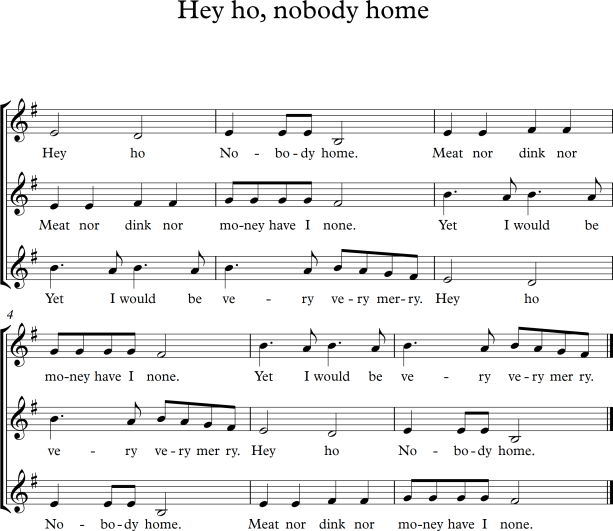
The whole piece sung by one voice would last for 6 bars, if one would put every two bars in one section, then the piece can be performed by three vocalists. The optional bass-line for the piano could be either just the two notes e, followed by d in every bar, or a downwards going section starting from e (assuming the piece has an e-minor key) as shown in the score below :
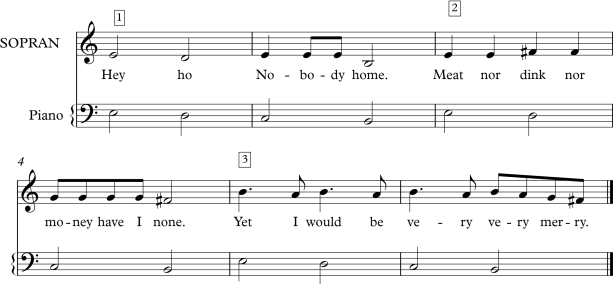
The round, parted into those sections and sung by three vocalists would therefore be :
The second way on how to perform this piece would be to put every single bar from the first score into one section, so that the round could be sung by a maximum of six people :
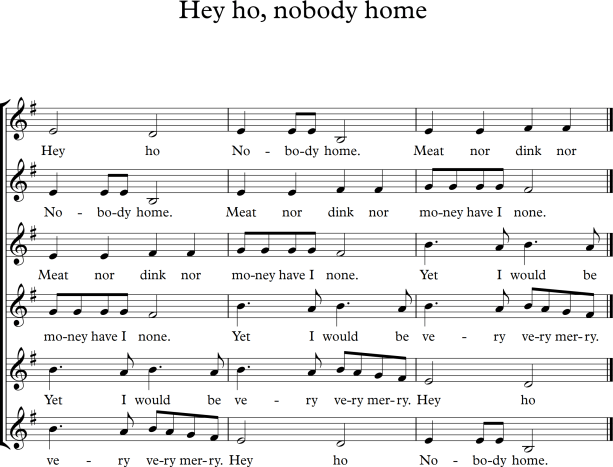
This though, is a version I myself haven’t found anywhere else yet, but due to the already mentioned possible bass-line which always switches between e and d, the piece would still be harmonic.
I came to this round through having learned the German version a few years ago. It is one of my personal favourites in terms of rounds. Mainly due to its dramatic character, and most of the other rounds I know are often in a major key, whereas this one is in minor.
Polyphony
Thomas Morley – April is in my Mistress’ face
This is a short piece for four voices (Soprano, Alto, Tenor, Bass), which creates, with a G-minor key signature, a quite dramatic and melancholic mood, nonetheless, some really short motives also create a feeling of hope. The change of dynamics is fluently. As well as in Morleys’ piece “Fyer, fyer” , the text can be well understood due to it being sung almost simultaneously throughout the whole piece.
It can be clearly divided into four parts, whereas every part has changes in the text and the melody. As already mentioned, even though the piece provides a generally sad feeling, there are small sections, sometimes only just one chord, which seem to lighten up the mood a tiny bit.
All of the four parts include different melodies, which only have slight differences between one another. Morley often uses distance of a major third interval, when Soprano & Alto or Tenor & Bass sing together. In the first part (bars 1 to 9) the mood stays sad and melancholic throughout. The second part goes from bar 9 to 15 and creates a fuller sound towards the end. At the beginning of bar 13 (which is in the centre of the second part) all voices build a F-major chord, which gives the colour of sound a change. It finishes on a B-major chord (which is the relative to g-minor). The third part (bar 14 to 23) works, compared to the previous one, the other way round, colourwise.) It starts of more positively and slowly creates a dramatic character, which is taken over from part 4.
Part 4 ( bars 23 to 38) has a bit of a different structure; this is the only part where a motive from the melody is repeated (the last 6 ones; bars 32 to 38). Even though the story that is being told comes to its most dramatic climax, the melody suddenly changes to an unexpected G-major ending-chord.
Due to the dramatic, but also the diversion of the melody, I really enjoyed listening to this piece. It is rich in variety, but the parts are still similar enough to one another, that it doesn’t become uninteresting.I was especially positively surprised by the major endings in the last part.
A score, provided by Andrew Sims can be found under the following link : http://www1.cpdl.org/wiki/images/9/99/Morley_April.pdf
Thomas Morley – Fyer, fyer
This piece mostly (there are a few exceptions) creates a feeling of hectic, but it also gives away a rather positive mood in most sections. “Fyre, fyre” is written for five voices of a mixed choir ( Soprano 1&2, Tenor 1&2, Bass) in f-major and one thing which is really distinctive, is that has quite abrupt tempo changes, whilst the modifications on dynamics work more fluently.
The whole piece is divided into 2 stanzas, whereas, at the end of the piece, the melody is repeated from the beginning, but the text changes. Both of those stanzas can each be parted in another 9 parts, which I labeled from a to e (some parts are repeating themselves). The entries from the different voices singing the same text is almost always at the same time, which makes it easier to understand the plot of the piece. The whole form of one stanza would be a, b, c, d, e, b, c, d, e. In the following paragraphs I’ll try to explain those parts further.
a
Goes from bar 1 to 12, but is being repeated and therefore ends at bar 24.Due to the often changing dynamics (ff, mf, p) and the text, it seems to be giving a hints of what else lies ahead. As already mentioned, the piece creates a feeling of hectic, which has an even stronger effect in this part due to it creating an abrupt start.
b
From bar 24 to 27 Morley creates a short bridge between part a and a very contrasing c-part. The pace and colour of sound is the same as in the previous section
c
This is the only part that makes a major contrast to the others, it lasts for 6 bars (28 – 34). The key changes to d – minor (which is the relative to f major and therefore has the same key-signautre). The notes are held much longer, which makes this part of the piece sound slow and melancholic. The segue between b and c as well as c and d both come rather unexpected, but part c therefore creates a nice change compared to the fast moving rest of the piece.
d
Making another abrupt change, which leads the melody back to the first parts, the unusual thing about part d is, that the entries of the voices are more shifted than in the other parts. Its lasts from bar 34 to 43.
e
Until the melody comes back to part b, this part is filled in with notes sung as “fa” and “la”, that makes the audience more aware of the melody, which even seems a little cheery due to the text and melody.
For me it isn’t a piece that I would add to my personal music collection, but I nevertheless enjoyed listening to it. I was quite surprised at the contrast in part c. Otherwise, I generally felt it was a bit to fast. Due to those few cheery sounding parts the piece actually sounded a bit absurd the me, because the text actually gave away a rather serious plot. One thing I liked though, was the fact, that the choir sung the same text either simultaneously or only with a little delay, which made it easy to follow the melody and text of the piece.
The score of the piece, provided by James Gibb can be found under the following link : http://www2.cpdl.org/wiki/images/a/ad/Fyer%2C_fyer%21_Morley.pdf
Thomas Tallis – Spem in alium
This motet for 40 voices, which has a duration of about 8 minutes, was written 1570 by Thomas Tallis. The title translated from Latin, means “Hope in any other”. The composer got inspired by Alessandro Stiggio, another composer from the 16th century. Who wrote the piece “Missa sopra Ecco sì beato giorno”, which is also for 40 voices. (1)
Structure :
The whole piece creates a lovely, encouraging and calm atmosphere. It stays in a medium tempo and is mainly consonant. Even though no instruments are being used, the piece has some parts where it sounds like something is being played, this is presumably caused by the amount of voices.
The choir itself is divided into 8 groups, whereas each of these groups contains a Soprano, Alto, Tenor, Baritone and Bass voice.
Due to so many voices singing, several small motives repeating themselves and the fact that this piece is polyphonic, it is difficult to find a “main theme”. Nevertheless, “Spem in alium” can be easily divided into three parts:
Part 1
In part one, one voice (Alto from the first group) starts, and all the others from the group join in one after another. The remaining seven groups start singing in the right order (group 1 to 8), whereas none of the single voices starts at exactly the same time. When the last few groups start singing, the first ones have already finished their motive. Once every group has had at least one part, the first section, where every voice is singing together, starts (bar 40). This lasts for five bars until the same scheme with every group joining in starts again, this time the other way round (group 8 to 1 ). Followed by another 6 bars of all voices singing together, the different entries of the groups appear a third time, with no particular pattern (or at least no pattern that I could find). This figure of groups just randomly joining and leaving goes to bar 108, where, for the very first time every voice is on a minim rest. This rest comes unexpected, considering that this first part of the piece (which is also by far the longest), had constantly at least one voice singing and for some reason I expected the melodies to be continued.
Part 2
This part makes a bit of a contrast to the previous one. Even though all voices start with the same strong motive, they separate after a few bars and only a few groups (maximum of 3) keep singing. The mood changes to something more sad, melancholic or lonely. The pattern of the voices making an entrance is the same as in the second section of the first part, groups start to sing from the bottom to the top, starting from group 6. Therefore, groups 7 and 8 don’t get to sing in this part. The end of it is signalized by the only other minim rest.
Part 3
Except for one or two bars at the beginning, all voices sing together in this part, which is the shortest one. Its only purpose is presumably to get the audience back to the mood of the first theme, whilst creating a very strong sound with all 40 voices included.
My personal opinion
I had the opportunity to play and sing some polyphonic peaces already, and I always really enjoyed it. For this piece, I really liked the theme of the piece, but it was too long until changes (that short second part, mentioned above) where made.
It didn’t become boring, which is probably mainly caused by me (and I suppose most other people as well) wanting to find one voice, which out stands the other ones. This of course is not possible, because all voices are equal, but I still, automatically tried to find a main voice, which kept my mind busy. Interestingly, every time one of the higher voices (sopranos) could be heard, I ended up following only them for a while, due to the high pitch, they seemed a bit more prominent than the other voices.
I got a little irritated after a while of having listened to it, because, until the piece reaches that fist break, it seemed a bit like a chaotic melody which wouldn’t ever end. Furthermore due to those varied entries of voices with some already singing, it somehow sounded a little bit like there was constantly someone whispering in the background.
One could say, that, even though “Spem in Alium” is for 40 voices, it becomes quite monotone-sounding after a while, simply due to its length. The only thing that still kept it a little it interesting for my were the dynamics. Even though one can barely find any changes of dynamics in the score, the usage of the amount of voices made huge differences.
References:
- Legge, P. (2008). Spem in alium nunquam habui, A motet for 40 voices by Thomas Tallis (c.1505 – 1585), 1st ed. (pdf). Available at : https://www.cpdl.org/wiki/images/5/55/Tallis_Spem_in_alium_full_score_PML.pdf
Orlando Gibbons – Hosanna to the Son of David
The piece “Hosanna to the Son of David” was originally in an F-major key, the version I found is a major second lower, in Eb-major. It is written for 6 voices; Soprano I, Soprano II, Alto I, Alto II, Tenor and Bass. Unlike the pieces I’ve observed before (April is in my Mistress’ Face and Fyer,fyre by Thomas Morley) the voices have more individual entries throughout the whole piece. It is furthermore in a medium slow pace and has a calm character.
The composition can be divided into 5 parts which are each completed with one Eb-chord where every voice sings a note at the same time (with a few exceptions). For the rest of the piece they all have entries at different times, they nevertheless all have the same text within one section. None of those five parts seems to be the most imported or most outstanding one. They are all compositionally similar to one another.
In the first part all of the voices have a similar sequence at the beginning, whereas Soprano I & II, Tenor and Bass start on the tonic of the scale Eb and the two Altos start on the dominant Bb. For the completion of the first part every voice, except for the bass lands on a Eb chord in bar 12.
For the beginning of he second part all voices start on an Eb, except for the Tenor voice, which starts on G (the major third). Similar to the start of the first part most of them move upwards within the next few bars, except for the two Sopranos, which make a contrary motion downwards. This part ends in bar 21 the same way as part 1 on a Eb-chord , which is bulid up by every voice this time.
The third part has different entries again on either the tonic or the dominant. There are two exceptions this time, which give this part of the piece a more colourful sound : Alto II makes the second last entry for this part on F and the Bass, which only joins in much later than the other voice starts on an A. This part is slightly longer to the previous ones and creates a harmony, that sounds a tiny bit more dramatic than the previous parts. It ends the same way the second part ended, except for that some of the voices where given different notes of the Eb-triad.
The start of the fourth part is the only time where at least three voices sing the same text at the same time (except for the end chords of the parts), which creates a nice difference, even though this sequence doesn’t last for long. After three bars they all starts drifting apart from one another again. The end of this part isn’t as clearly defined as the other ones. This is due to the bass already starting with the 5th part before the rest of the voices, except for the Tenor build up to form another Eb-triad in bar 61.
Part 5 is with only 6 bars by far the shortest. It starts similar to the third part and ends as all the other ones do. With every voice singing and an ritardando at the end.
To me the piece seemed rather long and monotone to me. The only change to it were those few starting bars in part 4, where always three out of the six voices sang at the same time. I sometimes find it difficult to follow polyphonic compositions, because there isn’t one main voice that can be followed, I always end up concentrating on just one of the voices, which makes it difficult to analyse the others.
A score of the piece provided by Diana Thompson can be found under the following link: http://www3.cpdl.org/wiki/images/9/95/Gibbons_Hosanna.pdf
Orlando Gibbons – O Lord, in thy wrath
O Lord, in thy wrath is a very slow paced melancholic, sad sounding piece for 6 voices (Soprano I, Soprano II, Alto I, Alto II, Tenor and Bass). It has an F-minor key signature and is mostly consonant sounding. There are nevertheless a few dissonances, which are always being resolved into a consonant chord. Gibbons furthermore often uses accidentals to create more varied, colourful sounds.
I was able to divide this piece into 6 parts. The transition from one part to another is more fluently in comparison to other pieces I’ve listened to so far, which made it a bit harder to find a start and an end of a new part.
The first part makes a soft start with only soprano I singing an f, shortly followed by a brief dissonance, created by Alto II singing an f and Soprano I singing a g. This dissonance is resolved shortly after. The timing of this part is different for every voice, but its en can be seen by the two Sopranos and Alto I forming a F-minor chord in bar 12.
The first entry for the second part is performed by Alto II in bar 11 already, the theme of this part is slightly different, still as dramatic as the first part, but with some small positive effective sides. For the whole part all voices have different timed entries, which makes it admittedly difficult to understand the text, but therefore the voices form rather beautiful harmonic chords. The end of this part can be found in bar 17, where Soprano I, Alto II, Tenor and Bass come to an end, whilst Soprano II and Alto I start with the next part.
In part 3 the voices seem to work together more, rather than against one another. There are always 2 or three voices which perform at similar times with the same text (the notes don’t have the exact same time values though). In bar 23 all the voices land on a half note which form a F-major chord, making a nice change to the minor piece.
The forth part starts simultaneously for Soprano I, II and Alto I, but as soon as the other voices start to singing, those first three voices start distributing again. This part ends in bar 30 where again, a f-minor chord is being formed.
The most interesting thing about the fifth part, is that, most of the time all the voices sing the same text at the same time, with only a few deviations. Towards the end of that part, the voices get distributed a tiny bit again, which makes it very unclear where exaclty the last part starts, but one could probably say, that the change from part 5 to part 6 is in bar 41.
The last part works the other way round the previous one did: The voices are more distributed at the beginning, but come together towards the end of the piece to form another F-major chord, which gives the piece a surprisingly positive end.
Even though it is rather slow I really enjoyed listening to this piece, due to its dramatic character. The fact that the voices sometimes ended on a major chord gave quite nice changes to the otherwise minor piece.
A score of the piece provided by James Gibb can be found under the following link : http://www3.cpdl.org/wiki/images/9/95/Gibbons_Hosanna.pdf
William Byrd – Though Amaryllis dance in green
This fast paced piece is written for 5 voices; Soprano, Alto I, Alto II, Tenor and Bass. It furthermore has a rather unusual 3/2 – time signature and a C-major key signature. The mood of the piece is mainly happy and cheerful.
The whole piece is being repeated 5 times, due to the five stanzas, whereas the first half of the piece always has a different text and the second half sticks to the same wording. Some of the notes in the second half are sun “staccato”, which helps to emphasize the joyful character of the piece.
At the beginning of the first half the piece seems to be well structured, having groups of two or three singers, singing the same text at the same time. But after the third part the voices start to distribute themselves already. Nevertheless, four out of the five singers end in the same way in bar 16, forming an interval of a major third on d (f#), which creates a major sound on the supertonic. Before that, Byrd uses some sharp accidentals on C and F to work towards that interval. Towards the end of the first half, the mood also slightly changes to something more serious which is also evoked by a slower tempo.
The second half starts rather abrupt, with an increased pace. All voices start at different times either on D or A. Due to the sharp accidentals used for all the f-notes up to bar 23, the key signature changes to the dominant G for a few bars. All voices come together for a moment in bar 27 to form a C-major chord, which indicates that the melodies have now come back to their original key. The voices then move forwards in a similar way to the G-part and land with a ritardano on another C- chord at the end of the piece.
I think I wouldn’t have enjoyed the piece that much if the stanzas would have been longer. Due to the abrupt start of the second half and its cheerful character I was rather entertained. Even though the second half is the part of the piece that never distinguishes itself from the other stanzas, it was the half I preferred. It was probably the always slightly changing mood that made the first half of the piece a bit boring for me after a while.
A score of the piece from the Petrucci music library can be found under the following link : https://imslp.org/wiki/Though_Amaryllis_Dance_in_Green_(Byrd%2C_William)
 Bluefoxxmusic