Exploring Counterpoint
This part of the course is about the counterpoint, an independent melodic line, that can be added to an existing melody, but has to be adjusted under strict rules.
- Project 11: inventing Free Counterpoint
- Project 12: Two Part Inventions
- Research Points
- Listening Log
Projects
Project 11: Inventing Free Counterpoint
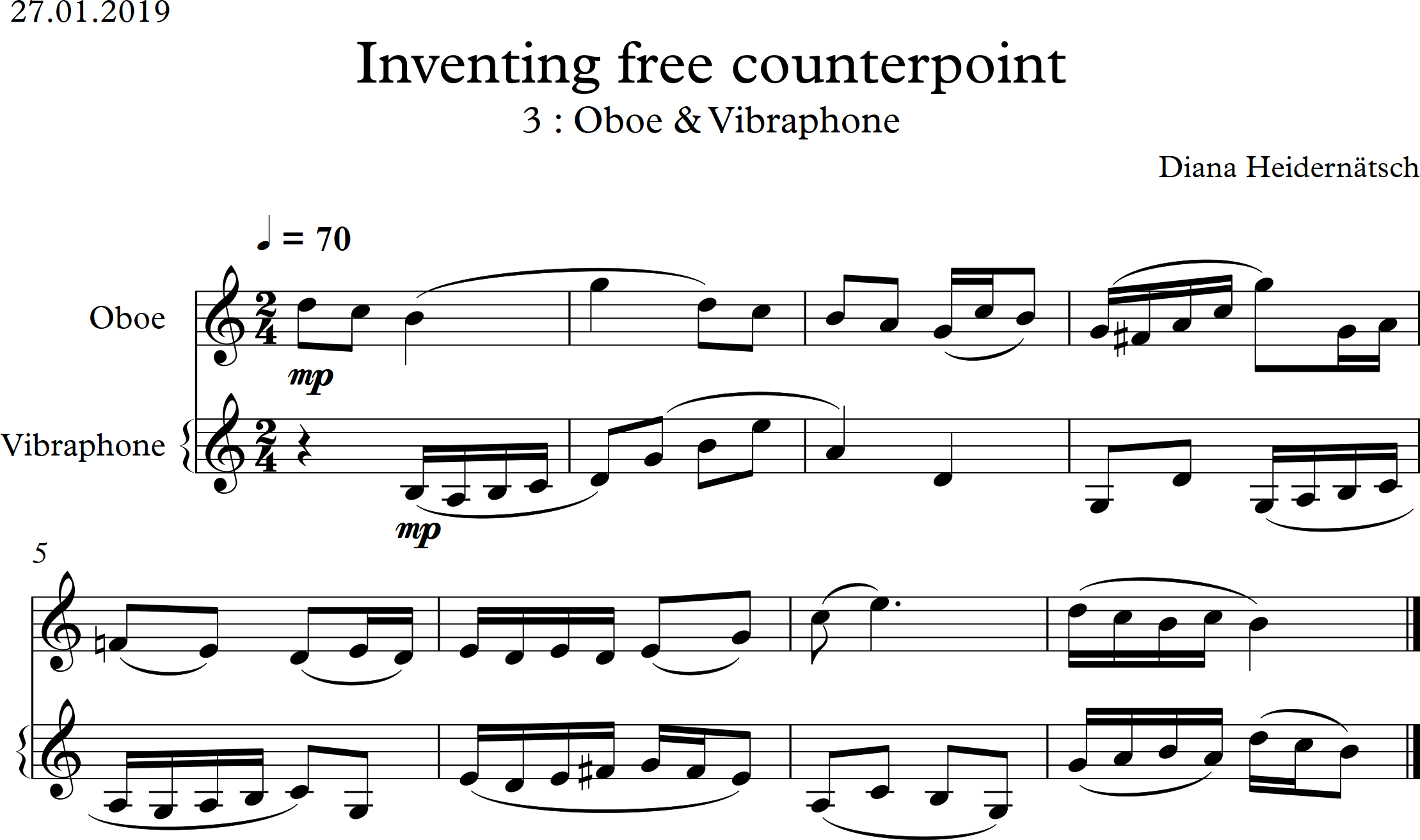
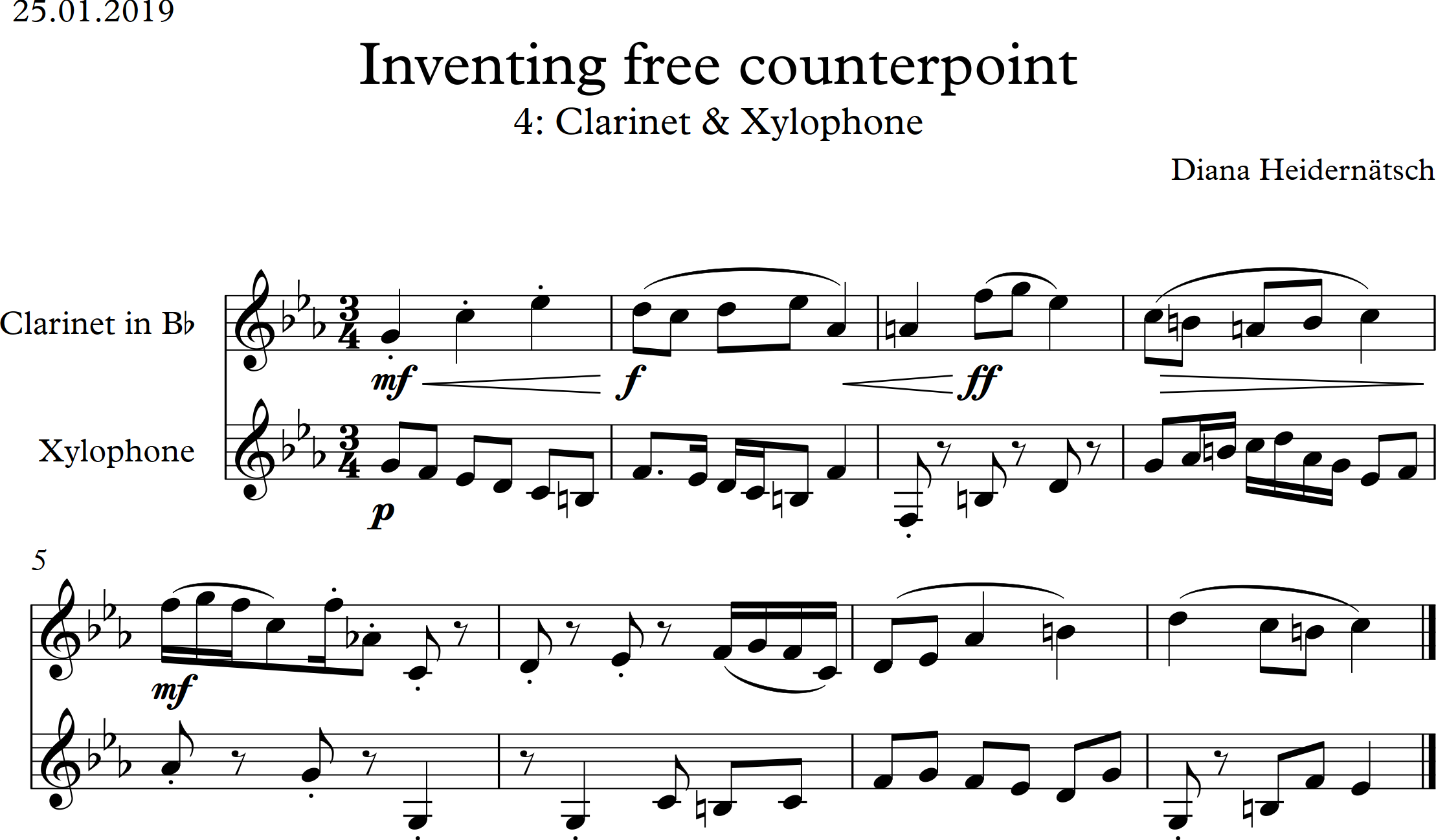
The first task for this project was to create a second melody for two given short melodies, for instruments of my choice. Secondly, I was asked to create another two short pieces, with a companion melody each. I had a free choice of instruments but was encouraged to work with a combination of woodwind and tuned percussion.
The following first two pieces are the ones, where I was provided with one line of the melody beforehand.
For this melody I added the line of the bass clarinet.

For this piece, the line of the Glockenspiel (Orchestral Bells) was already given.

Project 12: Two part inventions
For this project I was asked to compose two short pieces which should include some examples of imitation, inversion, augmentation and diminution.
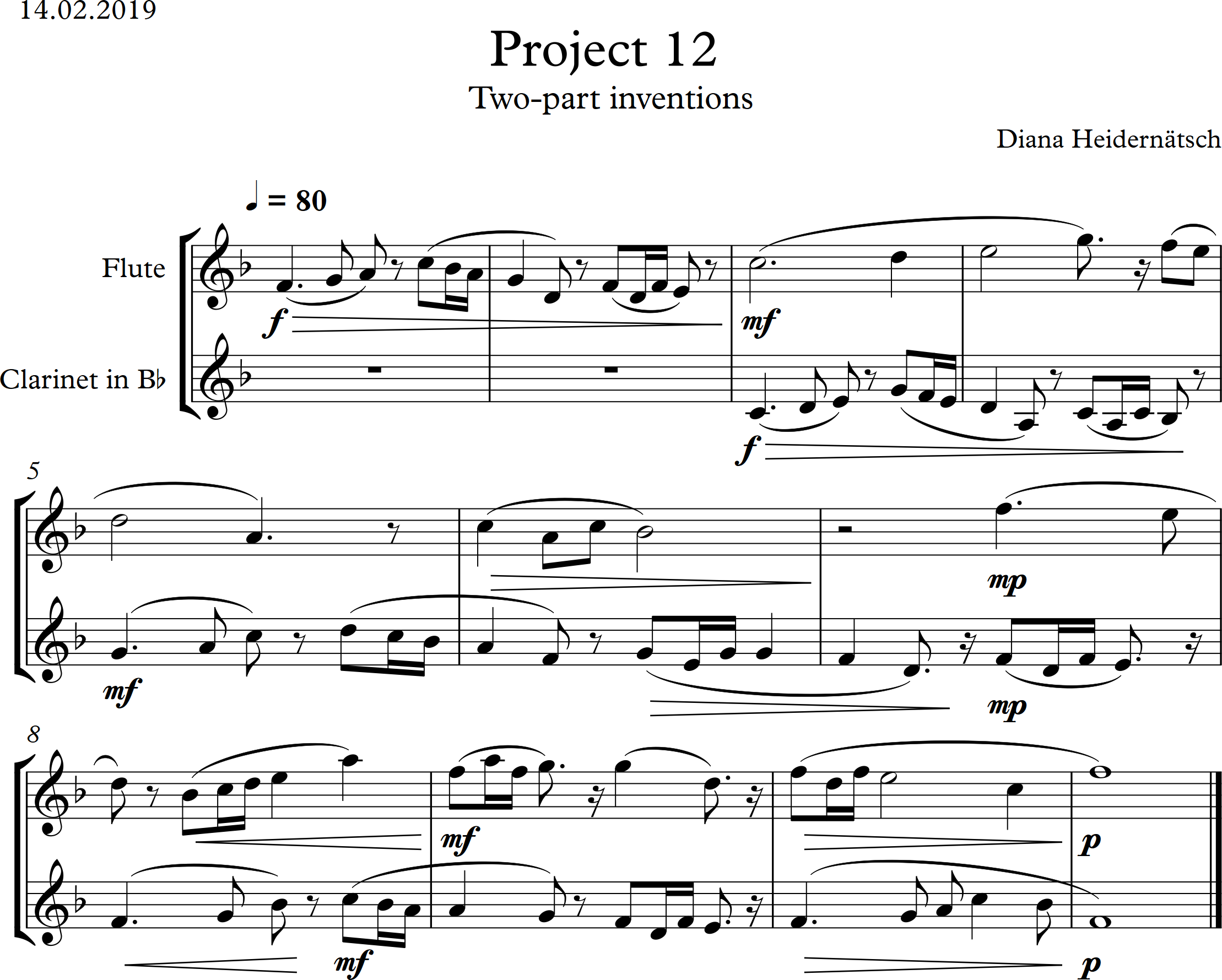
For this piece the theme consists of 12 notes, which can be seen in the first to bars for the flute. Until bar 6 the flute continues with a slightly varied augmentation starting on the dominant 5th (C). This is followed by an inversion and within the last three bars I used a variation of only the second half of the theme.
The voice of the clarinet starts in bar 3 with the theme on the dominant 5th (C) and is followed by a variation starting on the major 2nd (G), which only finishes in bar 7. In bar 8 and 9 the theme can be heard in its original form one more time and the clarinet finishes the piece by playing a variation of the beginning of the theme.
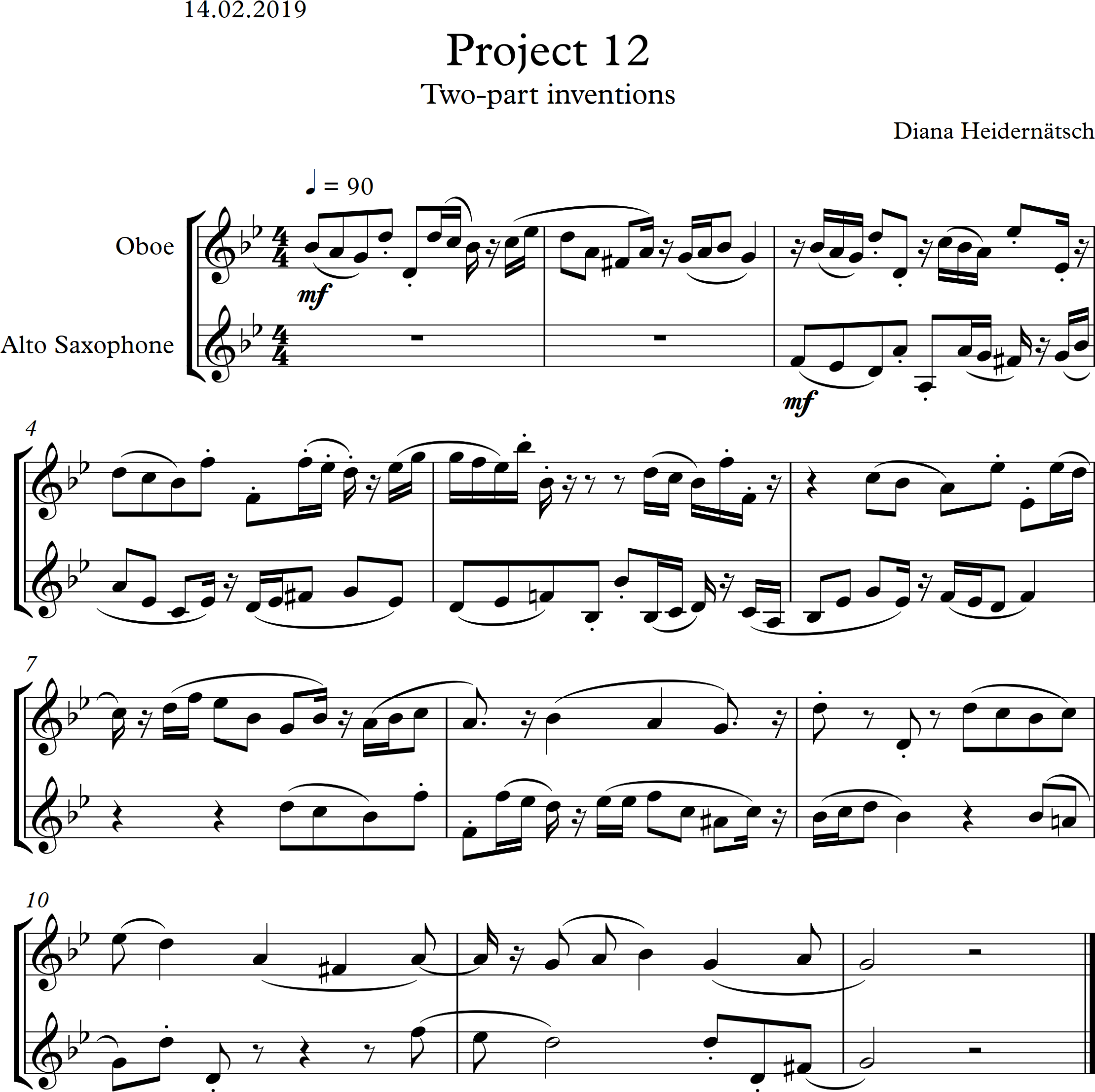
The theme of this piece involves 18 notes and also lasts for two bars. It can be heard the first time being played by the oboe, starting on the minor third (Bb). For the third bar the oboe continues with a diminished variation of the first half of the theme, being played twice and then goes onto a variation of the theme starting on f. After that, a short motive from the theme can be heard until another variation, starting on c this time, is played. The last 5 bars (8-12) involve a varied augmentation starting on the original starting note Bb.
The voice for the saxophone starts in bar 3 with a variation of the theme, starting on f and is followed by an inversion on d. From the end of bar 7 to the beginning of bar 9 another variation can be heard, also starting on d. The last for bars only involve short motives from the theme.
Research Points
Counterpoint
The rules and versions of a counterpoint came with the first polyphonic pieces. Counterpoint comes from the Latin phrase “punctus contra punctum“, which means “note against note“. The typical polyphonic forms ,structures or compositional techniques, which involve a counterpoint are the following:
- C.F – technique : One after another voice is added to an existing one (the cantus firmus)
- Free imitation : A rhythmical or melodic motif is recited in one voice and emulated by one or more voices.
- Canon (Rounds, Catches): A strict form of imitation where not only a theme or a motif is emulated but the whole voice. The melody of the voice is played time-displaced in one or more other voices
- Fugue : A composition-technique, where a subject (theme) is being answered by a counter melody
- Ricercar : A precursor of a fugue, where one imitates section by section.
(1)
Furthermore, there are 5 big groups a counterpoint can be part of :
- Species Counterpoint :
The species counterpoint is meant to be for students, where they are supposed to learn to add a counterpoint to a cantus firmus in five steps (or species). In the first species the students are asked to add one consonant note against each note, or the on-beats of the cantus firmus (first voice). For the second species the students have the task to add two notes for each note of the first voice instead of one. It is allowed to put dissonances over off-beats. The third species requires to write four notes per bar, whereas dissonances may occur on the second, third and fourth beat. For the fourth species the students have to work with syncopation. The fifth and last species combines all of the previous ones and is supposed to give students a good understanding of the counterpoint. In all of the species octave and quint parallels should generally be avoided. (2)
- Free counterpoint : This kind of counterpoint is not strictly bound to the rules of the species counterpoint and sometimes even appears without a cantus firmus.
Any chord used in Harmony is available for use, dissonances enter without preparation, and are used with irregular and with interrupted resolutions ; chord progression determines to a great extent the voice progression. (York, 1994)
- Linear counterpoint : In the Oxford Dictionary of Music I found the following definition :
Term used specifically to describe type of 20th‐cent. counterpoint with emphasis on the individual strands of the fabric rather than on their harmonic implications—but all counterpoint is by nature linear. (Michael Kennedy, Joyce Kennedy and Tim Rutherford-Johnson, 2013). - Dissonant counterpoint : For the dissonant counterpoint all the rues from above are turned upside-down, the composer has to primarily focus on dissonances and can put in a few consonant notes in. (3) One good example for a dissonant counterpoint is Sarah Cahill’s “Dissonant Counterpoint“.
- Heukäufer, N.(2014). Musik Abi – Kompaktwissen Oberstufe. Berlin: Cornelsen Scriptor, p. 57-58
- Pankhurst, T. (2017). Schenker’s Theory of Counterpoint. (online). Available at : http://www.schenkerguide.com/counterpoint.html (Accessed 17. February 2019)
- Spilker, J. (2013). Dissonant counterpoint. (online). Oxford Index. Available at : http://oxfordindex.oup.com/view/10.1093/gmo/9781561592630.article.A2240654 (accessed at : 17.February .2019)
The History of Tuning
The history of musical temperament as we now it today already started with Pythagoras 500.B.C. Since then it went through several stages of development.
- The Pythagorean tuning
Pythagoras created a diatonic system, which consists of 12 perfect fifths put on top of one another. But using only perfect fifths lead the “b-sharp” (which should enharmonical changed be the same note as C) on the 12th fifth to be a bit higher than the c which one would get from 7 octaves put on top of one another. The difference between those two notes can be given in the ratio 73:74, this numerical proportion is also called “Pythagorean comma”, it equals around a quarter of a chromatic semitone. Furthermore, the major thirds are a bit impure (higher than they should be). This kind of tuning can predominantly be used for music of the middle age for one voice, but becomes impure for polyphonic pieces.
- Pure intonation
The pure intonation is made from a row of partials, where, apart from the octave, the perfect 5th and major 3rd are adjusted to the tonic as well. Even tough the major thirds are harmonic for this kind of tuning, some problems still occurred. If one would start a major scale using pure intonation on c, for example, the first two notes (C and D) have the ratio 8:9 and one further (notes D and E) have the ratio 9:10. But, if one where to start a D-major scale the first two notes (also D and E) have to have the same ratio as the first two notes of the C-major scale (C and D). This means that the same notes from one scale have a different ratio when they’re being played in another key. The difference between that “big” and “small” whole-tone step is called “Syntonic comma” and has a ratio of 80:81, which equals about the fifth of a chromatic semitone. The pure intonation has the advantage of a nice sound, as long as the music stays in the same key.
- Meantone temperament
In contrast to the Pythagorean Tuning the Meantone temperament doesn’t work with perfect fifths, but with major thirds. This way of tuning corresponded to the sound-ideal of the Renaissance. The Meantone temperament compensates the Syntonic comma and works with only one whole-tone, which lies in between the two different whole-tones of the Pure Intonation. Nevertheless, the fifths are a bit to small.
- The well-tempered tuning
At around 1700 the German musician Andreas Werckmeister divided the octave into 12 equal intervals. Through that, every interval is slightly unexact, but this imperfection is barely noticeable, which allows musicians to perform in all of the 24 major and minor keys.
Johann Sebastian Bach wanted to make use of this new discovered way of tuning and therefore wrote two books (published 1722 and 1744), which he called “Das Wohltemperierte Klavier (=The well-tempered clavier). Each of those books include 24 preludes and fugues, one for all major and minor key-signatures in chromatic order.
(1)
- Knapp, W. and Peschl, W. (2005). Wege zur Musik-Oberstufe Band 1. Rum/ Innsbruck : Helbling, pp:46-47
Fugue
At this research point I was asked to chose one or two of Bach’s Fugues or Inventions, which I should analyse in terms of contrapuntal diversions and add to my listening log.
Those four diversions mentioned in my study folder are:
- Imitation : Which is either a modification or the exact repetition of a motif.
- Inversion: Is usually the reflection of the intervals from a motif.
- Augmentation: Describes the expansions of note values
- Diminution: Describes the reduction of note values
From my own musical experience I also know, that there are a few more ways to diverse a theme. Those especially developed in the 20th century through Arnold Schönberg’s 12-tone-technique, but having played and analysed a few of Bach’s Preludes and Fugues already, I noticed that diversions like that where used in the period of the Renaissance.
- Retrograde : Is a motif being played backwards
- Retrograde-inversion : A mixture from the two points mentioned above, which describes a motif that is being played backwards with reflected intervals
- Stretto : (close; thight) : A start of a new imitation of a motif before the motif that was played before is ended.
From my former studies also already learned, that a fugue is always a polyphonic piece, which usually has either three or four voices. The amount of voices stays the same throughout the whole piece. Furthermore, a fugue is mono-thematic, which means, that there is only one single theme which is being repeated in varied ways. ( There are a few exceptions, where a fugue has more than one theme). The parts of the piece, where the theme doesn’t appear is called “episodes”, they often even contain short motives of the theme. The parts of the piece which include the main theme are called subject presentations.
A fugue always has the same structure. It is basically compound by only subject presentations and episodes (which usually have a modulating use). Only the first thematic development has to follow certain rules: At the beginning of a fugue (the very first thematic development), the theme has to be played once in every voice. The first note of the theme alternates between the tonic and the dominant. After the first theme (also called “Dux”), which is only played by the first voice, is finished, the second voice starts playing the theme (called “Comes“) on the dominant 5th. During this variation of the first theme, the first voice continues with a contrapuntal theme. (1)
As mentioned above, the second voice (Comes) starts the theme on the dominant. For this entrance there are two possibilities : The real answer and the tonal answer. The real answer occurs when the intervals of the first theme (dux) are kept the same. The (more often used) tonal answer, stays in the same key signature.
- Heukäufer, N.(2014). Musik Abi – Kompaktwissen Oberstufe. Berlin: Cornelsen Scriptor, p. 107-108
Invention
The definition for “Invention” in the Oxford Dictionary of music is the following is the following:
Name given by J.S.Bach to 15 of his shorter keyboard comps. in 2 parts or ´voices´,inc. in his Klavierbüchlein*, 1720. They are highly contrapuntal, being largely imitative in form. Each works out some short melodic motif. Bach also left another 15 comps. in the same style, now known as his ´3-part Inventions´, to which he gave the title ” Symphonies”.
– Michael Kennedy, Joyce Kennedy and Tim Rutherford-Johnson, 2013
The description above indicates, that an invention is basically a shorter, smaller form of a fugue and sometimes even a canon, which has one motif that is being presented in varied forms throughout the piece. The simplicity of those 30 pieces was created on purpose; Bach’s intention was to write those pieces for younger pupils to study. (1)
*Klavierbüchlein (Ger) = “Small piano-book
- Heukäufer, N.(2014). Musik Abi – Kompaktwissen Oberstufe. Berlin: Cornelsen Scriptor, p. 112
Structure of a Tango (Assignment 4)
For my fourth assignment I had the idea to combine the structure of a tango with the strict rules of a fugue, that’s also how I came to find the piece Tango fugue on a theme by Piazzolla by Stefan Wirth.
The basic structure of an Argentinian tango is often described in different ways, I decided to go for a “A-B-A-C-A” – form for my assignment. A classical tango usually consists of those five sections. Each section has four phrases and each phrase has four measures. Written in an 4/4 -time signature, that gives me quite a good basic structure to begin with and exactly 80 bars to fill.
Typical rhythms for a tango are usually either:

or:

Mostly the “A”-parts are written in minor whereas the “B” and “C” parts make a contrast in major. (1)
- Rauscher, C. (2016). The structure of Argentine Tango Music. (online). Tangology 101. Available at : http://www.tangology101.com/main.cfm/title/The-Structure-of-Argentine-Tango-Music/id/971 (accessed at: 17.February.2019)
Listening Log
- Dimitri Shostakovich – Fugue in A major
- J.S. Bach – Fugue in d-minor BWV 851
- J.S. Bach – Invention in Bb major BwV 785
- Johanna Beyer – Dissonant Counterpoint I
- Stefan Wirth – Tango fugue on a theme by Piazolla
Dimitri Shostakovich – Fugue in A major
This piece was written 200 years after Bach’s death alongside with another 23 fugues, the idea to write those pieces came from Bach’s Well-tempered clavier. The special thing about the a-major fugue is, that it, unlike most of the other pieces Shostakovich wrote, this composition doesn’t have any dissonances. He varies between several chords but only involves the notes from the corresponding triad. ( Tonic, Mediant & Dominant). Being restricted to only this structure the piece could have become rather boring, but Shostakovich managed to put the chords and the pitches into an order, which makes the composition sound rather interesting. (1)
Shostakovich starts the first few lines by using chords from the perfect 4th (D) or 5th (E), but starts varying with jumping between the maj 2nd (B-minor) and major 3rd (C# -minor). As far as I’ve observed it, Shostakovich sometimes uses the beginning section in order to keep apart the “more interesting” parts. Those involve even chords, which aren’t present in a a-major scale, such as Eb, F, Bb, G-minor and A#-minor.
Unfortunately I was unable to find a downloadable score, but a video on Youtube, which includes a picture as well as an audio file of the piece, provided by Veritas Bear can be found under the following link : https://www.youtube.com/watch?v=nLMvjGS9XiA
I found this piece really nice to listen to and was therefore surprised how simply structured it was once I started analyzing it in detail.
- Adams, R. (1981). Dmitri Shostakovich and the fugues of op.87 : A Bach bicentennial tribute (pdf) Texas. Available at: https://digital.library.unt.edu/ark:/67531/metadc504244/m2/1/high_res_d/1002776039-Adams.pdf
J.S. Bach – Fugue in d-minor BWV 851
Bach’s fugue in d-minor has three voices and generally provides a sad, dramatic but also calm character. I chose this piece because I was about to learn it for a piano-exam a few years ago, until I changed my mind and picked another one, but I always enjoyed listening to it. The picture below shows a score of the piece, provided by the Petrucci Music library.
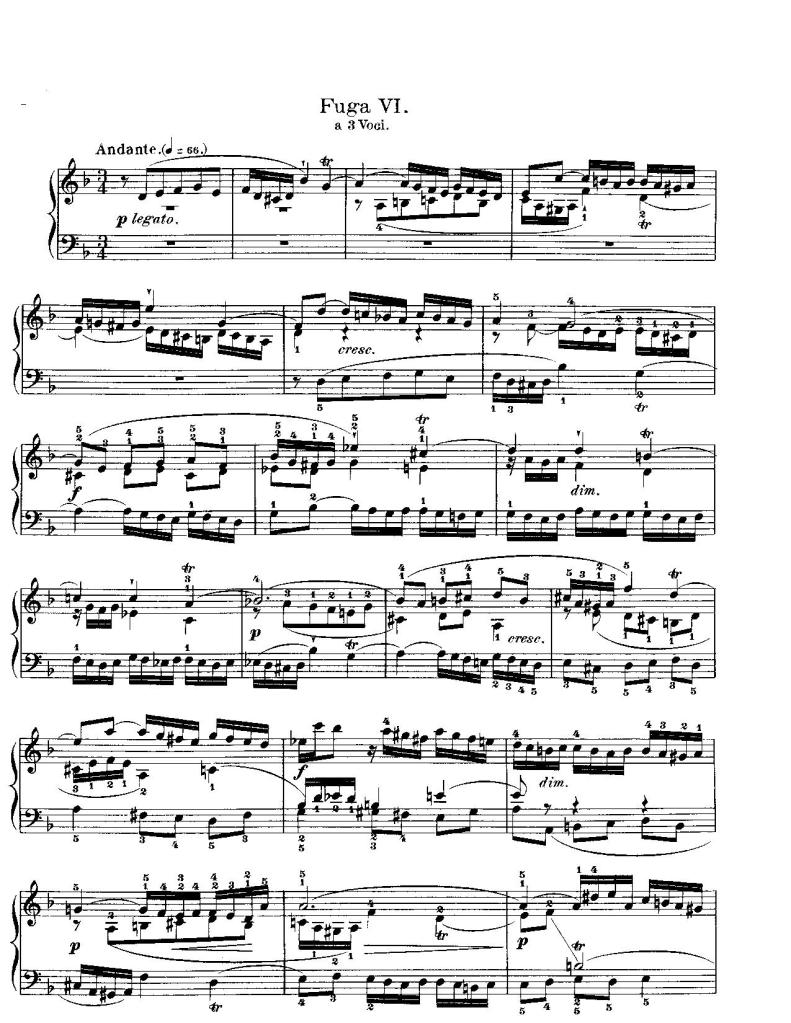
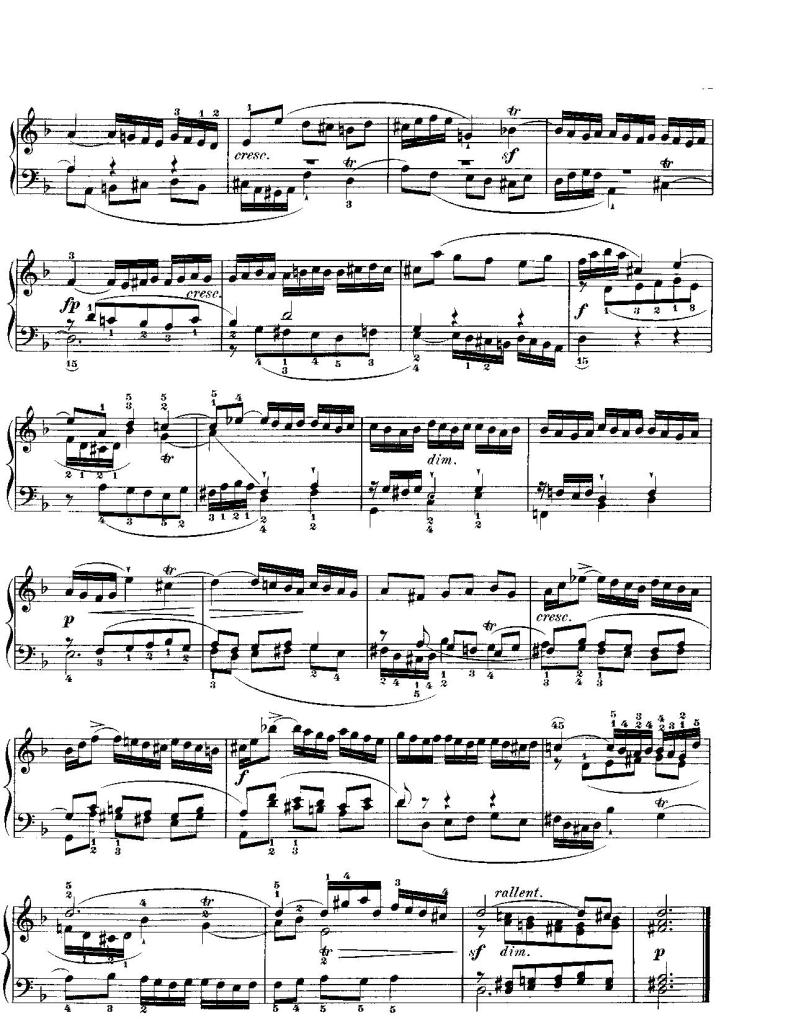
Within the first few bars one can see the first (and only) theme being played in the first voice, the theme comes to an end when the second voice starts playing. Which means, that the coming variations of the theme are all linked to this very first one :

The following list shows how often and where, and in which way the theme is being played within one voice. It has to be mentioned, that the second (middle) voice sometimes jumps from one notation system to another one, one can keep the this voice apart from the other by looking at the tail of the notes.
| Page | Bars | Voice | Form of variation |
| 1 | 1-2 | 1 | Original (starting on D) |
| 3-4 | 2 | Real answer (starting on A) | |
| 6-7 | 3 | Original (D) | |
| 8-9 | 1 | Starting on maj.2 (E) | |
| 13-14 | 1 | Answer, slightly changed intervals (A) | |
| 14-15 | 2 | Inversion, on maj.2 (E) | |
| 17-18 | 3 | Real answer (A) | |
| 18-19 | 2 | Answer, slightly changed intervals (A) | |
| 2 | 21-22 | 3 | Answer, slightly changed intervals (A) |
| 22-23 | 1 | Inversion, on maj.2 (E) | |
| 27-28 | 1 | Inversion (A) | |
| 28-29 | 2 | Original (D) | |
| 29-30 | 3 | Inversion (A) | |
| 34-35 | 3 | Slight variation of original (D) | |
| 39-40 | 3 | Original (D) | |
| 40-41 | 2 | Original (D) |
In this piece Bach often uses false entrances for the theme as well as many stetti. (A stetto occurs, when one theme starts in a new voice before another entrance of the theme has come to an end ). Parts counterpoint that is being used in the first voice, when the second voice makes an entrance with the theme, is being used throughout the whole piece.
In some of those false entrances, as well as the episodes (parts without a theme) one can find diminished or augmented parts of the theme. The counterpoint itself is linked to the theme as well: The first half(bar 3, voice 1) is basically the inverted diminished version of the first part of the theme, whereas the second half (bar 4/5, voice 1) is a processed version of the second part.
The most unusual part about this piece is its ending. Even though the amount of voices should stay the same in a fugue, Bach doubled the three voices in the last two bars and leads the voices (with a basso continuo on d, which is often used at the end of fugues) towards a D-major chord. This “cheery” sounding chord at the end of the minor piece has a positively surprising effect.
I found it rather fascinating to analyse this piece, especially interesting was, how often Bach makes use of the first theme. There are hardly any parts (including the episodes) where one can’t hear at least one version of either the theme or the counterpoint (which are, as mentioned above, linked as well)
J.S. Bach – Invention in Bb major BwV 785
This is one of the 15 inventions from Bach with only two voices. Overall the piece sounds light-heartedly and soft, although in the centre of the piece Bach often uses deeper pitched notes, which creates a tune that sounds a bit more serious.
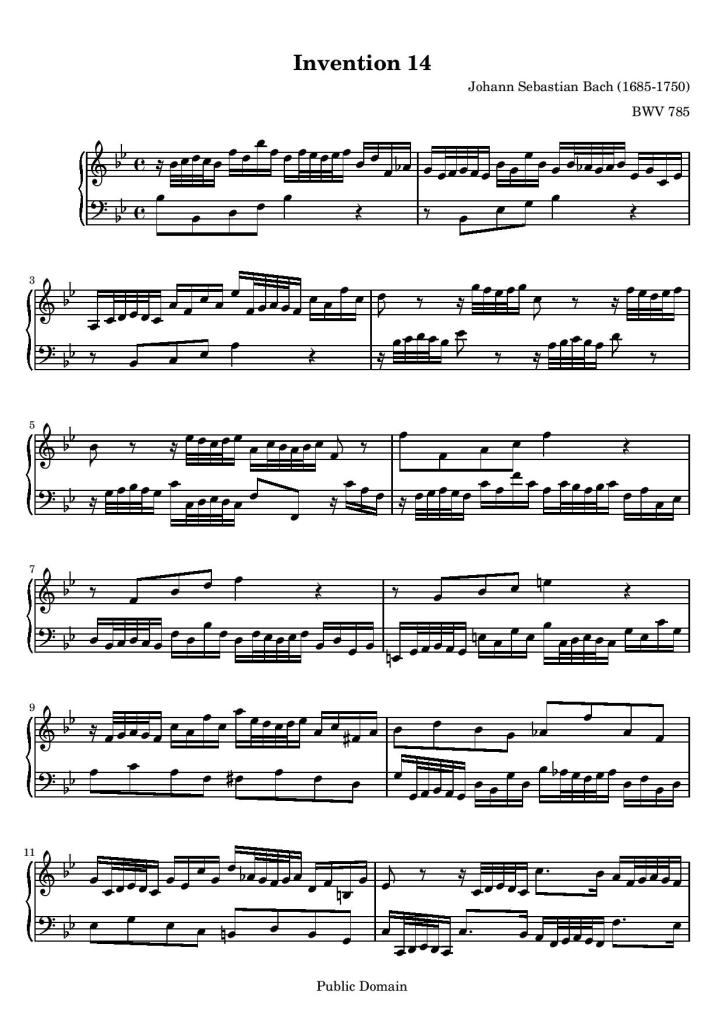
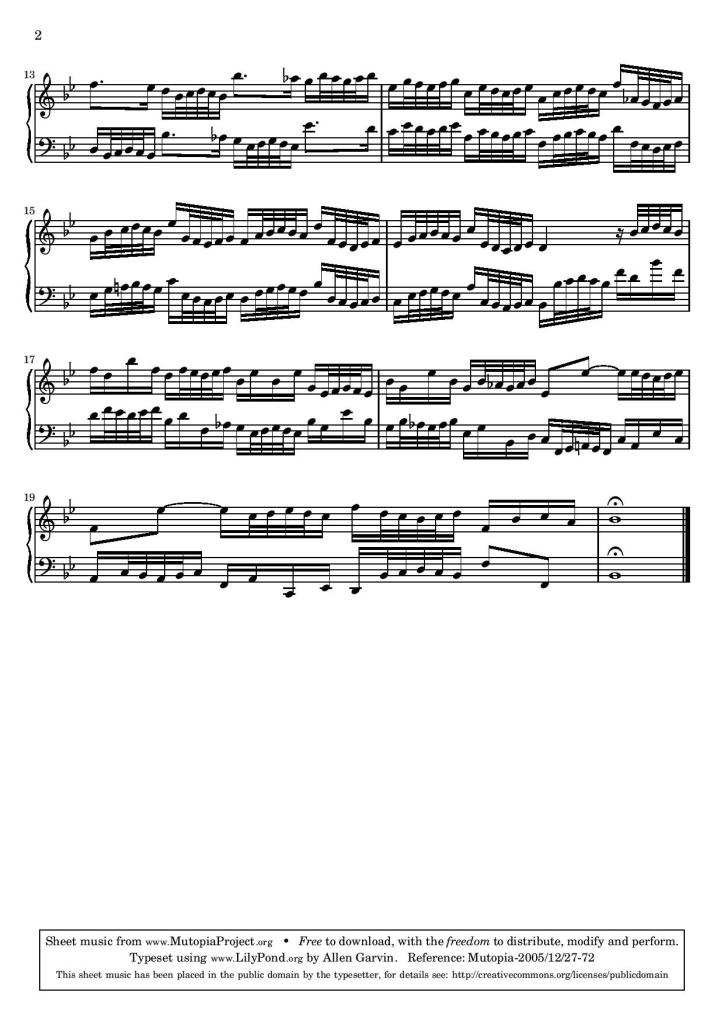
A score of the piece provided by the Petrucci Music library can be seen below. The theme that Bach works with for this piece ends in the centre of the first bar. (Starting on a Bb, ending on a D). Right after that it’s inversion is being played, where it has to be mentioned, that, at the end of the inversion Bach uses a third instead of a forth for the second last interval and a completely free ending for the last one.
If I haven’t miscounted (and I added the false entrances as well), I was able to find 16 “normal” subjects, of which eight were false entrances and 19 inversions with 13 of them being inversions for the right hand. In the left hand voice I found 21 subjects, including 13 false entrances and 11 inversions with 6 false entrances.
For the whole piece Bach uses a huge amount of false entrances of the theme, in both, original and inverted versions. In all of those cases its only the beginning motif (the first 4 or 5 notes) of the theme, that is being played.
Another thing I noticed concerning this piece in specific, is, that Bach uses 3 versions of a counterpoint (although all of them are mainly made up from arpeggios), but only throughout the first half of the piece. From bar 14 to the end either false or proper entrances of the theme or its inversion complete one another. (Whereas, at least until bar 15 the theme in the right hand is being played together with the theme in the left hand and vice versa with the inversions.
Johanna Beyer – Dissonant Counterpoint I
Unfortunately I wasn’t able to find a score for this piece, which makes it really difficult for me to find a structure-especially because the piece is mainly dissonant.
Beyer divided this short piece into 3 parts, building a A-B-A’ – form. Within the first 15 seconds one can hear 2 voices playing. Starting in forte and ending quietly they don’t seem to meet at one harmonic interval at all. In the second part, after a short rest, seems a bit calmer than the first section at the beginning but becomes slightly louder towards the end. Beyer seems, at least for the beginning of this part, to be working with three voices. She also uses a few consonant intervals. Within the second half of this part is a section, which involves alternated high and low notes. This is the only part of the piece where only one voice at a time can be heard. The third part of the piece starts and sounds similar to the first one and is probably a variation of it.
As far as I’ve understood it, all the rules of a normal counterpoint are being turned around for a dissonant counterpoint, which means that dissonant intervals are primarily being used. As well as with Schönbergs 12-tone-technique I think this technique is a fascinating mathematical rather than musical subject, which makes an analysis interesting, but it is difficult to enjoy listening to it due to the amount of dissonances.
Stefan Wirth – Tango fugue on a theme by Piazzolla
This piece is being played by “The Gershwin Piano Quartet”, and therefore written for four pianists. As the title is already indicating, the fugue is based on a tango by Astor Piazolla. The piece is arranged for four polyphonic voices.
Within the first third of the piece, two of the pianists play the rhythm of the theme (or its counter-subject ) on, what I personally think, are wood-blocks. These wood-blocks don’t have entrances one-after another, they are being played from the beginning onward. Unlike most fugues, the theme for this one is unusually long. It provides a strong, slightly dramatic character, which can be heard especially powerful once the fourth and lowest voice starts. A short dramatic rest for all voices indicates, that the exposition of the fugue has come to an end.
In the next part of the piece, all four pianos are being used for the first episode, where one can hear a few separate sections from the main theme, the colour of the sound says the same. Compared to the exposition, the episode has been kept really short. Once, one can hear the theme again, two of the pianists start playing on the wood-blocks once more. The following part of the fugue seems more chaotic than the previous ones. This is caused by the theme being altered, furthermore, the number of performers playing the piano and the wood-blocks varies. I’m not sure, but it may be possible, that for an incredibly short section five voices can be heard at the same time, which is rather an ususual seeing, that the amount of voices of a fugue normally stays the same. At a point of this part, where the voices all seem to be tangled into one another and it becomes difficult to follow the piece, snaps are added to the sound-range as well.
The chaotic sounding phrases continue, adding mainly dissonances, become louder towards the end until they reach a climax. Another short rest for all the voices follows, similar to the one after the exposition. For the last five to ten seconds of the piece I myself actually expected it to come back to the more harmonic sounding beginning, but surprisingly, dissonances where used here as well.
It was interesting to listen to this piece and I especially enjoyed the, calmer sounding beginning, where I was still able to easily distinguish all the voices. I furthermore think, that the theme (when it was played in this very first part) was very entertaining and the first few counterpoints were written well. Seeing though, that, after the exposition it all started sounding stressful and dissonant, I couldn’t really enjoy listening to the rest of the piece.
 Bluefoxxmusic
Leave a comment