Exloring Harmony
This part is about harmony and the effect that certain arrangements of chord progressions can have.
Projects
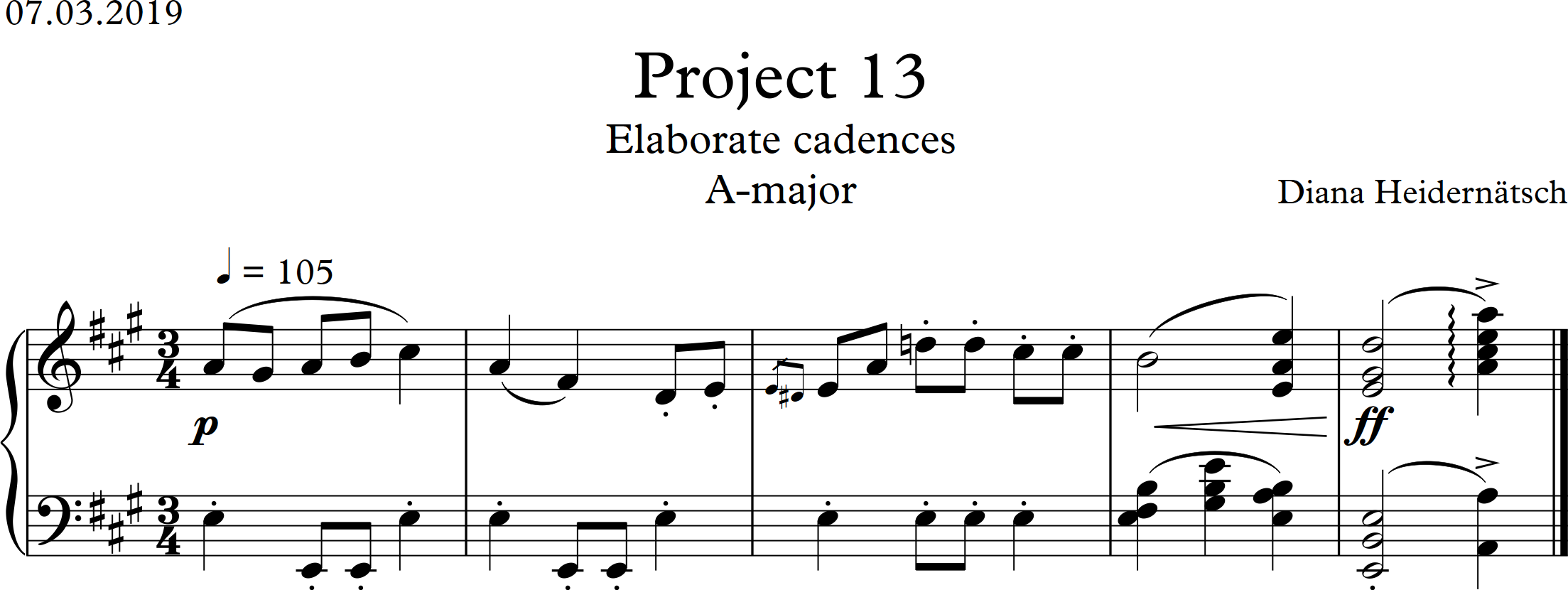
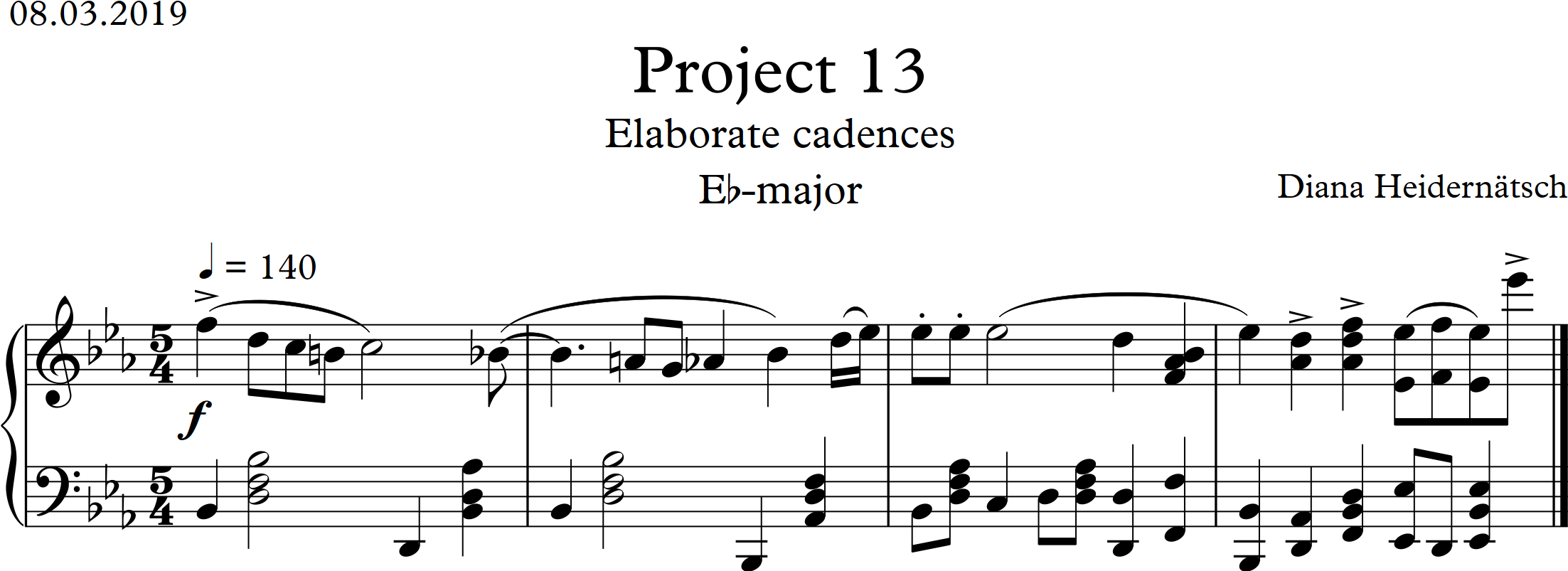
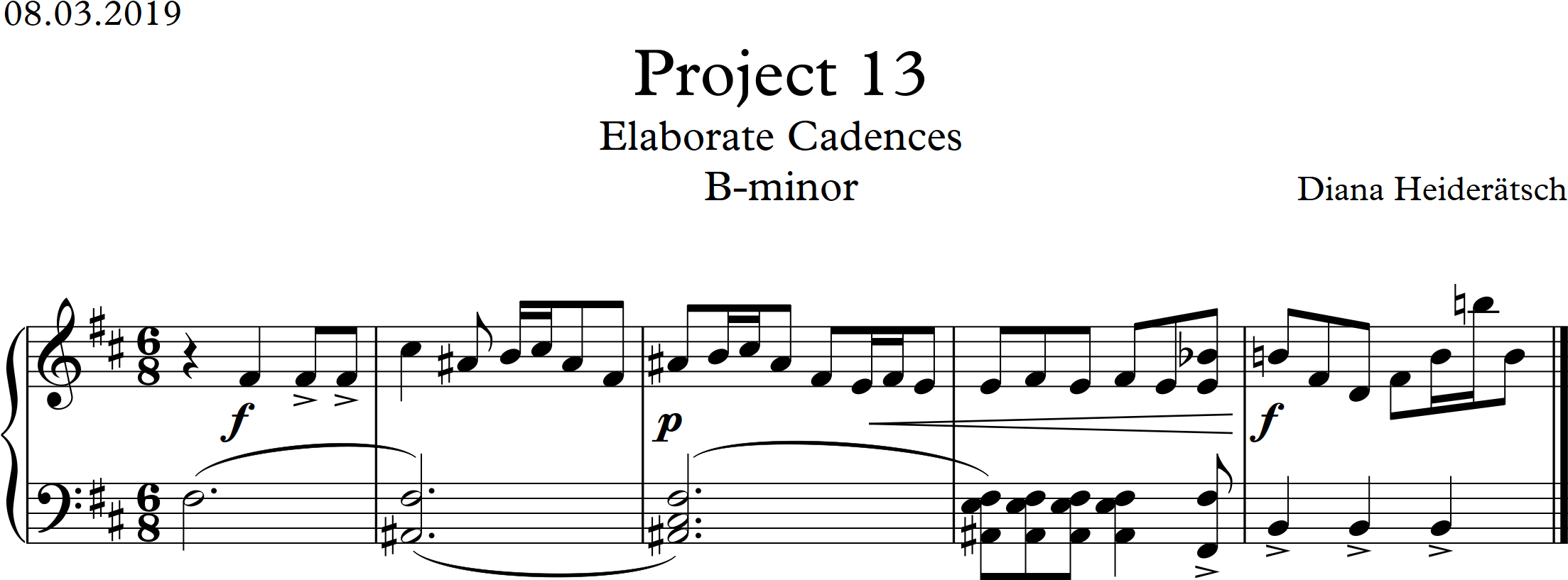
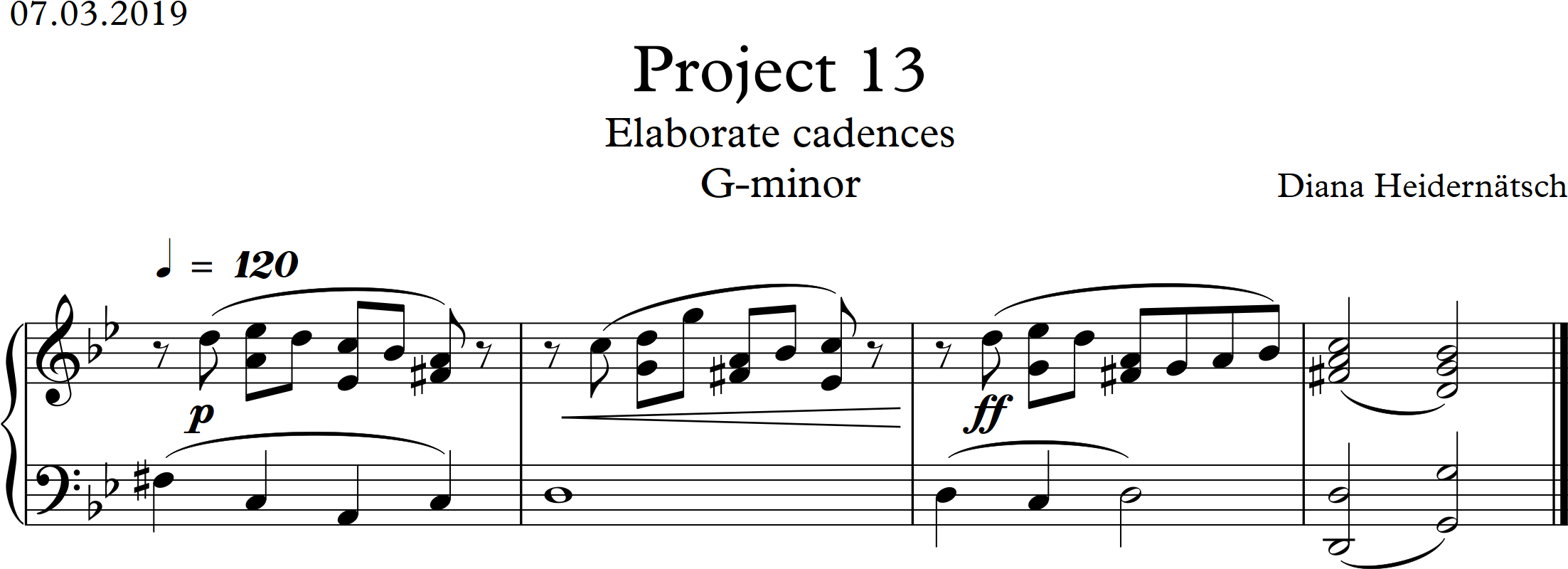
Project 13: Elaborate Cadences
For this project I was asked to write four examples of a dressed up perfect cadence. Two in major and two in minor. A perfect cadence is made of the dominant 5th followed by the tonic.
Project 14: Improvising on a dominant
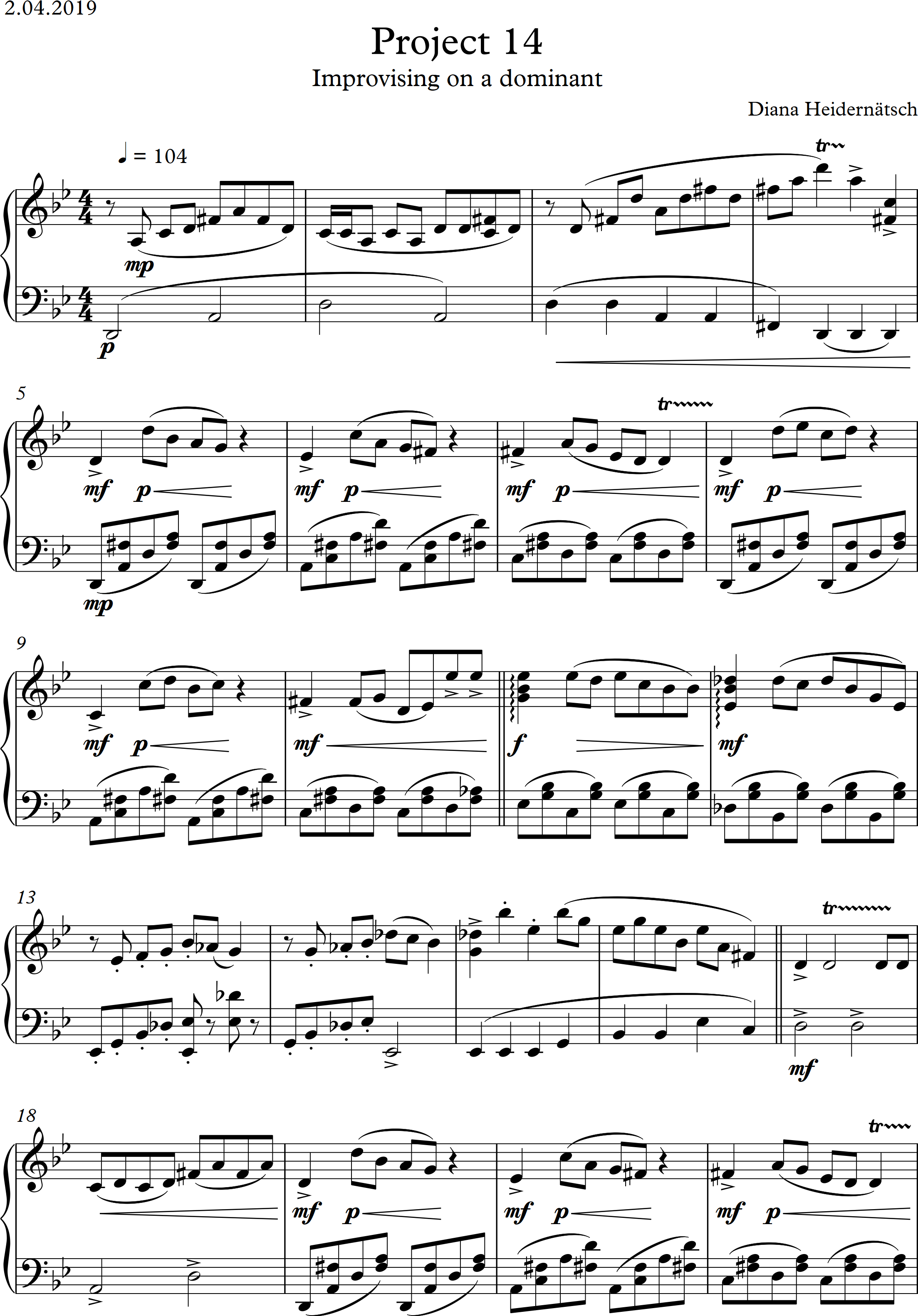
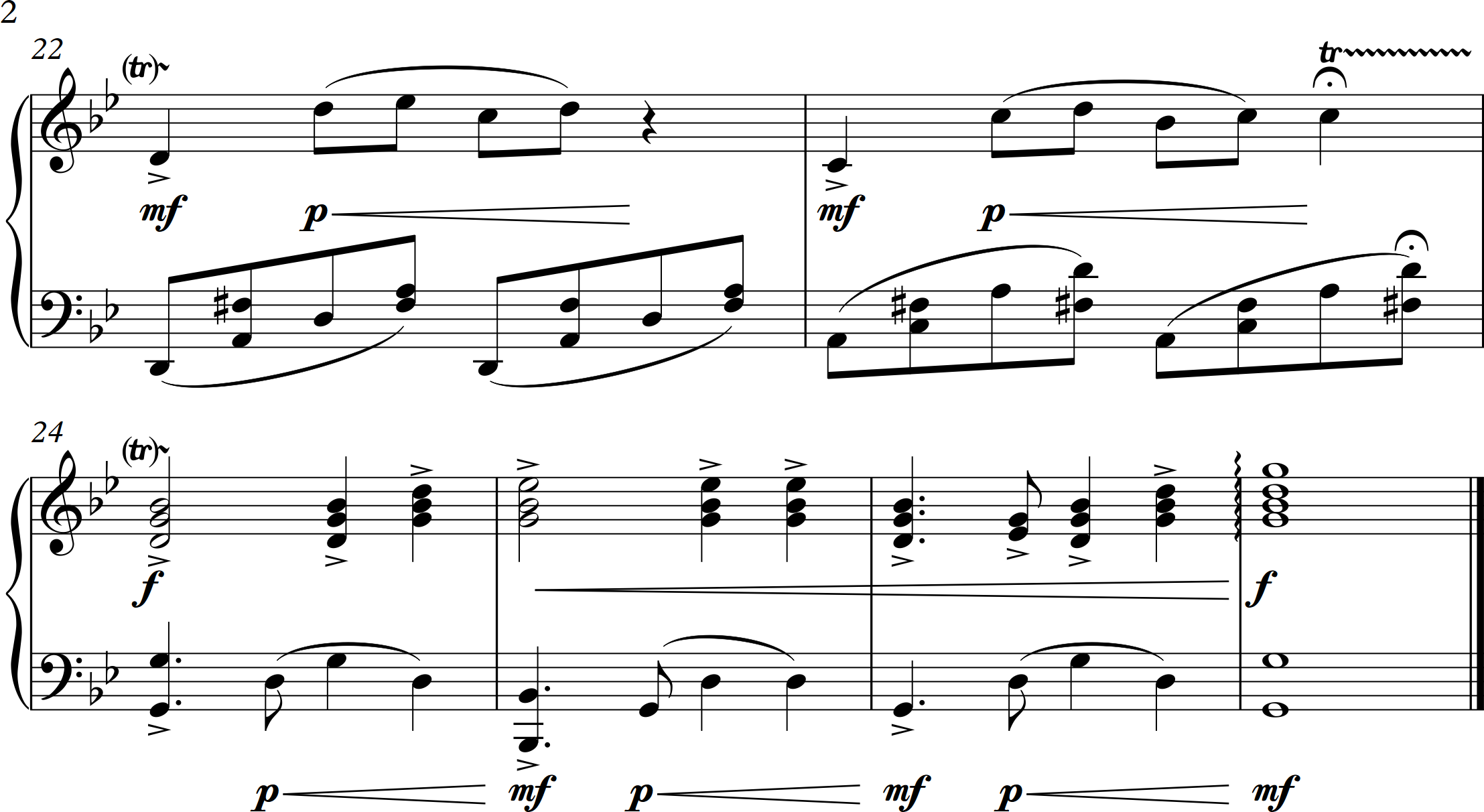
As the title already indicates, for this project I was asked to improvise on a dominant. The given task was, to hold a piece (played on the piano) on its dominant for as long as possible, without it getting boring. Furthermore, it was suggested in my study-folder, that, if possible I could change the key signature, to keep the piece entertaining.
For this piece, I started with the dominant of G-minor, which is D-major. To make a transition from one key signature to another as easy as possible, I continued with the dominant of B-flat-major, E-flat. (B-flat is the relative key to G-minor, so I didn’t have to change the key signatures).
Research Points
Cadenza
Generally a cadenza can be described as a sequence within a concerto, where only the instrument, for which the concerto was written for, plays.
Within a cadenza, which is normally placed at the end of the first movement of a concerto, themes and motives from the correspondent concerto are usually being processed. Originally, cadenzas were improvised by the performer, but some cadenzas are written out, either by the composer from the concerto him/herself, or by another composer. When the cadenza is improvised, the performer lets the orchestra know, that he is finished with the solo by playing a long thrill.
Logically, for the few concertos which are written for more than one instrument, for example W.A. Mozart`s – Concerto for Flute and Harp, cadenzas have to be written out, so that the performers would stay harmonically and in the same rhythm.
Through my research I found that the length of a cadenza (obviously especially the improvised ones) can have a high range of variety. It’s up to the performer (or composer) whether it stays interesting. So far I’ve listened to cadenzas, which were really long and interesting to listen to, and other, really short ones, which became boring just after a few seconds.
In a full score of a concerto, cadenzas can be found, where all of the other instruments are on a rest, lasting normally for one bar. All of them (except for the solo instrument) have a fermata on top of the rests. Sometimes, not often, composers have written “cadenza” out in full letters above the place were they wanted it.
The cadenzas I’ve listened to can be found in my Listening Log below.
(1), (2), (3), (4), (5)
- Kennedy, J; Kennedy, M; and Rutherford-Johnson, T .(2013). Oxford – Dictionary of music. Oxford: Oxford Univ. Press,. p. 135
- Swain, J. (1988) – Form and Function of the Classical Cadenza. Univ. of California Press ., pp. 27-59
- Green, A (2018). What is a Cadenza? . [online]. ThoughtCo. Available at: https://www.thoughtco.com/what-is-a-cadenza-724139 [Accessed 18.03.2019]
- 8notes, (2018). Cadenza – Musical Definition. [online]. Available at: https://www.8notes.com/glossary/cadenza.asp [Accessed 18.03.2019]
- Tarloff, E. (2010). Classical Cadenzas. The Atlantic. [online]. Available at: https://www.theatlantic.com/entertainment/archive/2010/02/classical-cadenzas/35353/ [Accessed 19.03.2019]
Listening Log
- Johannes Brahms – Mozart’s Piano concerto in D – minor – Cadenza
- J.Haydn – Cello Concerto no. 1 Cadenza
- J.Haydn – Violin Concerto no.4 – Cadenza
- L.v. Beethoven – Violin concerto in D-maj, op. 62 – Cadenza
- Niccolo Paganini – Violin Concerto no. 1 – Cadenza
- Sergey Rachmaninoff – Piano Concerto no. 3 – Cadenza
- W.A.Mozart – Violin conc. no. 2 – Cadenza
- W.A. Mozart – Concerto for Flute and Harp – Cadenza
- Richard Wagner – Das Rheingold, Prelude
Johannes Brahms –
Mozart’s Piano concerto in D – minor – Cadenza
Unfortunately, I wasn’t able to find a score of the cadenza. Its’ length is around three minutes. As already given with the title, Brahms wrote the cadenza for one of Mozart’s concertos.
Suitable to the minor-key, the whole cadenza has a dark and sad sounding character. Throughout most of it, one can hear one hand hectically and fast accompanying the melody played by the other hand. At the beginning, Brahms started of on a very low pitch, slowly working his way up. A very short sequence follows, where just one hand is playing, having reduced the tempo, before the second hand starts playing a fast under-voice again. The theme that follows is a bit softer than the previous ones, it seems to be working in waves, by constantly changing between loud and quiet as well as the amount of keys being played at the same time. The pace gets slower once more and the key changes to major for a very short time. Rather sudden, the tempo gets faster again, a scale is being played down and up, ending the cadenza with a thrill on the highest point.
I personally wasn’t too excited about this cadenza. There was too little variety in the themes Brahms used and even though it lasted for only three minutes, I found it had become rather boring after only a short while. Besides that, with all the other cadenzas I have listened to, I always had the feeling that they sounded improvised, even if they had been written down, and put alongside with the concerto, whereas this one, I found sounded like a small piano piece, which could have been played on its own as well.
J.Haydn – Cello Concerto no. 1 – Cadenza
The instrumentalist I listened to was Zuill Bailey, unfortunately I wasn’t able to find out whether his cadenza was improvised or had been written down beforehand. Compared to other cadenzas I’ve listened to so far, this one is, with a duration of around 1 min. 10 sec. , the longest. It can be found eight bars before the end of the first movement.
Bailey starts on a deep pitch with the main theme of the piece. As he progresses throughout the first part of the cadenza, still working with the theme, he works his way up, always becoming a bit louder. Throughout this section, he occasionally puts in chords. Bailey continues to a motif were he plays a soft melody on a higher pitch, which gets “interrupted” by a few strong deep notes. This motif becomes faster and brings more hectic to the cadenza, until bailey closes the theme by playing two long deep pitched notes. From there on he works his way up again, playing short thrills on every note he stays on. After a long thrill the orchestra continues playing.
I found it interesting that, even though this cadenza was unusually long (or at least long compared to others I looked at so far) it didn’t become boring. Bailey used the motifs from the concerto in such an interesting and varied way, that he created several different moods, which lead the cadenza to be entertaining.
J.Haydn – Violin Concerto no.4 – Cadenza
This was the first cadenza so far, were I was able to find a score. There are of course, several versions of the cadenza for this piece, but I found one, which was written by Haydn himself. It is also the first time I saw the word “cadenza” written out instead of just seeing a fermata on top of breaks for the instruments of the orchestra.
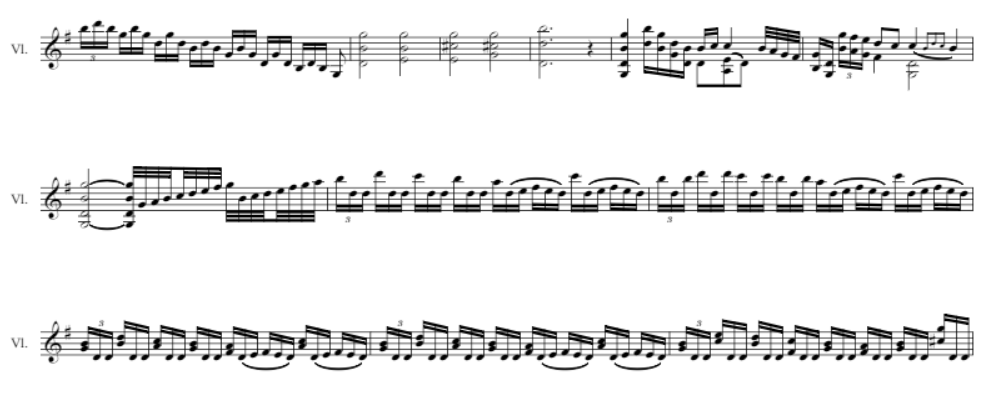
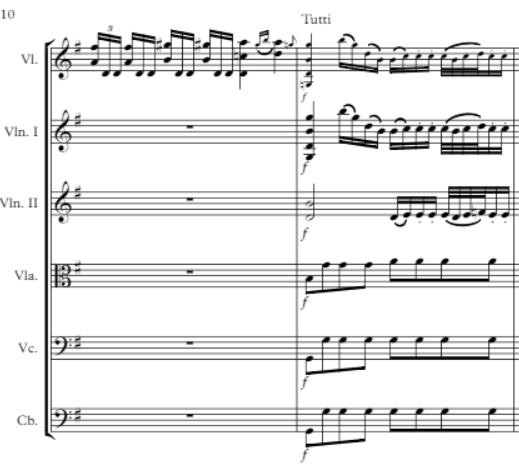
As one can see, Haydn generally often used double or even triple stopping. He starts with an arpeggio going down, only just using the notes from a G-major chord. This fast played sequence is taken over by long lasting chords. After the next part, in which the instrumentalist has to perform a few scales, or parts of them up and down, a high pitched melody occurs, which is interrupted by two or more lower pitched notes. This scheme is kept up until the end of the cadenza. The only thing that changes, is the whole motif going on octave down and instead of just one voice in the melody, two are being used at the same time. After the octave drop- the two voiced melody is usually a third apart, except for the last few notes, where they are either an augmented fourth or a major sixth apart. The violin performs a thrill before the orchestra starts playing again.
As already mentioned, this was the first cadenza where I was able to find a score (on https://imslp.org/wiki/Violin_Concerto_in_G_major,_Hob.VIIa:4_(Haydn,_Joseph) ) , to work with. Through this I was able to observe much better, which themes and motifs were used to write it. Nevertheless, I have to say that I found especially this one a bit too short. I didn’t have the feeling that it became boring, but seeing that Haydn wrote the cadenza for his own concerto himself, I expected it to be longer than just eleven bars.
L.v. Beethoven – Violin concerto in D-maj, op. 62 – Cadenza
This cadenza was unusually long, even though the first movement of the concerto takes roughly 25 minutes (the other 1st movements I’ve listened to so far were all around only eight minutes) . Therefore one might think that the instrumentalist, Itzhak Perlman wanted to adjust the cadenza, which was improvised, to the length of the movement.
The cadenza itself only has a calmer part at near the end of it, the rest seems mostly very hectically and fast. He starts with fast upwards going arpeggios, and a scale going down. It is noticeable, that there is one motive he uses throughout most of the cadenza, which he starts on different notes. Towards the end of the cadenza, he uses many thrills in a row, always an octave apart from one another. There is one part ,near the end, of the whole cadenza,which is a bit slower and calmer to the rest and creates a good contrast to the generally hectic motifs.
For this cadenza I found it difficult to follow the motifs and themes, due to its length and speed. As mentioned in the first paragraph, Perlman probably adjusted the length of the cadenza to the length of the first movement. 25 minutes obviously give away more material to work with in a a cadenza, but I myself found it was too long. Due to the nearly always similar staying colour of sound, I had the feeling that it became rather boring after the first minute.
Niccolo Paganini – Violin Concerto no. 1 – Cadenza
This cadenza is one of the most well ones, even though the length of the first movement is only roughly 20 minutes, the cadenza fills, with 5 minutes nearly a quarter of it. It was written by the french composer Émilie Sauret and performed by Tatsuki Narita. Unfortunately I wasn’t able to find a score.
The beginning of the cadenza generally consists of detached notes. After introducing with the main theme, a motive which involves downwards moving scales, always starting from a higher pitch is being used. Having started in a major key, the mood changes to a sad sounding minor key after a short while. This minor part involves a mix of detached and smooth notes, as well as many double stoppings. After that, the main theme can be heard again, followed by the first slower played part, which has a sad character. The melody is being played a bit faster again and introduces a polyphonic theme, involving two melodies working with one another.
I found that, with longer cadenzas such as this one it becomes more and more difficult to analyse the structure. Despite its length I didn’t think it became boring after a while, even though there were some parts, where I thought that they would mark the end of the cadenza. Sauret used very contrasting motifs from the concerto, which kept the cadenza entertaining. I especially liked the two-voiced part, and also noticed that some notes, which were usually placed at the end of scales or frequencies were plucked instead of being played with a bow, which created a nice change.
Sergey Rachmaninoff – Piano Concerto no. 3 – Cadenza
Rachmaninoff himself wrote two cadenzas for this concerto. The one I listened two was in a chordal style, its also known as the “ossia” – cadenza. Its length is roughly three and a half minutes.
If there are a few notes, that are being placed on their own, they were barely noticeable. The whole cadenza provides a feeling of tension, due to it being rather fast and hectic combined with mostly dissonant chords. At the very beginning, it seems, that the lower voice (left hand) plays a very deep pitched melody whilst the right hand accompanies with chords. There are parts, were , the changes between high and low pitched notes happen rather slowly, for those the melody leads its way up and down. Within a sequence in the middle, this motif changes to quick jumps from low pitched chords, to very high ones.The last few seconds of the cadenza seem to be the only ones, which seem a bit calmer than the rest.
I personally didn’t like the hectic of this cadenza, especially because it didn’t fit well to the concerto, which generally seems a bit calmer. All the dissonant chords made it difficult to find any structure, after having listened to it the first time it just seemed like a random mix of notes to me, with slight aspects of the main theme getting involved. Also, quite interestingly, and maybe due to the fact, that Rachmaninoff worked with a few pentatonic scales, I had the feeling the cadenza had a “Asian”- (and very aggressive) sounding character.
W.A.Mozart – Violin conc. no. 2 – Cadenza
This cadenza is one of the improvised ones, played by Vladimir Spivakov. It starts at the end of the first movement of the concerto, 8 bars before the end of the piece. The last chord the orchestra plays is D-major. The cadenza lasts for roughly 45 seconds.
Within the cadenza Spivakov often mainly worked with double used motives and movements going up and down. As far as I am able to tell he also always used themes that were played within the rest of the concerto. He starts with playing the same motif 3 times always starting on a lower note. Followed by an arpeggio going upwards and a scale going down. One motif, near at the end, in which Spivakov uses skips of fourths, is played twice, once loud and with rather detached, strong notes and the repetition soft an quietly. He ends with going up another scale until he lets the orchestra know, by playing a short thriller on e, that they should continue playing the last 8 bars of the first movement.
This was the very first cadenza I deliberately listened to, I was surprised by the effect of the orchestra suddenly stopping. This created a sound character that created tentions throughout the whole cadenza, as if all the other instruments were holding their breath. This “tention” was only abrogated when the orchestra started plying again. It wasn’t easy for me to follow what exactly Spivakov was doing with the motifs of the first movement, but I found that the most memorable motif from the cadenza was this repetitive theme with the skips of fourths.
It took me a little while to find the cadenza itself, due to it not being specifically marked as such, I knew though, that it would either be at the end of the first or third movement of the piece and eventually found it, where all the other instruments have a fermata-sign on top of a break. Overall I enjoyed not only listening to the cadenza, but the whole concerto.
W.A. Mozart – Concerto for Flute and Harp – Cadenza
Seeing that this concerto is written for two main instruments, it is difficult to improvise at a cadenza, because the instruments should be able to sound well with one another, therefore the players have to know what the other ones play. Therefore, every cadenza that was played alongside with this specific concerto, has been written down beforehand.
Unfortunately, for this specific cadenza I listened to, I wasn’t able to find out who wrote it. The instrumentalists are Frank Theus and Marjan de Haen. The cadenza itself starts 15 bars before the end of the first movement and lasts for roughly 30 seconds.
The flute starts first with the main theme of the concerto. One can barely hear the harp joining in after a short while. Throughout the whole cadenza there is a high variety in dynamics. For the first half of the cadenza the two instruments work “against” one another by using contrary motions combined with a question – answer scheme, whereas the flute is always the one “asking” the question. The mood of the cadenza varies from a cheery sounding stating point to a more mysterious sounding character. Within the last part of the cadenza the the two instruments start working with one another. The flute makes arpeggio movements upwards, performing a thrill on every note. On the highest point, a thrill on e, together with the harp, the orchestra continues playing the last 15 bars of the first movement.
I found that this cadenza had a good length, with roughly 30 seconds. The instruments make a good harmony with one another and I enjoyed the way they “talked” to one another, ending up being on the same level at the end of the cadenza.
Richard Wagner – Das Rheingold, Prelude
The prelude of the Opera “Das Rheingold” (The Rhinegold) has a length of 4 min 20, and the most interesting thing about it is, that the harmonies are constantly staying on the tonic, and its major triad. Unfortunately, I wasn’t able to find a score for the whole orchestra, but I found a piano reduction, which was quite helpful as well.
It starts off with something, that can best be described as “a deep humming” on E- flat. Only after four bars of just this one note, a second one, the perfect 5th, B-flat, is added. Those two notes are being held up to the 12 bar, together they create a rather mysterious, but neutral sound.
The first change to this section comes in bar 13, where a new instrument joins in, being the first one to play a sequence of notes rather then just staying on the same note throughout. This sequence only consists of the already present alternating notes, E-flat and B-flat, starting on a low E-flat, moving its way upwards. Even though, there are only two notes which are being played, this new sequence adds a new, warm colour to the two notes, from the beginning, which are still being played throughout this new part.
This theme is continued with two voices playing, which makes, the mentioned effect of a warm sound even stronger. The speed of the sequences, as well as the frequency of those two notes appearing increases and after a short while, the last missing note of the E-flat-triad, G, is added. Despite the fact, that only those three notes are used, the piece stays interesting. As far as I am able to tell, up to this point, Wagner made only use of different wind-instruments. It sounds as if the notes were being placed randomly and chaotic
Having all the mixed sounds of the wind instruments in the background, just playing notes of the triad, one can hear a violin stating to play, sticking out as a “main” voice. The melody line of the violin works using quavers in up-and-down-going waves, always starting on a higher point with each start of a new wave. After having finished with her first passage, a second violin joins in, which plays a similar theme, double as fast on top of the first violin using semiquaver notes. After this second violin has started, the first violin starts using transition-notes, such as F, A-flat and D for the first time. (Of course all in the key of E-flat).
With all the voices playing together, the music seems to be becoming stronger and faster, especially when the main voice of from the violin is being doubled in octaves. A crescendo can be heard, performed by all the instruments. The main voice becomes faster and more hectic until, at the very end, for about one or two bars the volume goes down a little at the piece stops rather abrupt. Unlike most other pieces from this time, the piece doens’t end with one final note played by all the instruments, they seem to dissolve in a tender way.
The piano reduction , with the orchestra playing in the background can be found here.
I personally really enjoyed listening to this prelude. Especially interesting for me to watch was, how, even though the whole piece was basically playing the same triad throughout, the piece din’t become boring at all. This is probably due to Wagner having added new sounds to the piece every time the old one would have become boring.
 Bluefoxxmusic
Leave a comment